Cognitive skills shape how we think, learn, remember, plan, speak, and respond to the world around us.
Most people never think about them until something starts to feel off. A child begins struggling in school. A parent hears the word ADHD and wonders if that is really the problem. An older adult starts forgetting names, losing track of conversations, or feeling mentally slower than before, and suddenly the fear of cognitive decline becomes very real.
That fear can be heavy. It is even heavier when no one has clearly explained what is happening. Many families use broad words like brain fog, poor focus, forgetfulness, mental fatigue, or cognitive decline. Those words are real, but they do not tell the whole story. In many cases, the true issue is not one big problem. It may be one or two specific cognitive skills that are weaker than the others.
If you are worried about cognitive changes in yourself, your child, or a loved one, it is worth getting checked out. The right testing can help show whether the issue is attention, memory, processing, brain regulation, or something else that deserves a closer look.
That is why this matters so much.
A person can look distracted and not actually have an attention problem. A child can seem forgetful when the deeper issue is how the brain holds verbal information. An adult can feel mentally off without fully understanding why. A senior can notice subtle changes and wonder if it is normal aging or the beginning of something more serious. Without proper testing, people are often left guessing.
At Genesis Brain Institute in Tampa, we believe guessing is not enough. Cognitive function is made up of many different skills, and each one affects daily life in its own way. That is why a deeper evaluation may include a cognitive assessment along with qEEG Brain Mapping, balance testing, pupil testing, and other diagnostics to better understand what is happening beneath the surface.
From there, treatment may include personalized therapies such as hyperbaric oxygen therapy, neurofeedback treatment, biofeedback, and other supportive options based on the findings.
This is especially important for parents who are trying to understand what is really going on with their child, and for adults or seniors who want to be proactive about cognitive decline, especially if they have watched a parent go through Alzheimer’s disease, dementia, or another neurological condition.
Many people do not want to wait until symptoms become severe. They want to test early, understand their baseline, and take wise steps now.
In this article, we are going to walk you through 12 cognitive skills that affect daily life more than most people realize.
You will see how these skills can impact school, work, memory, attention, planning, communication, and aging.
More importantly, you will see why understanding these skills can help move a person from fear and confusion toward clarity, hope, and a smarter path forward.
How Cognitive Skills Changes Can Look Like Memory Problems
When most people hear the phrase cognitive decline, they think of memory loss first. That makes sense. Forgetting names, misplacing items, repeating stories, or losing track of appointments can feel alarming. Still, memory is only one part of how the brain works. Cognitive function is made up of many different skills, and a problem in one area can look like a memory issue even when the root cause is something else.
This matters because the brain does not work as one giant skill. Attention helps information get in. Short term memory helps hold it. Working memory helps use it. Planning helps organize it. Verbal reasoning helps make sense of it. Response inhibition helps filter distractions and pause before reacting. When one or two of these areas are off, daily life can feel harder in ways that are easy to misunderstand.
That is why broad labels can be risky. Words like forgetful, distracted, lazy, overwhelmed, or just getting older may describe what someone looks like from the outside, but they do not explain why it is happening. Without cognitive testing, people are often left assuming. They may blame the wrong thing, pursue the wrong solution, or wait too long to look deeper.
That is also why early brain testing can be so helpful. It gives people a chance to look beyond symptoms and understand what may really be happening. For some, that brings peace of mind. For others, it helps create a more informed and proactive plan. Either way, the goal is the same, do not guess, get checked out, and let the data tell a clearer story.
Why Cognitive Skills Testing Matters More Than Most People Realize
Cognitive testing matters because symptoms alone do not always tell the full story.
A child may seem distracted in class. An adult may feel mentally foggy at work. A senior may start forgetting names or misplacing things and worry about cognitive decline. Those concerns are real, but what you see on the surface does not always explain what is happening underneath.
That is where testing becomes so important. Instead of guessing, cognitive testing helps break brain function into specific areas. It can show whether a person is struggling with attention, working memory, verbal short term memory, planning, reasoning, response inhibition, or another cognitive skill that affects daily life. That kind of clarity matters because the right next step depends on understanding the real issue, not just the symptom.
This is one reason families can feel stuck for so long. A child may be told they have an attention problem when attention is not the main weakness. An older adult may fear widespread decline when only one or two cognitive areas are beginning to change. An adult under stress may think they are simply burned out when their testing shows a more specific pattern. Without proper evaluation, all of these people can end up with labels, worry, or confusion instead of answers.
Good testing can also create a baseline. That is especially valuable for adults and seniors who want to be proactive, particularly if they have watched a parent go through Alzheimer’s disease, dementia, or another cognitive disorder. Many people do not want to wait until problems become more obvious. They want to understand how their brain is functioning now, while they still feel mostly like themselves. That information can help guide decisions, track change over time, and support earlier intervention (brain treatment) when needed.
At Genesis Brain Institute, cognitive testing is not viewed in isolation. It is part of a broader effort to understand the brain more fully. Depending on the person, that may also include qEEG Brain Mapping, balance testing, pupil testing, and other diagnostics that help reveal what may be contributing to symptoms.
From there, supportive therapies such as HBOT treatment, neurofeedback, biofeedback, and other personalized options can be considered based on the findings.
The goal is not to scare people. The goal is to bring clarity sooner. When you understand what is happening, you are in a much better position to make wise decisions for your child, yourself, or a loved one. That is why cognitive testing matters more than most people realize. It helps move the conversation from assumptions to answers, and from fear to a more informed path forward.
What Does a Cognitive Skills Test Look Like?
Many people hear the phrase cognitive testing and picture a simple memory quiz. In reality, a good cognitive test is often much more detailed. It is designed to look at how the brain handles different types of information, not just whether someone can remember a few words.
That matters because daily life depends on many different cognitive skills working together. A person may be able to remember parts of a conversation but still struggle to follow verbal instructions. Another person may do well with basic attention but have trouble planning, organizing, or filtering distractions. Someone else may feel mentally slower even though the deeper issue is not memory at all. A detailed cognitive assessment helps uncover those differences.
For parents, this can be especially helpful when a child seems inattentive, forgetful, or overwhelmed in school. The real issue may not be “can they pay attention.” It may be how they process language, hold information in mind, shift between tasks, or control impulsive responses. For adults and seniors, testing can help show whether concerns may be related to normal stress, aging, concussion history, or early cognitive decline that deserves a closer look.
This is one reason testing can bring so much relief. It gives people something more solid than guessing. Instead of relying only on symptoms, a cognitive assessment helps break brain function into measurable areas. That creates a clearer picture of strengths, weaknesses, and where support may be needed most.
20 Cognitive Test Example Questions
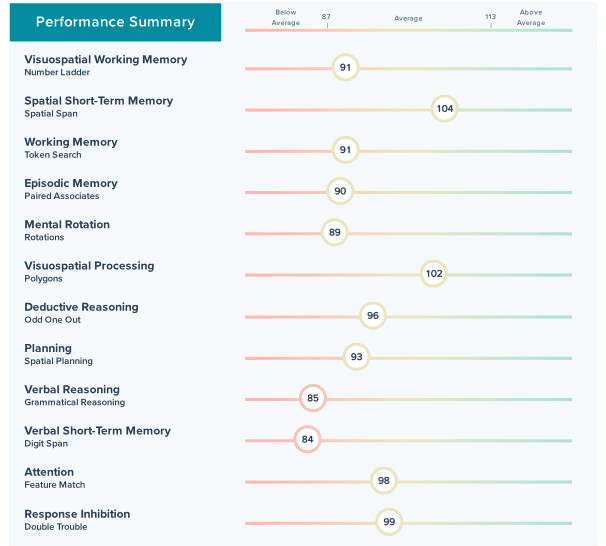
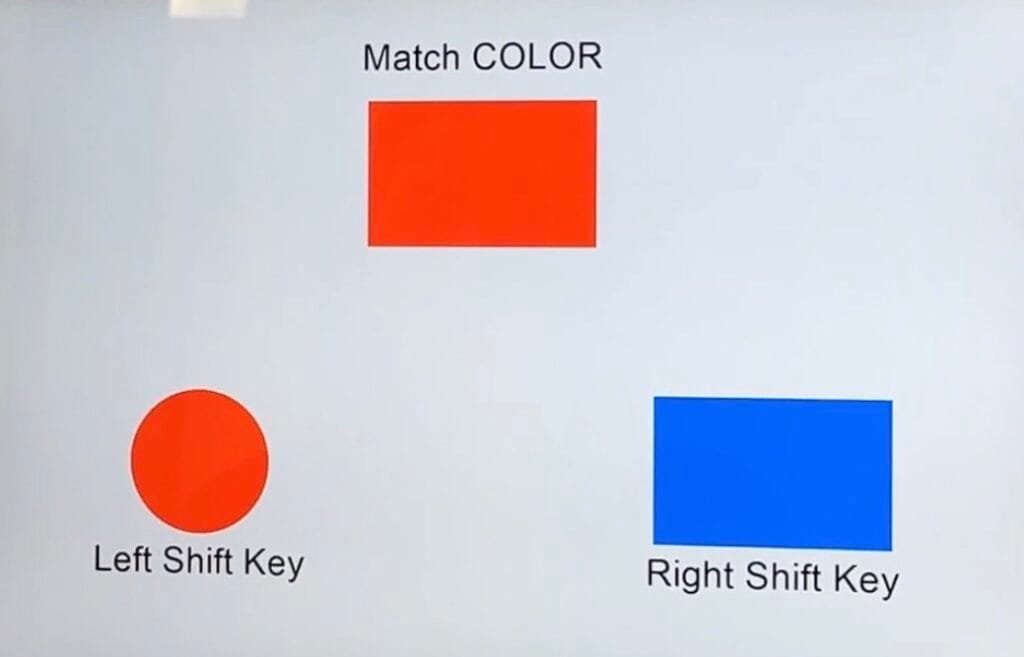
Below are examples of the kinds of prompts, tasks, or question types a person may see during a computerized cognitive assessment. These are not meant to diagnose anything on their own. They simply help show how different cognitive skills can be measured, including memory, attention, planning, verbal reasoning, processing, and response control.
Remember a short list of words and identify them later
Repeat a sequence of numbers in the same order
Repeat a sequence of numbers in reverse order
Follow a set of instructions shown on the screen in the correct order
Choose which word best completes a sentence
Identify how two words or ideas are alike
Sort letters and numbers into the correct pattern
Respond quickly when a certain shape, letter, or symbol appears
Avoid pressing a key when the wrong symbol appears
Keep track of changing rules during a timed task
Remember where an object appeared on the screen
Match shapes or patterns that look similar
Rotate an object mentally and choose the correct answer
Solve a simple problem while holding information in mind
Pick the next step in a sequence or pattern
Complete a task while ignoring distractions
Recall details after a short delay
Choose the best answer based on verbal reasoning
Stay accurate while working under time pressure
Shift from one rule to another without losing focus
The 12 Cognitive Skills That Affect Daily Life More Than You Realize
Not all cognitive decline looks the same. Not all attention problems are really attention problems either. That is why it helps to break cognition into specific skills.
When you understand what each skill does, it becomes easier to see why a child may be struggling in school, why an adult may feel mentally off, or why an older adult may notice subtle changes before anything feels severe.
Some people are strong in most areas but have one weak spot that keeps showing up in daily life. Others may have a few skills that need support. Either way, the goal is not to label someone too quickly. The goal is to understand how the brain is functioning so the right next step becomes clearer.
Below are the 12 cognitive skills often looked at in a more detailed cognitive assessment, and why each one matters in real life.
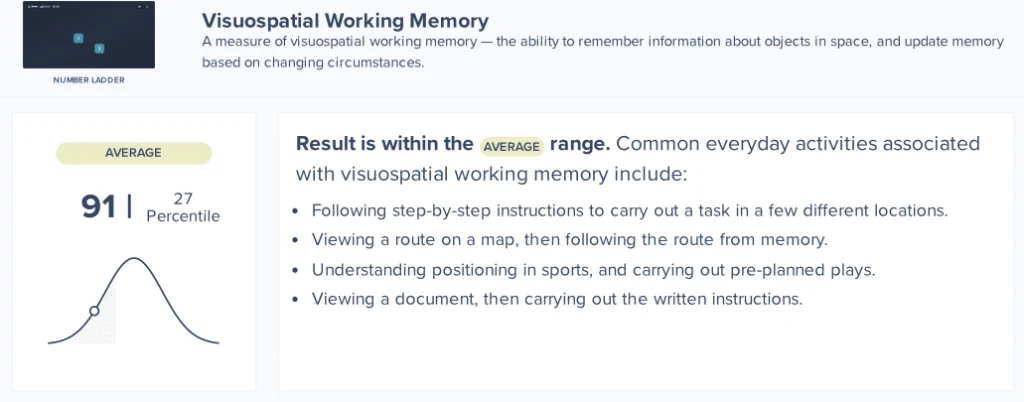
1. Visuospatial Working Memory
Visuospatial working memory is the ability to hold visual and spatial information in your mind and use it right away. It helps you remember where things are, keep track of visual patterns, and mentally work with what you just saw.
This skill matters more than people realize. A child may lose their place on a worksheet, struggle with math setup, or have trouble copying from the board. An athlete may find it harder to react quickly to moving players or changing positions. An adult may forget where they placed an item, lose track of visual steps on a screen, or have trouble organizing a space.
When this area is weaker, life can feel more scattered. A person may not be lazy or careless. Their brain may simply be having a harder time holding and using visual information in the moment.
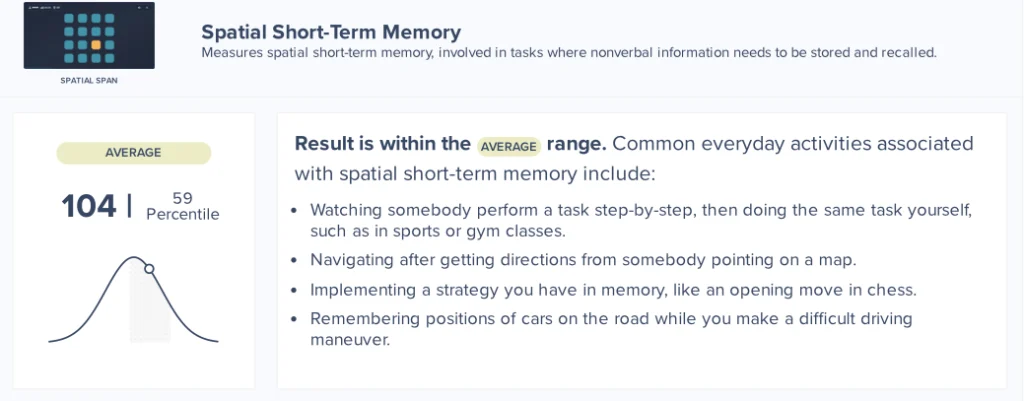
2. Spatial Short Term Memory
Spatial short term memory helps you briefly remember where something was located. This could be where you set your keys, where a word appeared on a page, or where an object was placed in a room.
In daily life, this skill supports organization, navigation, and visual recall. When it is weaker, a person may constantly misplace items, forget where something was just set down, or need more time to relocate things. A child may seem disorganized. An older adult may start feeling frustrated because they know they just had something in front of them, but cannot remember where it went.
On its own, this does not always point to major cognitive decline. Still, it is one of those subtle areas that can affect confidence and independence when it starts slipping.
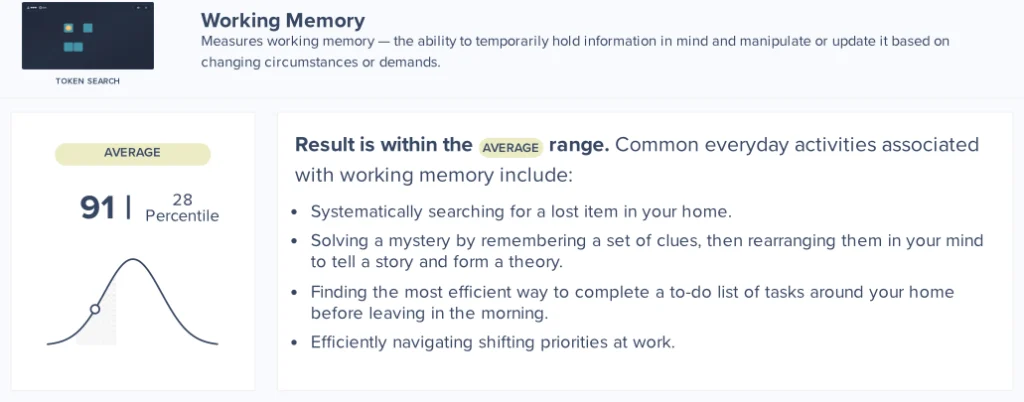
3. Working Memory
Working memory is one of the most important cognitive skills for school, work, and everyday life. It is the ability to hold information in your mind long enough to use it. This is what helps you remember directions while following them, keep track of the next step in a task, or solve a problem without losing your place.
When working memory is weak, a child may hear instructions but only remember the first part. An adult may walk into a room and forget what they meant to do. A person may struggle in meetings because they cannot hold onto one point long enough to connect it to the next. This can look like distraction, but sometimes the deeper issue is that the brain is not holding information efficiently.
For families worried about ADHD or cognitive decline, working memory is a huge one to understand. It affects learning, communication, planning, and confidence in a very real way.
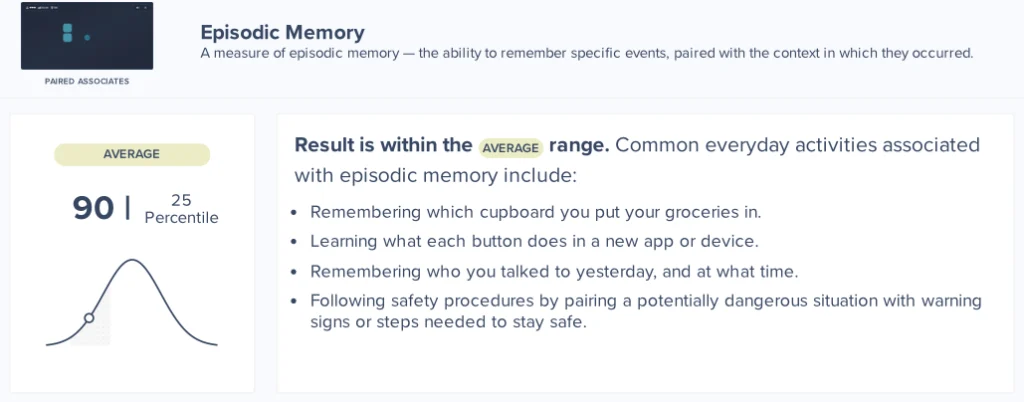
4. Episodic Memory
Episodic memory is the ability to remember personal experiences and events. It helps you recall what happened yesterday, what someone said during a conversation, or details from a recent appointment or family event.
This is one of the areas people often think about first when they worry about cognitive decline, because changes here can feel personal and unsettling. An adult may start forgetting details from recent conversations. A senior may remember older stories clearly but struggle more with recent events. A child may have trouble recalling what happened during the school day, even when they were there and paying attention.
Episodic memory matters because it shapes daily life and relationships. It affects conversations, routines, trust, and confidence. When it starts to feel less reliable, people often feel scared. That is one reason early testing can be so helpful. It gives more clarity around whether episodic memory is truly the concern, or whether another skill may be contributing.
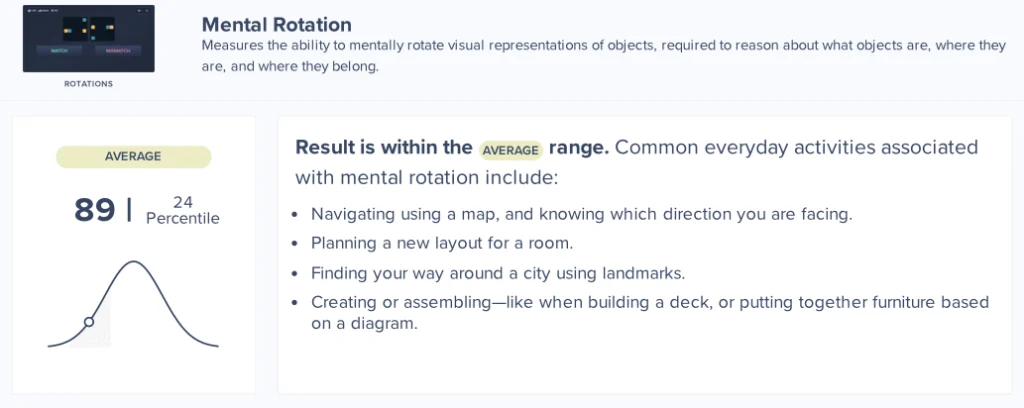
5. Mental Rotation
Mental rotation is the ability to picture an object turning or moving in space. It helps you understand direction, shape, and orientation.
This skill matters in more places than most people think. It can affect reading maps, understanding geometry, packing items into a space, judging how things fit together, or reacting quickly in sports. A child may struggle with puzzles or visual math concepts. An adult may have trouble with directions or visual problem solving. An older adult may notice that tasks involving space, layout, or visual judgment feel harder than they used to.
Weakness in this area does not always stand out right away, but it can quietly make life more frustrating.
6. Visuospatial Processing
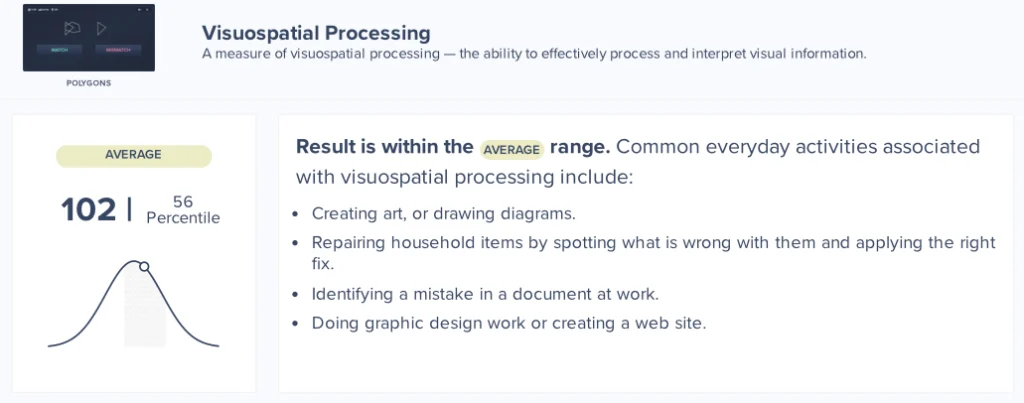
Visuospatial processing is how the brain understands visual information and where things are in space. It helps with reading layouts, recognizing patterns, judging distance, and making sense of what the eyes are seeing.
When this area is weak, people may bump into things more often, struggle with reading graphs or diagrams, lose their place while reading, or feel overwhelmed by visual clutter. Children may have a hard time lining up schoolwork or making sense of visual instructions. Adults may notice visual confusion in busy environments. Seniors may feel less confident driving, walking in crowded places, or judging steps and distance.
This is a key example of why symptoms should not be brushed off too quickly. What looks like clumsiness or distraction may actually be tied to how the brain is processing space and visual input.
7. Deductive Reasoning
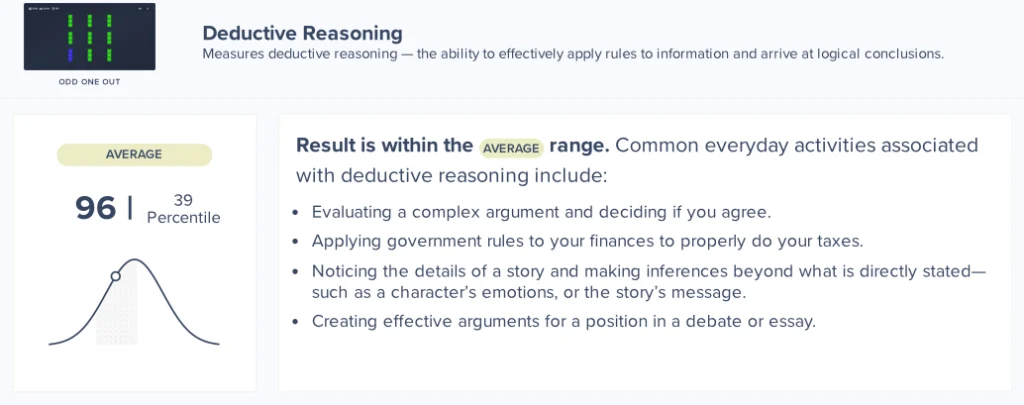
Deductive reasoning is the ability to take information, look for patterns, and reach a logical conclusion. It helps you make sense of what you are seeing, hearing, or reading, then decide what likely comes next.
In everyday life, this skill shows up when a student solves a problem, when a parent figures out why a routine is not working, or when an adult has to make a smart decision with limited information. A person with weaker deductive reasoning may seem slower to catch on, struggle to connect the dots, or need more repetition before something makes sense.
This matters because reasoning problems can sometimes be mistaken for poor effort or low motivation. In reality, the brain may simply need more support in processing logic and patterns. That can affect school performance, confidence, work tasks, and even how a person handles change.
8. Planning
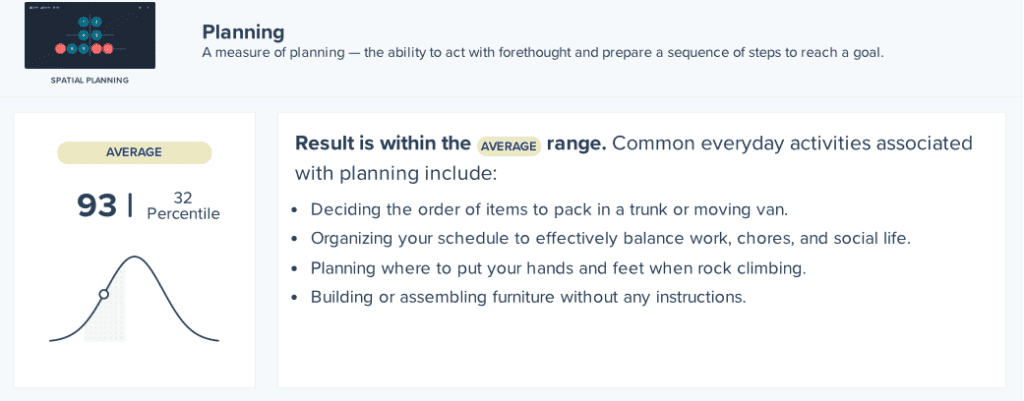
Planning is the ability to think ahead, organize steps, and carry out a goal. It helps you prepare for a school project, get ready for an appointment, manage your schedule, or handle a task with more than one step.
When planning is weak, life can feel harder very quickly. A child may know what to do but still struggle to get started. A teen may procrastinate because large tasks feel overwhelming. An adult may miss deadlines, forget steps, or feel mentally drained trying to stay organized. An older adult may begin avoiding tasks that used to feel simple because there are just too many moving parts.
Planning problems are often misunderstood. People may think someone is lazy, careless, or unmotivated. Sometimes the real issue is that the brain is having trouble organizing actions in the right order. That is one more reason why detailed cognitive testing can be so valuable.
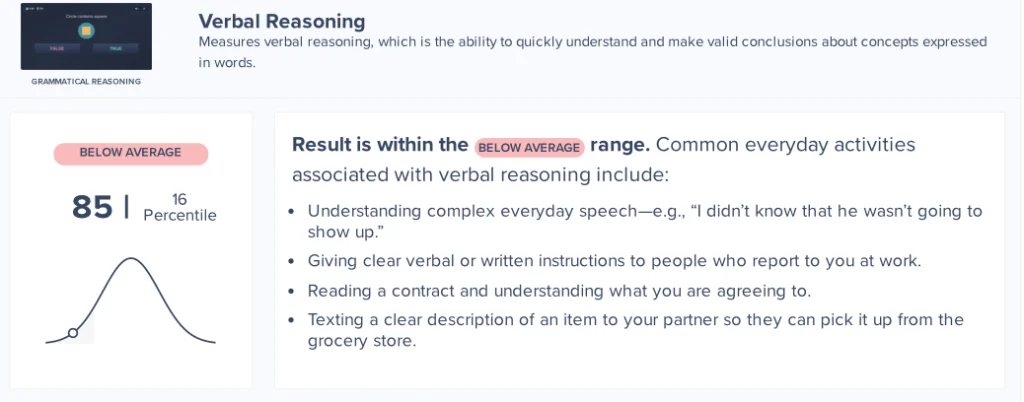
9. Verbal Reasoning
Verbal reasoning is the ability to understand language, compare ideas, make sense of words, and think through information that is spoken or written. It affects comprehension, conversation, learning, and decision making.
When this area is weaker, a child may struggle to understand directions, explain their thinking, or keep up in class discussions. An adult may find it harder to follow complex conversations, process spoken information quickly, or express thoughts clearly under pressure. A senior may feel more frustrated in conversations because the words are heard, but the meaning does not come together as easily.
This can be especially important when someone appears inattentive. Sometimes they are not tuning out. Sometimes they are working harder than people realize just to process the language coming at them.
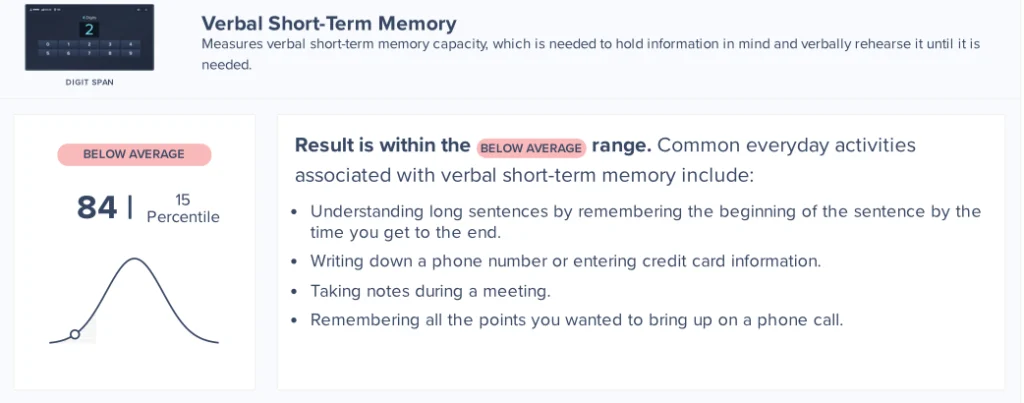
10. Verbal Short Term Memory
Verbal short term memory is the ability to hold spoken information in mind for a short period of time. It helps you remember directions, repeat back what someone said, and stay on track during conversations or tasks.
This area affects daily life in big ways. A child may hear multi step instructions and only remember the first part. A teen may forget what the teacher just said a few seconds later. An adult may struggle in meetings because information comes in faster than it can be held. A senior may feel embarrassed when they lose track of details in a conversation.
This is a perfect example of why surface symptoms can be misleading. A person may look distracted or forgetful when the deeper issue is that spoken information is not being held long enough to use well. Once families understand that, the conversation can shift from blame to support.
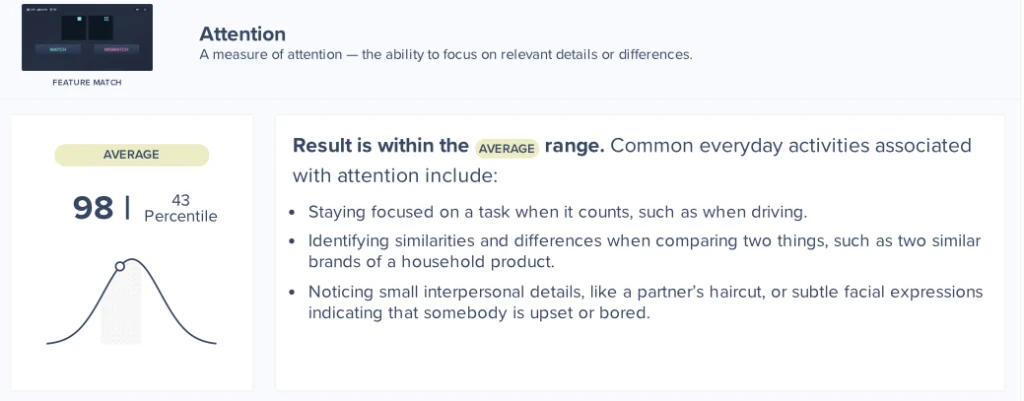
11. Attention
Attention is the ability to focus on the right thing long enough to take it in. It helps you listen, complete tasks, notice important details, and stay engaged without drifting away too quickly.
People often assume attention is the main problem anytime someone struggles in school or seems mentally off. Sometimes it is. Other times attention is only one part of the picture. A person may technically be paying attention but still struggle because another cognitive skill is weaker.
That is why attention should not be looked at by itself. A child may seem unfocused, but the real issue may be working memory, verbal processing, or response inhibition. An adult may struggle to stay engaged, not because they do not care, but because stress, fatigue, brain fog, or other changes are draining mental energy. A senior may worry about cognitive decline because focus feels harder, when the true pattern may be more specific.
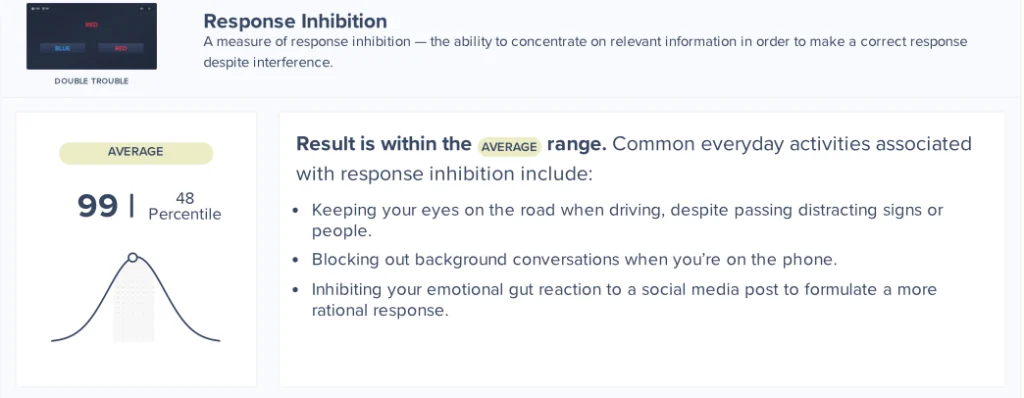
12. Response Inhibition
Response inhibition is the ability to pause, filter distractions, and stop yourself from reacting too quickly. It helps you think before speaking, ignore the wrong stimulus, and stay steady when the environment is busy or overwhelming.
This is one of the most misunderstood cognitive skills. Many people think they have an attention problem when the deeper issue is actually filtering. A child may struggle in class not because they cannot focus, but because they cannot easily tune out extra noise, movement, or competing input. An adult may react too fast in a stressful moment and regret it later. A person may make careless mistakes when rushed, overstimulated, or under pressure.
Response inhibition matters in school, work, sports, parenting, relationships, and emotional regulation. When it is weak, life can feel louder, faster, and harder to manage. Once people understand this skill, many start to realize that what they thought was an attention problem may actually be something deeper and more specific.
Why Understanding These 12 Cognitive Skills Matters
These 12 cognitive skills affect much more than test scores or clinic results. They shape how a person learns, communicates, organizes, remembers, reacts, and moves through daily life.
When one or two areas are weaker, the effects can show up in school performance, work stress, family life, confidence, independence, and even emotional well being.
That is why the goal is not to reduce someone to a label. The goal is to understand what may be driving the struggles. A child may not simply have an attention problem. An adult may not simply be burned out. A senior may not be experiencing the kind of cognitive decline they fear, or they may be seeing early changes that deserve a closer look. In each case, testing can help bring more clarity.
The brain is complex, but that does not mean the next step has to stay confusing. When you understand which cognitive skills are strong and which ones need support, it becomes easier to build a smarter plan forward. That may begin with a detailed cognitive assessment, but it often expands into a broader look at brain function through qEEG Brain Mapping, balance testing, pupil testing, and other diagnostics that help uncover what is really going on.
From there, care can be more personalized. For some people, that may mean proactive support because of family history and concerns about cognitive decline. For others, it may mean targeted therapies such as HBOT, neurofeedback, biofeedback, and other brain based strategies designed around the findings. The hope is not found in guessing. The hope is found in understanding.
Cognitive Testing for ADHD, When the Real Problem May Be Something Else
When a child struggles in school, many parents hear the same thing first. Maybe it is ADHD and then they automatically think medication. Sometimes that is true. Still, not every child who seems distracted, forgetful, impulsive, or overwhelmed has a true attention problem. That is one reason cognitive testing can be so valuable.
From the outside, many struggles can look the same. A child may miss directions, rush through assignments, lose their place, forget steps, seem easily distracted, or shut down when work feels too hard. Teachers and parents often see the behavior first. What they do not always see is the deeper reason behind it.
That is where cognitive testing for ADHD can help bring clarity. A child may look inattentive, but attention may not be the main weakness at all. The real issue could involve working memory, verbal short term memory, response inhibition, planning, or another cognitive skill that affects learning and behavior in everyday life. In other words, the child may not simply have an attention problem. The child may have a different brain based challenge that deserves a closer look.
This matters because the wrong assumption can lead families down the wrong path. If a child is treated like the issue is only attention, but the deeper problem is filtering, memory, or processing, the support may miss the mark. That can leave the child frustrated, the parent confused, and the teacher still searching for answers.
It also matters emotionally. Too many children start to believe they are lazy, difficult, or not smart enough when the truth is more specific and much more hopeful. Too many parents carry the stress of not knowing whether their child is dealing with ADHD, anxiety, learning challenges, brain regulation issues, or a mix of several things. A detailed cognitive assessment can help reduce that uncertainty by showing where a child is strong, where they are struggling, and what may need support most.
This is one reason cognitive testing should not be viewed as just another school tool. It can be a powerful step toward understanding how a child’s brain is actually functioning. Once that picture becomes clearer, the next step becomes clearer too. Families can stop guessing and start making decisions based on better information.
The goal is not to label a child too quickly. The goal is to understand what is really going on. Sometimes the answer is ADHD. Sometimes it is something else. Either way, children deserve more than assumptions. They deserve a closer look, a clearer explanation, and a smarter path forward.
Why Early Testing Matters If Cognitive Decline Runs in Your Family
For many adults, concern about cognitive decline does not begin with their own symptoms. It begins with what they watched happen to someone they love. A parent started forgetting names. A grandparent began repeating stories. A family member who once seemed sharp and steady slowly changed over time. Once you have seen that up close, even small changes in yourself can feel heavier.
That is why so many people want to be proactive. They do not want to wait until symptoms become obvious or severe. They want to understand how their brain is functioning now. They want a baseline. They want to know whether what they are noticing is normal stress, normal aging, or something that deserves a closer look.
That is a wise approach.
Early testing does not mean assuming the worst. It means choosing clarity sooner. In some cases, that clarity brings peace of mind. A person may learn that their cognitive skills are stronger than they feared. In other cases, early testing may reveal subtle changes in specific areas that deserve follow up and support. Either way, there is real value in understanding what is happening before more time passes.
This matters because cognitive decline does not always begin in one dramatic way. Sometimes the earliest concerns are easy to dismiss. A person may lose track of conversations more often. They may feel slower when making decisions. They may struggle more with planning, verbal recall, mental stamina, or staying organized. These changes can seem small at first, but when there is family history, many people would rather know than wonder.
Getting checked out early can also help people make more confident decisions about next steps. That may include monitoring changes over time, improving sleep and stress management, or looking deeper with objective testing. At Genesis Brain Institute, that deeper look may include a cognitive assessment, qEEG Brain Mapping, balance testing, pupil testing, and other diagnostics that help create a fuller picture of brain function.
For some people, care may remain focused on tracking and prevention. For others, supportive therapies such as hyperbaric oxygen therapy, neurofeedback, biofeedback, and other personalized strategies may be considered based on the findings. The key point is this, early evaluation gives people more options, more information, and more time to act wisely.
There is hope in being proactive (especially for your mental health). There is wisdom in paying attention early. Most of all, there is value in not ignoring what feels off simply because it is still subtle.
How Cognitive Skills Testing Goes Deeper at Genesis Brain Institute in Tampa Florida
When someone is worried about cognitive decline, one test alone does not always tell the full story. That is why we believe in looking deeper. Cognitive symptoms can come from many different causes, and the more complete the picture, the better the next step can be.
A cognitive assessment is often one important piece. It helps show how different cognitive skills are functioning, including memory, attention, verbal processing, planning, reasoning, and response control. That kind of testing can reveal whether a person is struggling in one specific area or across several. It can also help explain why someone feels mentally off, even when the problem is not obvious from the outside.
Still, cognition is only part of the bigger picture. At Genesis Brain Institute in Tampa, a deeper evaluation may also include qEEG Brain Mapping, which looks at electrical patterns in the brain, along with balance testing, pupil testing, and other diagnostics that help us understand how the brain and nervous system may be functioning. Each tool adds another layer of insight. Together, they can help uncover patterns that might otherwise be missed.
That matters because two people can have similar symptoms with very different underlying issues. One person may be dealing with changes tied to attention and brain regulation. Another may be showing weaknesses in verbal memory or processing speed. A third may have balance or autonomic issues that are affecting how they feel day to day. Looking at the brain from more than one angle can help create a more informed and personalized plan.
This is especially important for parents trying to understand a child’s struggles and for adults who want to be proactive because of family history or concern about early cognitive decline. Guessing leaves too much room for fear and confusion. Testing gives us something stronger to work with.
The goal is not to run tests just to run tests. The goal is to understand what is happening beneath the surface so care can be based on findings, not assumptions. That is where clarity starts, and clarity is often the first real step toward hope.
How to Treat Cognitive Decline After Cognitive Testing
When people search for how to treat cognitive decline, what they usually want to know is simple, what can actually be done once testing shows a problem. The answer depends on the person. Not every child has the same needs. Not every adult with brain fog has the same pattern. Not every older adult worried about cognitive decline is dealing with the same type of change. That is why treatment should not be one size fits all. The better the testing, the better the care plan can be.
At Genesis Brain Institute, treatment is guided by what the testing reveals. A cognitive assessment may show weaknesses in memory, attention, verbal processing, planning, reasoning, or response control. qEEG Brain Mapping, balance testing, pupil testing, and other diagnostics may add even more insight into how the brain and nervous system are functioning. Once that picture becomes clearer, the next step becomes more targeted.
One treatment that may be part of that plan is hyperbaric oxygen therapy. This matters because oxygen is fuel for the brain. When the brain is under stress, dealing with inflammation, or not functioning as efficiently as it should, improving oxygen support may be one helpful part of care. Dr. Emily Kalambaheti explains HBOT in a simple way. It helps increase oxygen delivery under pressure, which may support healing, circulation, and brain function. For people concerned about cognitive decline, that can be an important part of a broader strategy.
Still, HBOT treatment is not positioned as a magic fix or the only answer. It is one tool that may be used thoughtfully based on the findings. Some people may also benefit from neurofeedback treatment, which may help support brain regulation and cognitive performance. Others may benefit from biofeedback, cognitive training, vestibular therapy, or additional therapies designed around their specific needs. The goal is not to throw random treatments at symptoms. The goal is to understand what the brain may need, then build a plan that makes sense.
That is why Genesis Brain Institute focuses on a more personalized approach. Two people may both complain of forgetfulness, poor focus, slower thinking, or mental fatigue, but the right treatment plan may look very different depending on what their testing shows. One person may need support with regulation. Another may need help with memory and processing. Another may need a proactive plan because of family history and early concerns about cognitive decline.
This is where the process becomes more hopeful. Once testing gives a clearer picture, treatment can be built around what the brain may actually need. For some people, that means early support before symptoms become more serious. For others, it means a more targeted plan based on measurable changes in cognitive skills. Either way, the goal is the same, stop guessing, start understanding, and move forward with a smarter path.
The goal is not to chase symptoms blindly. The goal is to understand the brain first, then support it in a more thoughtful and personalized way. Hope grows when people stop guessing and start working from a clearer picture.
When to Get Checked Out for Cognitive Skills Changes
Many people wait too long to look deeper because they are not sure whether what they are noticing is serious enough. They tell themselves it is probably stress. They blame lack of sleep. They assume it is normal aging. They hope it will pass. Sometimes it does. Sometimes it does not.
That is why it is important to pay attention when something feels off.
If a child is struggling with focus, following directions, organization, memory, or emotional regulation, it is worth looking deeper. If an adult feels mentally slower, forgetful, foggy, or overwhelmed more often than usual, that matters too. If an older adult is noticing subtle changes in memory, language, planning, processing, or confidence, those concerns should not be brushed aside.
This does not mean every symptom points to a major problem. It means the brain deserves the same level of attention you would give any other part of the body. If something feels off, get checked out. Testing can help uncover whether the issue is tied to attention, memory, processing, regulation, or another part of brain function that deserves support.
This is especially important for people with a family history of Alzheimer’s disease, dementia, or other neurological conditions. Many adults do not want to wait until symptoms become obvious. They want to understand their baseline, monitor changes over time, and be proactive while they still feel mostly like themselves. That is a wise decision, not an overreaction.
At Genesis Brain Institute, the goal is not to create fear. The goal is to reduce it. When people have clearer answers, they can make wiser decisions. They can stop guessing. They can stop assuming. They can start moving forward with a better understanding of what their brain may need.
In many cases, the hardest part is not the testing. The hardest part is living in uncertainty. Once that uncertainty starts affecting school, work, confidence, relationships, or peace of mind, it is time to take the next step and get checked out.
FAQ About Cognitive Skills, Cognitive Decline, and Cognitive Testing
What is cognitive decline?
Cognitive decline is a change in how a person thinks, remembers, processes information, plans, or communicates. It can affect memory, attention, language, reasoning, and other brain based skills. Sometimes the changes are mild at first. Other times they become more noticeable over time.
What are the early signs of cognitive decline?
Early signs of cognitive decline can include forgetting names more often, misplacing things, losing track of conversations, repeating questions, slower thinking, trouble planning, word finding problems, and feeling mentally off. In some people, the first changes are subtle. That is one reason early testing can be so helpful.
Is cognitive decline always about memory loss?
No. Memory loss is one part of the picture, but it is not the whole picture. Cognitive decline can also affect attention, verbal processing, planning, reasoning, organization, and response control. A person may feel like their memory is the issue when the deeper problem is something else.
What is the difference between normal aging and cognitive decline?
Normal aging may include occasional forgetfulness or taking a little longer to recall something. Cognitive decline becomes more concerning when changes begin affecting daily life, communication, confidence, work, independence, or relationships. If something feels off more often than it used to, it is worth getting checked out.
When should someone get cognitive testing?
A person should consider cognitive testing when memory, focus, planning, verbal processing, or mental clarity start affecting daily life. Testing may also make sense earlier for someone who has a family history of Alzheimer’s disease, dementia, or other neurological concerns and wants to be proactive.
What does cognitive testing actually show?
Cognitive testing helps show how different parts of brain function are performing. It may reveal strengths and weaknesses in attention, working memory, verbal short term memory, planning, reasoning, response inhibition, and other cognitive skills. That can help explain why someone is struggling and what may need support.
Can cognitive testing help if someone thinks they have ADHD?
Yes. Cognitive testing for ADHD can help show whether the issue is truly attention, or whether the deeper problem may involve working memory, verbal processing, response inhibition, planning, or another cognitive skill. That is important because not every child or adult who looks distracted has the same underlying issue.
Should I get tested early if dementia or Alzheimer’s runs in my family?
Many people choose to get tested early because they want a baseline and do not want to wait until symptoms become more obvious. That can be a wise decision. Early testing may offer peace of mind, reveal subtle changes, and help people make more informed decisions about support and next steps.
Can cognitive decline be treated?
Treatment depends on the person and the underlying pattern. That is why testing matters so much. Once there is a clearer picture, a more personalized care plan can be built. At Genesis Brain Institute, that may include cognitive testing, qEEG Brain Mapping, balance testing, pupil testing, and therapies such as hyperbaric oxygen therapy, neurofeedback treatment, biofeedback, and other supportive options based on the findings.
How do you treat cognitive decline after cognitive testing?
After cognitive testing, treatment is guided by what the results show. One person may need support for memory and processing. Another may need help with regulation, focus, or verbal skills. The goal is not to guess. The goal is to build a treatment plan based on what the brain may actually need.
Can hyperbaric oxygen therapy help support cognitive function?
For some people, hyperbaric oxygen therapy may be part of a broader care plan. Our Functional Neurologist in Tampa, explains that oxygen is fuel for the brain, which is why HBOT treatment may be considered when brain support and healing are part of the bigger picture. It is not a one size fits all answer, but it may be one helpful therapy depending on the findings.
What tests may be helpful besides a cognitive assessment?
A deeper evaluation may include more than one test. At Genesis Brain Institute, that may include a cognitive assessment, qEEG Brain Mapping, balance testing, pupil testing, and other diagnostics that help create a fuller picture of how the brain and nervous system are functioning.
If I am worried about cognitive decline, what should I do next?
If something feels off, do not ignore it and do not assume. Get checked out. The right testing can help show whether the issue is attention, memory, processing, regulation, or another area of brain function that deserves a closer look.
Cognitive Skills Testing May Reveal More Than You Expect
Cognitive skills do not always break down in obvious ways. Sometimes the first sign is forgetfulness. Sometimes it feels like brain fog. Sometimes it looks like poor focus, slower thinking, trouble finding words, feeling more overwhelmed than usual, or simply sensing that something is off. For parents, it may look like a child who seems distracted, forgetful, or inconsistent in school. For adults and seniors, it may feel like a quiet change that is hard to explain but impossible to ignore.
That is why guessing is not enough.
What looks like one problem on the surface may be something very different underneath. A person may seem inattentive when the real issue is working memory. Someone may feel forgetful when the deeper problem involves verbal short term memory, planning, processing, or response inhibition. An older adult may worry about major decline when the first changes are still subtle and limited to one or two specific cognitive skills. Without proper testing, those differences are easy to miss.
That is what makes cognitive skills testing so valuable. The goal is not just to ask whether something is wrong. The goal is to understand what may be changing, where support may be needed, and whether the concern is really what it seems. When cognitive testing is combined with qEEG Brain Mapping, balance testing, pupil testing, and other diagnostics, the picture can become much clearer.
And that clarity can change everything.
For some people, testing brings relief. It shows that the problem may not be as serious as they feared. For others, it reveals patterns that deserve earlier support before they grow into something bigger. Either way, getting checked out can turn uncertainty into useful information. It can help explain struggles that have been misunderstood for months or even years.
That is the real message of this article. Cognitive skills affect daily life in more ways than most people realize. When one or two areas are off, the symptoms can be confusing. Still, confusing does not mean hopeless. The sooner you understand how the brain is functioning, the sooner you can make wiser decisions for yourself, your child, or a loved one.
If something feels off, this may be the right time to look deeper. If you are in the Tampa area, Genesis Brain Institute is here to help. If you are traveling from outside Tampa, there are two hotels located right outside our office doors in our business park, making it easier for families and patients coming in for testing and care. The answers may be more specific, and more hopeful, than you think.
If you are concerned about cognitive skills in yourself, your child, or a loved one, Genesis Brain Institute in Tampa can help you look deeper with advanced testing and personalized care.
Disclaimer: This content is for informational purposes only and does not constitute medical advice. Please consult with a licensed healthcare provider. Genesis Brain Institute is a Brain Treatment Center in Tampa offering non-pharmaceutical solutions that bring clarity, restore function, and offer real hope for those who feel lost, stuck, or simply want more from life.