Mental health evaluations should do more than name a child’s symptoms. They should help families understand what could be driving the problem, what might be getting missed, and where to look next.
On July 24, 2026, Florida brought healthcare, education, and behavioral health leaders together for a youth mental health roundtable (read more here). The message was clear: before major treatment decisions are made, children deserve comprehensive mental health evaluations.
Genesis Brain Institute, Tampa, agrees. Florida’s call also raises an important question:
What should a comprehensive mental health evaluation include now that technology allows us to gather more objective information?
Imagine two students who are both falling behind, forgetting instructions, and struggling to focus. Both could be described as having attention problems. However, cognitive testing could show that one student struggles to hold information in working memory, while the other understands the information but has trouble controlling distractions and responses.
From the outside, their struggles can look the same. Inside, something very different could be happening. If we stop at the label, we can miss important clues that could change what happens next.
Too often, a child receives a diagnosis based largely on conversations, questionnaires, and what others can observe. Those things matter, but they do not always reveal the full picture.
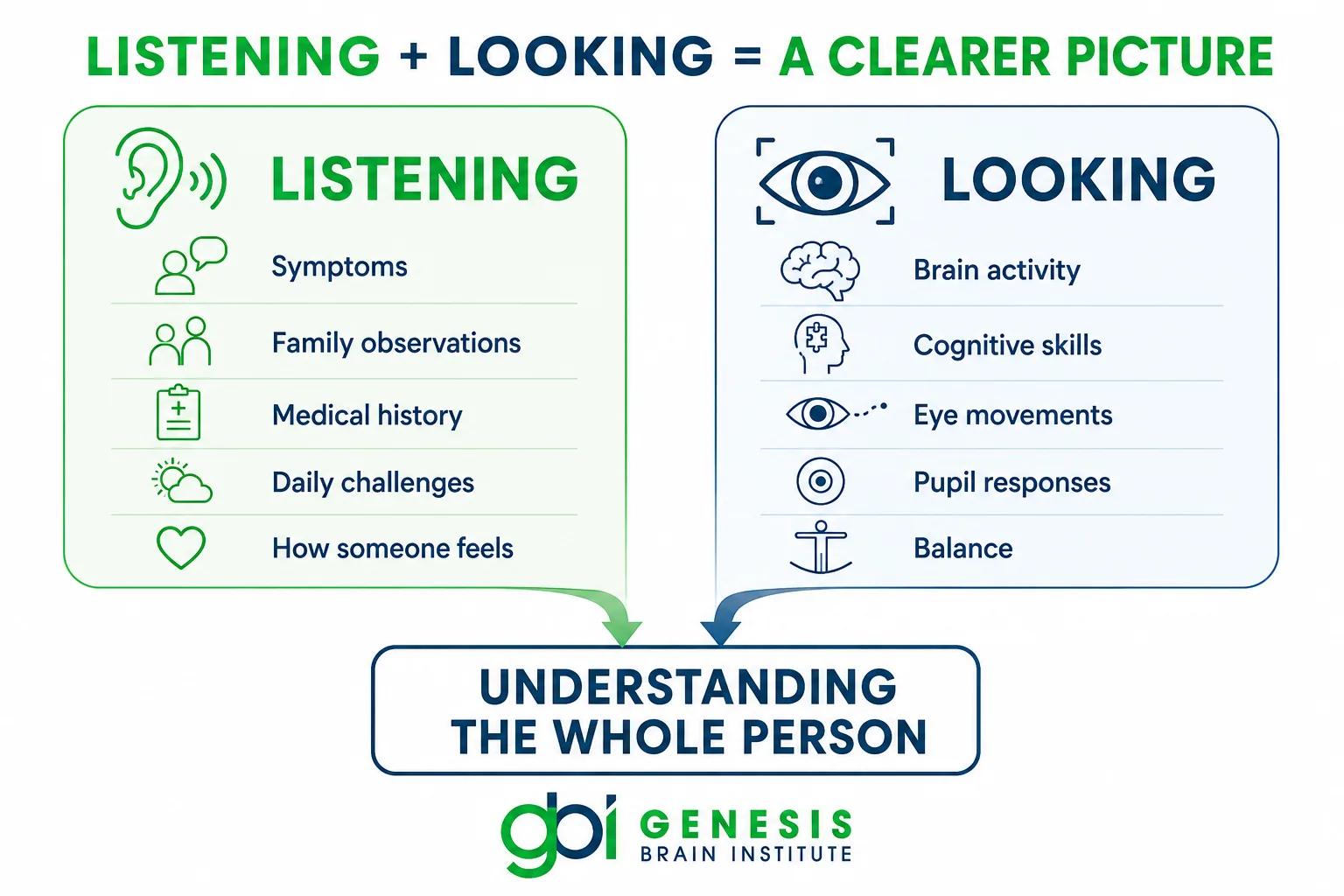
Medical history, family life, sleep, diet, screen use, stress, school, and physical health all matter. Mental health is brain health. We can now examine areas such as brain activity, cognition, eye movements, balance, and nervous system function. If those measurements can reveal clues that symptoms and questionnaires miss, why would we leave them out?
Families should not have to choose between listening to how someone feels and looking at objective information about how the brain is functioning. They deserve both.
If we are concerned enough to consider a mental health diagnosis, medication, or long term treatment plan, we should be concerned enough to gather the clearest picture possible first.
Why Is Florida Calling for Comprehensive Mental Health Evaluations?
Florida’s new guidance raises concerns about children beginning psychotropic medication without first receiving a complete evaluation.
On July 24, 2026, Florida Surgeon General Dr. Joseph A. Ladapo brought leaders from healthcare, education, and behavioral health together for a youth mental health roundtable. The discussion focused on how children are evaluated, how treatment decisions are made, and whether families receive enough information about the possible benefits, risks, and alternatives.
Dr. Ladapo described a problem many parents have experienced:
“But unfortunately, the structure of the system incentivizes fast prescriptions, patient throughput, and not delving into why people are actually having problems, and that’s a huge problem.”
Florida’s guidance calls on healthcare providers to complete comprehensive mental health evaluations before beginning treatment for a mental or behavioral condition, except during an emergency.
- A complete medical and family history
- A psychosocial assessment
- A mental status and physical exam
- Sleep quality and daily routines
- Screen use and technology habits
- Diet and physical activity
- Family, school, and environmental stress
- Relevant laboratory tests
- Additional medical testing when appropriate
The guidance also says psychotherapy, healthier daily habits, and changes within a child’s environment should be considered. In certain cases, it lists an electroencephalogram, or EEG, among the medical tests a provider can consider.
Importantly, Florida does not tell families to suddenly stop a child’s medication. The guidance warns that abruptly stopping psychiatric medication can cause serious problems and should not be done without guidance from a qualified healthcare professional.
This is not a call to replace one automatic treatment path with another. It is a call to slow down, listen carefully, gather more information, and understand the individual child before making decisions that could shape their future.
That is an important beginning. However, if Florida is asking healthcare providers to look deeper, we must also ask what modern tools can add to that evaluation.
Why a Mental Health Diagnosis Should Not Be the End of the Evaluation
A mental health diagnosis can give families a name for what they are seeing. A diagnosis such as ADHD, anxiety, depression, PTSD, autism, or another mental health condition can also open the door to care, school accommodations, counseling, therapy, and other helpful resources.
However, a diagnosis often describes a group of symptoms. It does not always explain what is driving those symptoms or reveal what could be getting missed.
Consider the two students from our opening. Both struggle to focus, forget instructions, and fall behind in class. Both could receive the same ADHD diagnosis. Yet one has difficulty holding information in working memory, while the other struggles to block distractions and control responses.
Their symptoms look similar, but the difficulties underneath them are different.
Sleep problems, chronic stress, trauma, poor nutrition, vision and eye movement difficulties, nervous system dysregulation, and other health concerns can also affect attention, mood, memory, learning, and behavior. That is why looking at the whole person matters.
This does not mean the diagnosis is wrong. It means the diagnosis should begin a deeper investigation instead of bringing the evaluation to an end.
Dr. Fabian Consbruck, a neuropsychologist at Genesis Brain Institute, helps examine how areas such as attention, memory, processing speed, response control, and other cognitive skills are functioning. This type of testing can help identify differences that conversations, questionnaires, and outward symptoms alone might not reveal.
Today, objective testing can provide additional information about brain activity, cognitive performance, eye movements, balance, reaction time, and nervous system function. No single measurement diagnoses ADHD, anxiety, depression, PTSD, or another mental health condition. However, when these findings are considered alongside symptoms, medical history, physical health, sleep, environment, and family observations, they can help uncover important clues.
A label tells us what the struggle looks like.
A comprehensive mental health evaluation helps us investigate what could be driving it and decide where to look next.
What Does Objective Brain Testing Add to a Mental Health Evaluation?
When someone experiences chest pain, doctors examine the heart. When breathing becomes difficult, clinicians look at the lungs. Yet when someone struggles with attention, anxiety, depression, memory, emotional control, or behavior, the evaluation often relies heavily on conversations, questionnaires, and symptoms observed from the outside.
Those sources of information matter, but they do not always reveal the full picture.
Objective brain testing adds measurable information and can uncover clues that are easily missed during a short clinical exam.
Imagine a teenager who has become anxious, irritable, and exhausted. Their grades are falling, they avoid homework, and they complain that reading gives them a headache. During a 15 minute appointment, the conversation might focus on anxiety, behavior, or problems at school.
Those symptoms are real, but they might not tell the whole story.
A more comprehensive evaluation could reveal that the teenager is having difficulty moving their eyes smoothly across a page. Cognitive testing might show that processing information requires more time and effort than expected. Balance or pupil testing could uncover additional differences in how the brain and nervous system are responding.
None of those clues would be easy to see while the student sits in a chair and answers questions.
Without objective testing, the family might leave knowing what the struggle looks like but still not understand what could be contributing to it. That is why looking beyond symptoms is so important.
At Genesis Brain Institute in Tampa, the Quant360 Functional Analysis uses a 20 minute qEEG brain map to measure electrical activity in the brain. It also examines cognitive skills, eye movements, pupil responses, and balance. Looking at these areas together provides objective information that a conversation or questionnaire alone cannot capture.
Why Looking at the Full Picture Matters
A 15 minute clinical exam has limits. A person can look calm while struggling internally. They can answer simple questions correctly but still have trouble with memory, processing speed, eye movements, sensory information, or nervous system regulation.
These problems do not always appear during a conversation. They often become visible only when the right functions are measured.
The value of the Quant360 Functional Analysis is not one isolated score or test. It comes from examining objective findings alongside symptoms, health history, and daily challenges. The findings are then reviewed with a functional neurologist.
Objective testing does not replace the person’s story. It helps uncover parts of that story that a short exam, symptom list, or questionnaire could miss.
What Role Should Schools Play in Youth Mental Health?
Educators were part of Florida’s youth mental health roundtable because teachers and school staff often notice changes before anyone else does.
They see students trying to focus, complete assignments, manage friendships, handle stress, and move through the school day. They can notice when a student begins withdrawing, falling behind, acting differently, or showing signs that something is seriously wrong.
We have seen how important that awareness can be.
A teacher noticed that Kyle’s son was searching online for ways to end his life.
The teacher took it seriously and spoke up. That action alerted his family to a crisis they could not see from the outside and helped them get their son to safety.
That teacher deserves to be honored. So do educators across Florida who pay attention, build trust with students, and act when something does not seem right.
Schools play an important role in recognizing warning signs, communicating with families, creating healthier learning environments, and connecting students with the right support. However, they should not be expected to diagnose students or replace parents and healthcare professionals.
As Mollyana Ward, a mother, grandmother, business leader, and candidate for Pasco County School Board District 3, explains:
“The mental health of our children deserves thoughtful, individualized care. Schools can and should provide support, resources, and trusted partnerships with families, but they should never replace the role of parents in making medical decisions for their children. Those decisions belong to parents, in consultation with qualified healthcare professionals.
I also believe we cannot have an honest conversation about youth mental health without addressing the impact of technology. Dr. Jared Cooney Horvath, author of The Digital Delusion, has warned that excessive screen exposure is fundamentally changing how young people learn, think, and develop. As we work to improve student well being, we should be encouraging healthy habits that include face to face relationships, physical activity, adequate sleep, and appropriate limits on screen time.
Our schools are partners with parents, not parental substitutes. By respecting parental rights while creating healthy learning environments, we can better support the whole child.”
That partnership matters. Parents know their children in ways no school ever could. Educators see students in a setting parents cannot observe throughout the day. Healthcare professionals bring another part of the picture.
When families, educators, and healthcare professionals share what they are seeing, a comprehensive mental health evaluation becomes more complete. The goal is not to place another burden on teachers. It is to respect their observations, involve parents, and help ensure that a young person does not remain unseen until a struggle becomes a crisis.
Schools can also create daily opportunities for students to strengthen mental health, manage stress, and learn how to regulate their brain, heart, and nervous system.
Through the Brain Performance Zone, Genesis Brain Institute partners with schools to bring simple brain training and nervous system regulation tools into the school day. It gives students practical skills they can use before stress becomes overwhelming while helping schools build a culture that supports mental fitness.
Florida Youth Mental Health Guidance: What Should Happen Next
Florida’s guidance should not end with another roundtable, announcement, or conversation. It should change what happens when a family asks for help.
A comprehensive mental health evaluation must do more than review symptoms and daily habits. It should combine the human story with objective measurements that help reveal what cannot be seen during a short appointment.
That is where Genesis Brain Institute in Tampa prays to help.
Through the Quant360 Functional Analysis, we measure brain activity, cognitive skills, eye movements, pupil responses, and balance. We look beyond the diagnosis to help families better understand how the brain is functioning and what could be contributing to the struggle.
We are also working with schools through the Brain Performance Zone to strengthen focus, stress regulation, and mental fitness before a student reaches a crisis.
Teachers should not carry this responsibility alone, but they should have tools that help students build these skills during the school day.
Medication is not the only question. The deeper question is whether we have taken the time to understand the person before choosing what happens next.
Families deserve more than a label.
Schools deserve more than another mental health mandate.
Young people deserve to be seen, understood, and supported before their struggle becomes a crisis.
Our prayer at Genesis Brain Institute is that every young person is seen, understood, and given a new beginning of hope before their struggle becomes a crisis.
Disclaimer: This content is for informational purposes only and does not constitute medical advice. Please consult with a licensed healthcare provider. Genesis Brain Institute is a Brain Treatment Center in Tampa offering non-pharmaceutical solutions that bring clarity, restore function, and offer real hope for those who feel lost, stuck, or simply want more from life.