A natural substitute for Ritalin is something many parents search for when they are tired, worried, and unsure what to do next.
Maybe your child is bright, but school feels harder than it should. Maybe homework turns into a battle every night. Maybe your child can focus on video games, sports, or favorite topics, but falls apart when it is time to read, write, sit still, or finish classwork.
Then the ADHD label enters the conversation.
A short doctor’s visit happens. A checklist is filled out. A diagnosis is given. Medication is discussed.
For some families, medication helps. For others, it raises more questions.
Will this change my child’s personality? Is this the only option? Why is my child struggling in the first place?
Is there a better way to understand what is really going on? Those are fair questions.
This article is not telling any parent to stop Ritalin or change medication.
Instead, this article is here to help you think deeper.
Because the real question is not just, “What can I use instead of Ritalin?”
The better question is, “What is actually happening in my child’s brain and body that makes focus, learning, behavior, or emotional control so hard?”
At Genesis Brain Institute, we believe ADHD support should start with better testing, not just another label.
Let’s look deeper at what may be happening beneath the ADHD label. And if something here sounds like your child, reach out to our team. We are here to help you take the next step toward clearer answers.
Why Parents Search for a Natural Substitute for Ritalin
Most parents who search for a natural substitute for Ritalin are not simply looking for a “natural pill.”
They are usually trying to solve a much bigger problem.
Ritalin is commonly used to help with ADHD symptoms like focus, attention, and impulse control. For some children, it can be helpful. But when the conversation starts and ends with medication, parents can feel like nobody actually explained why their child is struggling.
That is where the concern begins.
A child may be labeled with ADHD because they cannot sit still, finish work, follow directions, control impulses, or stay focused in class. But those behaviors can come from different places, and a short doctor’s visit does not always reveal what is really driving them.
One child may have a true attention regulation issue.
Another may have weak working memory, so they lose instructions before they can act on them.
Another may have slower processing speed, so they look unmotivated when they are really overwhelmed.
Another may have trouble with response inhibition, which means the brain has a hard time hitting the brakes before speaking, moving, or reacting.
Another may be overloaded by noise, movement, stress, poor sleep, or visual demands in the classroom.
To the teacher, all of these children may look distracted.
To the parent, all of them may look like they are not listening.
But inside the brain, these are not the same problem.
That is why the search for a natural substitute for Ritalin should not start with “What can I give my child instead?”
It should start with “What is actually driving the focus problem?”
Because if the root issue is working memory, the plan should support working memory.
If the root issue is processing speed, the plan should support processing speed.
If the root issue is nervous system overload, the plan should support regulation.
And if several systems are involved, the plan should be built around the whole child, not just the ADHD label.
Before Looking for Ritalin Alternatives, Look Deeper
Ritalin can help some children focus. That matters.
But focus is not the only thing parents care about.
Parents also want to know why their child struggles to start tasks, finish work, manage frustration, remember directions, sit still, or calm down after getting upset.
That is where guessing becomes the real problem.
If the only question is, “Does this child have ADHD?” the answer can become too simple.
Yes, your child may meet the criteria for ADHD.
But that still does not explain what is happening underneath the label.
It does not explain why one child can focus for hours on something they love, but cannot focus for ten minutes on homework.
It does not explain why another child reads the same page three times and still cannot remember what they read.
It does not explain why a child melts down over a simple transition, like turning off a screen, getting ready for bed, or starting a worksheet.
It does not explain why your child seems brilliant one moment and completely stuck the next.
That is why so many parents feel confused.
They were given a name for the struggle, but not a real map for what to do next.
The label may be accurate. But the label is not the full answer.
At Genesis Brain Institute in Tampa, we are not trying to argue with a diagnosis.
We are trying to help you understand what is happening underneath it.
Because a natural ritalin alternative should not be built from another guess.
It should be built from better information.
That means looking at how your child’s brain, body, and nervous system are working together, so the next step makes sense for your child, not just the category they were placed in.
Why ADHD Symptoms Need a Deeper Look
ADHD is a real diagnosis.
But it is also a broad one. That matters.
A child can be labeled with ADHD because they struggle with attention, hyperactivity, impulsivity, task completion, organization, emotional control, or follow through.
But those symptoms do not all come from the same place.
This is where many families get stuck.
The label tells you the child fits a category. It does not tell you which brain skills are weak. It does not tell you which systems are overloaded.
It does not tell you whether the child’s attention problem is really an attention problem, a memory problem, a processing problem, a regulation problem, or a sensory problem.
That is a big difference.
Think about it like a check engine light.
The light tells you something needs attention. But it does not tell you if the issue is the battery, oil, transmission, sensor, fuel system, or engine.
ADHD can work the same way. The label tells you something is happening.
It does not automatically tell you what is causing it.
That is why two children can both have ADHD and need very different support.
One child may need help with working memory because they cannot hold instructions long enough to use them.
Another may need help with processing speed because the classroom is moving faster than their brain can comfortably respond.
Another may need help with response control because their brain struggles to pause before acting.
Another may need help with nervous system regulation because stress, noise, sleep, or sensory overload keeps pushing them into fight or flight.
If all four children get treated as the same ADHD case, important pieces can be missed.
That is why the ADHD label should not be the finish line. It should be the starting point for better questions.
Why Better ADHD Testing Matters Before Treatment
A short doctor’s visit can start the conversation. It can identify symptoms, lead to a diagnosis, and help families know they are not imagining the struggle.
But it is not the same as understanding the whole child.
Most ADHD conversations begin with what people can see. Can the child sit still, focus, follow directions, finish work, and control impulses?
Those questions matter, but they are still surface level.
They do not show how the child’s brain is processing information. They do not show whether the child is struggling with working memory, processing speed, eye tracking, sensory overload, nervous system regulation, or emotional control.
That takes more than a checklist.
It takes time, better data, and a deeper look at how the brain and body are working together.
At Genesis Brain Institute, our Quant360 Functional Analysis is a 4 to 6 hour diagnostic process designed to look deeper. This is not a rushed visit where a child or adult walks in, gets labeled, and leaves with the same unanswered questions.
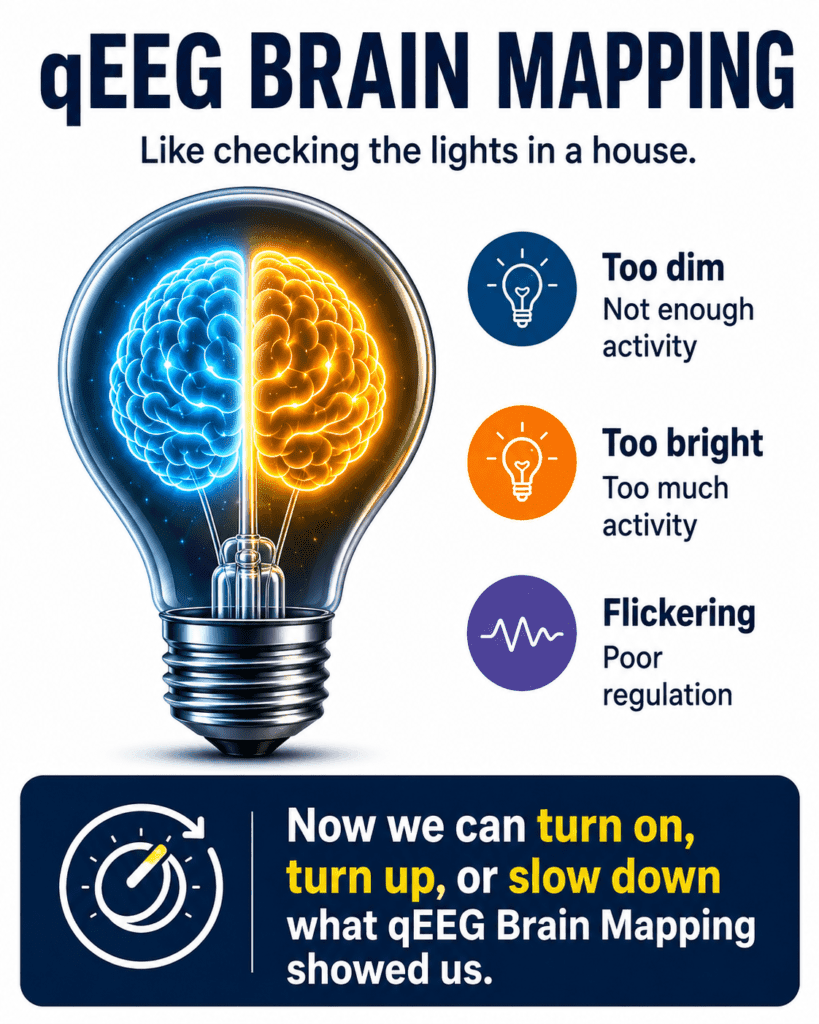
It is a deeper evaluation of how the brain, body, and nervous system are working together. That can include qEEG brain mapping, cognitive performance testing, eye movement testing, balance testing, nervous system related measures, a detailed history, and a review of symptoms.
The goal is not to diagnose ADHD all over again. The goal is to understand what may be driving the symptoms.
Because if a child is struggling to focus, we want to know why. If homework takes three hours, we want to know why. If emotions go from zero to one hundred, we want to know why. If a bright child keeps falling behind, we want to know why.
And if the child is being told to “try harder,” we want to know whether their brain is already working harder than everyone realizes.
A short visit can name the struggle. A deeper diagnostic process can help reveal the pattern behind it.
And once you understand the pattern, you can build a better path forward.
ADHD Is More Than Focus: The 12 Cognitive Skills That Matter
One of the biggest missing pieces in most ADHD conversations is cognitive performance, which simply means how the brain thinks, learns, remembers, reacts, solves problems, and handles information.
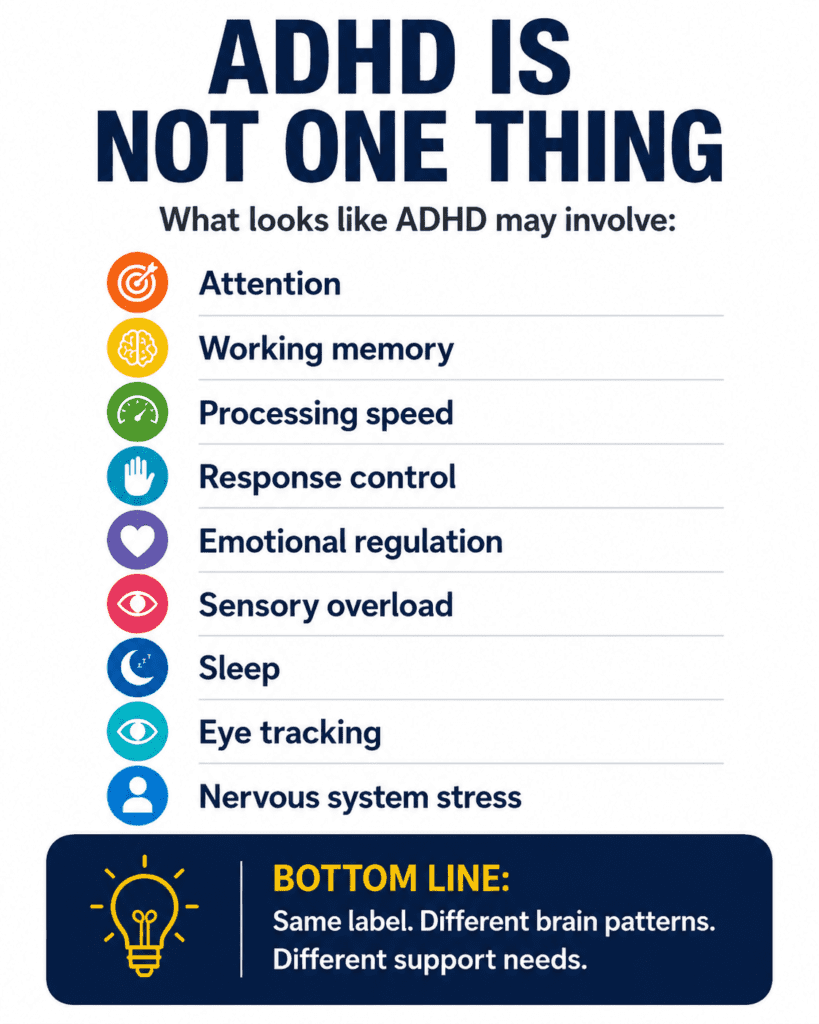
Most people hear ADHD and think, “This child has an attention problem.” But attention is only one part of the story.
At Genesis Brain Institute, we look at multiple cognitive domains because focus does not happen by itself. It depends on several brain skills working together at the right time.
A child may need to pay attention to the teacher, remember the instructions, block out noise, control impulses, process information, shift between steps, plan the work, and stay emotionally regulated long enough to finish.
That is a lot for one brain to do.
So when one of those skills is weak, the child may look like they “just have ADHD.” But underneath the label, something more specific may be happening.
For example, a child may struggle with attention, which helps the brain lock onto the right thing. They may struggle with working memory, which helps the brain hold information long enough to use it. They may struggle with processing speed, which affects how quickly the brain takes in information and responds.
Other children may struggle with response control, which helps the brain pause before acting. Some struggle with cognitive flexibility, which helps the brain shift from one task to another. Others struggle with planning and problem solving, which help the child organize steps and finish work.
Visual and auditory processing also matter because the brain has to use what the eyes see and the ears hear. Memory and learning matter because the brain has to store information and bring it back later. Emotional regulation matters because a child has to stay steady when something feels hard, boring, frustrating, or overwhelming.
This is why ADHD support should not stop at the label.
If the real issue is working memory, the child needs support for working memory. If the real issue is processing speed, the child needs support for processing speed. If the real issue is emotional regulation, the child needs support for regulation.
And if several areas are involved, the plan should reflect that.
That is the power of looking at cognitive domains and individual cognitive skills. It gives parents a clearer way to understand why their child is struggling, instead of putting every behavior into one big ADHD bucket.
ADHD and Working Memory: Why Directions Get Lost
Working memory is like the brain’s sticky note. It helps your child hold information in mind long enough to use it.
This matters a lot in school.
A teacher may say, “Open your book, turn to page 42, answer questions 1 through 5, and turn it in before recess.”
One child hears that and gets started.
Another child hears it, but loses part of the instruction before they can act on it. They may remember the page number but forget which questions to answer. They may start the assignment but forget when it is due. They may look around the room because they are trying to figure out what everyone else is doing.
Then the adult says, “You were not listening.”
But that may not be true.
The child may have heard the instruction. Their brain just could not hold all the pieces long enough to use them.
That is very different from being lazy, careless, or defiant.
It also explains why some children can seem smart in conversation but struggle when directions have multiple steps. They understand the words, but the brain has trouble holding the steps in order.
This is why better testing matters.
If a child’s focus problem is really a working memory problem, then the plan should not stop at “try harder” or “pay attention.” The plan should help support the brain skill that is actually weak.
Some kids are not ignoring instructions.
Their brain is dropping pieces before they can use them.
ADHD and Processing Speed: When Slow Looks Like Lazy
Processing speed is how quickly the brain takes in information, understands it, and responds.
This matters because a child can be very smart and still need more time.
Some children know the answer, but not fast enough for the pace of the classroom. They may freeze during timed tests, fall behind while copying notes, take too long to start assignments, or feel overwhelmed when adults rush them.
To a teacher or parent, this can look like laziness.
But slow is not the same as lazy.
A child with slower processing speed may be working hard internally, even when it looks like nothing is happening on the outside. Their brain is trying to take in the information, sort it, understand it, and figure out what to do next.
That takes effort.
It also explains why some children do better when they are given more time, fewer distractions, or step by step instructions. They do not always need the work to be easier. They need the pace to match how their brain processes information.
This is one reason a quick ADHD label can miss the bigger picture.
If the real issue is processing speed, the child does not just need to “focus more.” They need support that helps the brain process and respond more efficiently.
A slow response is not always a lack of effort.
Sometimes the brain needs more time to catch up.
ADHD and Impulsive Behavior: When the Brain Cannot Hit the Brakes
Response control is the brain’s brake system. It helps a child pause before speaking, moving, grabbing, interrupting, or reacting.
When this system is weak, the child can know the rule and still break it in the moment.
That is what makes this so frustrating for parents.
Your child may know they should not interrupt. They may know they should not yell. They may know they should not grab the toy, slam the pencil, run across the room, or say the first thing that pops into their head.
But knowing the rule and stopping the reaction are two different brain skills.
This is why some children feel sorry right after they act. Once the moment passes, they can see what happened. They can explain what they should have done. They can even promise they will not do it again.
Then it happens again.
That does not mean consequences never matter. It means the child may also need help building the brain skill that allows them to pause.
If the brain struggles to hit the brakes, the child can look rude, wild, careless, or defiant.
But underneath the behavior, the real issue may be response control.
That is why deeper testing matters. If impulsivity is a major part of the struggle, the plan should help support the child’s ability to pause, regulate, and respond instead of simply react.
Some children do not need more shame.
They need stronger brakes.