Stem cells vs. exosomes is an important comparison to understand before exploring regenerative medicine. But there’s a third type of cell you probably haven’t heard much about, MUSE cells.
And what makes these three different might surprise you.
You’ve probably heard about professional athletes, celebrities, and everyday people traveling to Mexico, Panama, or Costa Rica to explore advanced stem cell treatments.
But what if you didn’t have to get on an airplane to explore these options?
Regenerative medicine is changing right here in the United States, and Florida is one of the states helping open the door to certain stem cell treatments.
In 2025, Florida expanded access to specific stem cell procedures for orthopedic conditions, wound care, and pain management.
However, not every type of stem cell treatment is the same, and not every emerging therapy is available for routine patient care.
Which brings us to something even more important.
Imagine visiting three different medical clinics.
Each one advertises stem cell therapy. Each talks about the potential for tissue repair and regenerative medicine.
But when you start asking questions, something surprising happens.
One clinic discusses mesenchymal stem cells (MSCs). Another talks about exosomes. The third introduces something called MUSE cells.
Are they offering the same thing under different names?
Not even close.
Exosomes aren’t even living stem cells.
And MUSE cells are a distinct population of stem cells that scientists are studying for their unusual biological properties.
Two clinics can advertise stem cell therapy while offering completely different biological products.
Some contain living cells. Others contain tiny particles released by cells. Even among living stem cell products, the source, processing, and contents can vary considerably.
So how do you know what you’re actually getting?
At Genesis Brain Institute in Tampa, Dr. Chris Gleis brings years of experience in pain management and in the growing science of regenerative medicine. His work involves understanding the differences between biological products rather than treating every form of stem cell therapy as interchangeable.
In this article, we’ll explore explanations of mesenchymal stem cells, exosomes, and MUSE cells, why scientists are interested in these differences, and what questions you should ask before considering stem cell treatment.
Because before asking which stem cell treatment is best, there’s a more important question: Do you know what you’re actually getting?
What Are Mesenchymal Stem Cells (MSCs), and How Do They Work?
When most people hear the words stem cell therapy, they picture special cells that can help the body repair damaged tissue.
But not all stem cells work the same way.
One type discussed by Dr. Chris Gleis is called mesenchymal stem cells (MSCs). These cells have attracted attention in regenerative medicine because they can develop into certain types of tissue.
For example, MSCs can develop into cells that form:
Cartilage: The smooth tissue that cushions your joints.
Bone: The hard tissue that gives your body structure.
Fat: Tissue that stores energy and helps cushion and support parts of the body.
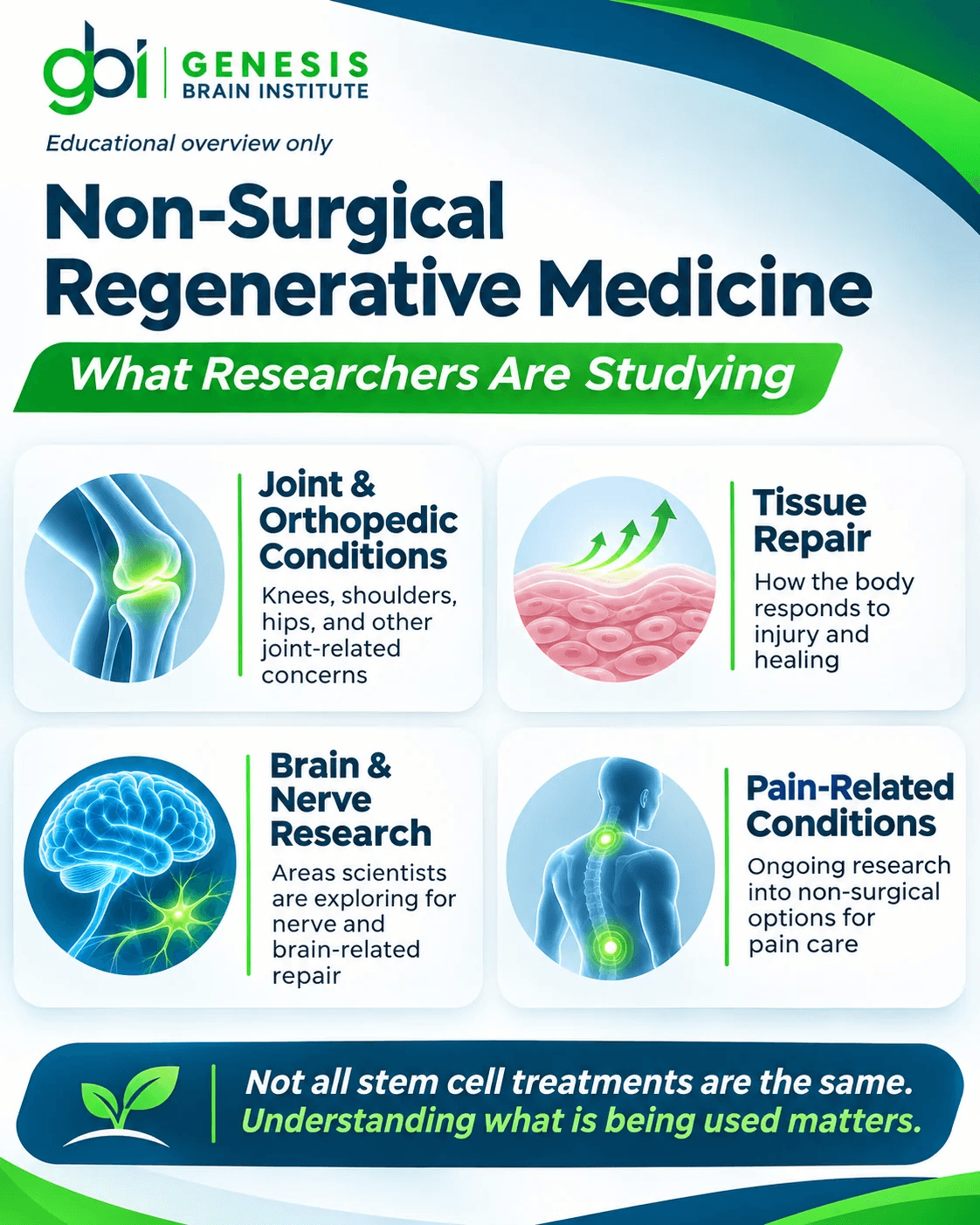
This is one reason researchers have been interested in MSCs for orthopedic conditions involving knees, hips, shoulders, and other joints.
However, there’s an important difference between what these cells can do under certain laboratory conditions and what happens when they’re used in a person. The ability to develop into cartilage cells does not mean an MSC injection will automatically regrow damaged cartilage.
Dr. Gleis also explained that MSCs can come from different sources, including a person’s own bone marrow or fat tissue, as well as donated umbilical cord tissue.
And that brings us to something important.
Just because two products are described as mesenchymal stem cells doesn’t mean they’re identical.
Their source, how they’re prepared, and what the final product contains can all be different.
But MSCs aren’t the only part of regenerative medicine attracting attention. Researchers are also studying tiny particles released by cells that help carry messages throughout the body.
These particles are called exosomes, and understanding how they differ from living stem cells is an important part of the conversation.
What Are Exosomes, and How Do They Work?
What if some of the most interesting parts of regenerative medicine aren’t the stem cells themselves, but the tiny particles those cells release?
That’s where exosomes come into the picture.
During our discussion, Dr. Chris Gleis explained that stem cells release exosomes, which can carry important biological messages to other cells in the body.
Think of it this way.
Stem cells are living cells. Exosomes are tiny packages released by cells that carry substances such as proteins and genetic material.
These packages can interact with other cells and influence how those cells respond to signals.
This process is one reason scientists are studying exosomes and their possible role in tissue repair and inflammation.
How Are Exosomes Different From Stem Cells?
The biggest difference is that exosomes aren’t living cells.
Unlike stem cells, exosomes cannot divide or develop into different types of tissue. Instead, researchers are interested in the messages they carry and how those messages affect other cells.
Dr. Gleis discussed why this distinction matters when exploring regenerative medicine. He also raised an interesting question about whether the type of cell that releases an exosome could influence its biological activity.
For example, would exosomes released by mesenchymal stem cells have the same properties as those released by MUSE cells?
That’s an important question because exosomes can differ depending on their cellular source and how they’re prepared. Scientists are still working to understand what those differences mean for potential medical uses.
And this leads to another fascinating area of stem cell research.
While mesenchymal stem cells have been studied for their ability to develop into bone, cartilage, and fat cells, Dr. Gleis also discussed a distinct population known as MUSE cells, which researchers are investigating for their broader ability to develop into different cell types.
What Are MUSE Cells, and How Are They Different From Other Stem Cells?
You’ve probably heard of stem cells. You might even be familiar with exosomes.
But have you heard of MUSE cells?
MUSE stands for Multilineage-Differentiating Stress-Enduring cells. That’s quite a mouthful, but the idea behind these cells is fascinating.
MUSE cells are a special group of stem cells that scientists are studying because of their ability to survive certain stressful conditions and develop into several different types of cells.
During our conversation, Dr. Chris Gleis explained why this makes them particularly interesting in the growing field of regenerative medicine.
What Makes MUSE Cells Different From Mesenchymal Stem Cells?
Remember how we discussed mesenchymal stem cells (MSCs)?
These cells can develop into cells that form bone, cartilage, and fat.
MUSE cells have a different ability.
Researchers have found that MUSE cells can develop into cell types associated with all three of the body’s main tissue groups.
To understand why that matters, think about how a baby develops before birth.
In the earliest stages, the developing body has three basic layers. Over time, those layers give rise to different parts of the body.
Ectoderm: Helps form the brain, nerves, and skin.
Mesoderm: Helps form bones, muscles, and cartilage.
Endoderm: Helps form parts of organs such as the lungs and digestive system.
Most people don’t need to remember those scientific names.
The important takeaway is that these three layers eventually help form many different tissues throughout the body.
This is why scientists are so interested in MUSE cells. In laboratory research, they’ve shown an ability to develop into a wider variety of cell types than those typically associated with MSCs.
Dr. Gleis discussed how this has sparked interest in studying MUSE cells for nerve tissue and other areas of tissue repair.
Of course, what scientists observe in a laboratory doesn’t automatically mean the same results will happen in a patient. Researchers are still studying what these cells can accomplish in humans.
Why Are MUSE Cells Called Stress-Enduring Cells?
The word stress is actually part of their name.
That’s because MUSE cells can survive certain harsh conditions that many other cells cannot.
Scientists are also studying how these cells respond to signals from damaged tissue and interact with the body’s natural repair processes.
Dr. Gleis explained why these characteristics make MUSE cells especially interesting to researchers exploring new approaches to tissue repair.
And this brings us back to the big lesson of this article.
Even though MSCs and MUSE cells are both called stem cells, they don’t have exactly the same biological properties.
Exosomes are different again because they aren’t living cells at all.
Understanding these differences helps explain why the words stem cell treatment don’t tell you everything about what’s actually being used.
Stem Cells vs. Exosomes vs. MUSE Cells: What’s the Difference?
Let’s say you’re researching stem cell therapy because you’re dealing with knee pain, an old injury, or another health concern.
You find three different medical clinics.
One offers mesenchymal stem cells (MSCs). Another discusses exosomes. The third mentions MUSE cells.
Which one should you consider?
Before you can answer that question, you need to understand what makes them different.
Here’s a simple breakdown.
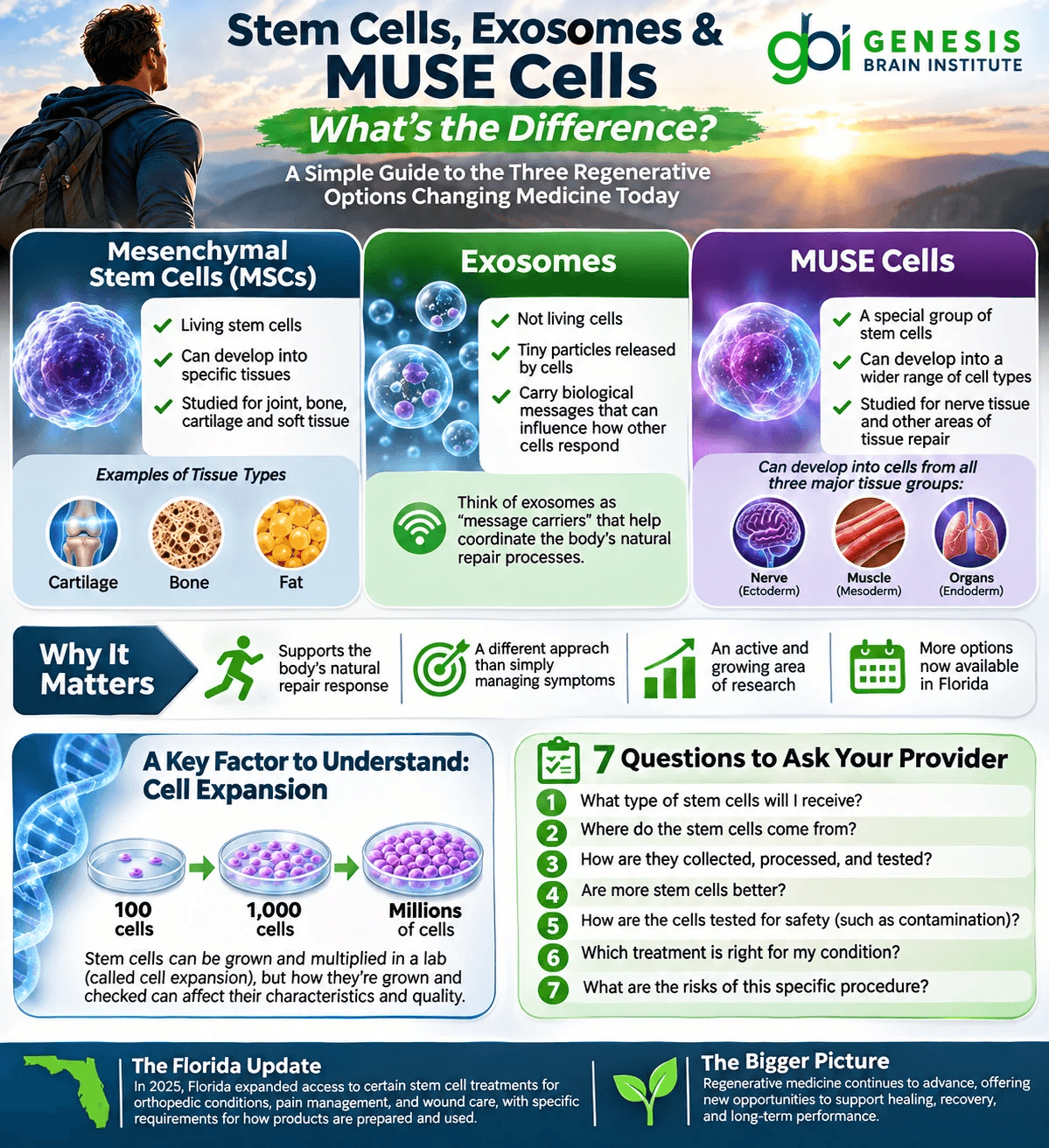
| Mesenchymal Stem Cells (MSCs) | Exosomes | MUSE Cells | |
|---|---|---|---|
| What are they? | Living cells | Tiny particles released by cells | A special type of living stem cell |
| What makes them different? | Can develop into certain tissues, such as bone, cartilage, and fat | Carry messages between cells | Can develop into a wider variety of cell types |
| Why are scientists interested? | Joint and tissue repair research | Cell communication and inflammation research | Nerve and tissue repair research |
Are MUSE Cells Better Than Regular Stem Cells?
That’s a reasonable question.
After all, if MUSE cells can develop into more types of cells, wouldn’t that make them better?
Not necessarily.
Dr. Chris Gleis explained that different stem cells have different biological abilities. However, that doesn’t mean one type is automatically the best choice for every condition.
For example, mesenchymal stem cells have been widely studied because of their relationship to bone, cartilage, and other connective tissues.
MUSE cells are attracting attention because researchers are exploring their ability to develop into a broader range of cells, including nerve-related cells.
Exosomes work differently. They aren’t living cells that can become new tissue. Instead, scientists are studying how the messages they carry influence other cells.
And here’s something important to remember.
Just because researchers are interested in a product for a certain type of tissue doesn’t mean it has been proven to repair that tissue in patients.
How Do You Know Which Stem Cell Treatment You’re Actually Getting?
This is where things become especially important for anyone considering treatment.
Imagine one clinic tells you it offers stem cell therapy for your knee.
Another clinic says it offers regenerative injections for the same problem.
Are they using the same product?
You wouldn’t know without asking.
One might use cells collected from your own body. Another might use a product derived from donated umbilical cord tissue. A third might offer exosomes, which aren’t living stem cells at all.
Even when two products contain the same general type of cells, they can differ in how they’re collected and prepared.
That’s why one of the simplest questions you can ask is:
“Can you explain exactly what’s in the product you’re recommending?”
A clear answer should help you understand whether the product contains living cells, cell-derived particles, or another form of processed tissue.
And once you understand what you’re getting, there’s another question worth asking.
How was that product collected, processed, and tested?
Dr. Gleis discussed why those details matter, particularly when it comes to how cells are grown, handled, and prepared before they’re used.
Why Does Stem Cell Processing and Expansion Matter?
Let’s say you’re considering stem cell therapy for knee pain.
You visit two clinics. Both say they offer 10 million stem cells.
Sounds like you’re getting the same thing, right?
Not necessarily.
What if the cells used by one clinic were grown and multiplied in a laboratory several times, while the cells used by the other were prepared differently?
Would you want to know?
During our conversation, Dr. Chris Gleis explained why the way stem cells are grown and handled is something patients should understand before considering treatment.
What Does It Mean When Stem Cells Are Expanded?
Stem cell expansion sounds complicated, but the idea is actually pretty simple.
Scientists can take a small number of cells and grow them in a laboratory, allowing them to multiply.
For example, imagine starting with 100 cells and allowing them to grow into 1,000. Those cells can then be used to grow even more.
This process is called cell expansion.
But here’s something important.
Each time cells multiply, there’s a chance their characteristics can change.
Dr. Gleis raised concerns about products that have been expanded repeatedly without enough attention to how the cells have changed.
That doesn’t mean growing stem cells in a laboratory is automatically bad. It means how the cells are grown and checked matters.
So when someone tells you a treatment contains millions of stem cells, remember that the number alone doesn’t tell you everything about those cells.
How Do You Know if Stem Cells Have Been Properly Tested?
Here’s another question worth asking.
Before those stem cells reach your body, how does anyone know the product is what it’s supposed to be?
Dr. Gleis discussed concerns about contamination and the importance of knowing how biological products have been prepared.
Think about the food you buy at the grocery store.
You expect it to be handled, stored, and checked properly before it reaches your kitchen.
Products made from human cells also require careful handling and quality testing.
For example, testing can help identify unwanted bacteria or other contamination. Depending on the product, laboratories can also check the types of cells present and whether living cells remain viable.
These checks matter because a product’s quality isn’t determined simply by how many cells the label says it contains.
Does Having More Stem Cells Mean Better Results?
Not necessarily.
Imagine one clinic advertises 10 million stem cells while another advertises 100 million.
It’s natural to assume that 100 million must be better.
But a higher cell count doesn’t automatically mean a treatment is safer or more effective.
The type of cells, their condition, the way they were prepared, and the research supporting their use all matter.
And this is exactly why Dr. Gleis’s explanation is so valuable.
Two treatments can have the same name, yet the products behind them can be quite different.
What Should You Ask Before Getting Stem Cell Therapy?
You don’t need to understand every step of laboratory processing.
However, you should feel comfortable asking your provider one important question:
“Where did these cells come from, and how were they grown, handled, and tested?”
A provider should be able to explain what the product contains and what information is available about its quality.
After all, if you’re considering putting something into your body, understanding what’s in it is a reasonable place to start.
And as Dr. Gleis explained, there’s much more to consider than simply hearing the words stem cell therapy.
What Are the Risks of Stem Cell and Exosome Treatments?
If you’re thinking about stem cell therapy, you probably have two questions.
Could it help me? And is it safe?
During our conversation, Dr. Chris Gleis explained that not all stem cell treatments carry the same risks.
Why? Because the type of cells, how they’re prepared, and where they’re placed in the body can all make a difference.
Let’s look at some of the concerns he discussed.
Can Stem Cell Products Become Contaminated?
Yes, and this is one reason proper testing matters.
Dr. Gleis shared a heartbreaking story from his medical training about a young patient who had received stem cell injections overseas.
According to his account, the product contained harmful bacteria. The patient developed a serious infection and sadly died.
This doesn’t mean every stem cell product is contaminated or that treatments overseas are automatically unsafe.
However, it shows why knowing how a product is handled and tested is so important.
Before considering treatment, ask your provider:
“How do you make sure the product is free from harmful bacteria?”
Can Stem Cells Cause Tumors?
Some types of stem cells can raise concerns about unwanted cell growth.
Remember, stem cells have the ability to multiply and develop into other types of cells.
That’s part of what makes them interesting to scientists.
However, researchers also need to understand what happens to those cells after they’re placed in the body.
Dr. Gleis discussed this concern when explaining the differences between mesenchymal stem cells and MUSE cells.
He noted that researchers are interested in MUSE cells partly because of their different growth behavior.
That doesn’t mean MUSE cells have been proven completely safe.
The important thing to understand is that different cells can have different risks.
Are Exosomes Safer Than Stem Cells?
This is an interesting question.
Unlike stem cells, exosomes aren’t living cells. They cannot multiply or grow into new tissue.
Dr. Gleis explained that this is one reason he is interested in exosomes.
Their small size can also make certain steps in the purification process possible.
But does that automatically make exosomes safer?
Not necessarily.
Exosome products still need careful handling and testing. Researchers are continuing to study their safety in humans.
So the answer depends on the specific product and how it’s being used.
Does It Matter Where Stem Cells or Exosomes Are Injected?
Absolutely.
Think about an injection into your knee compared with a procedure involving the fluid around your brain and spinal cord.
Those are very different parts of your body.
Dr. Gleis explained that the location of a procedure matters because some areas are more sensitive than others.
For example, he discussed the challenges of placing products into the space surrounding the brain and spinal cord.
That’s why it’s important to ask:
“What are the risks of this particular procedure?”
After all, the safety of a treatment involves more than just what’s inside the injection.
What Should You Know About Stem Cell Therapy Safety?
Here’s the biggest takeaway from Dr. Gleis’s explanation.
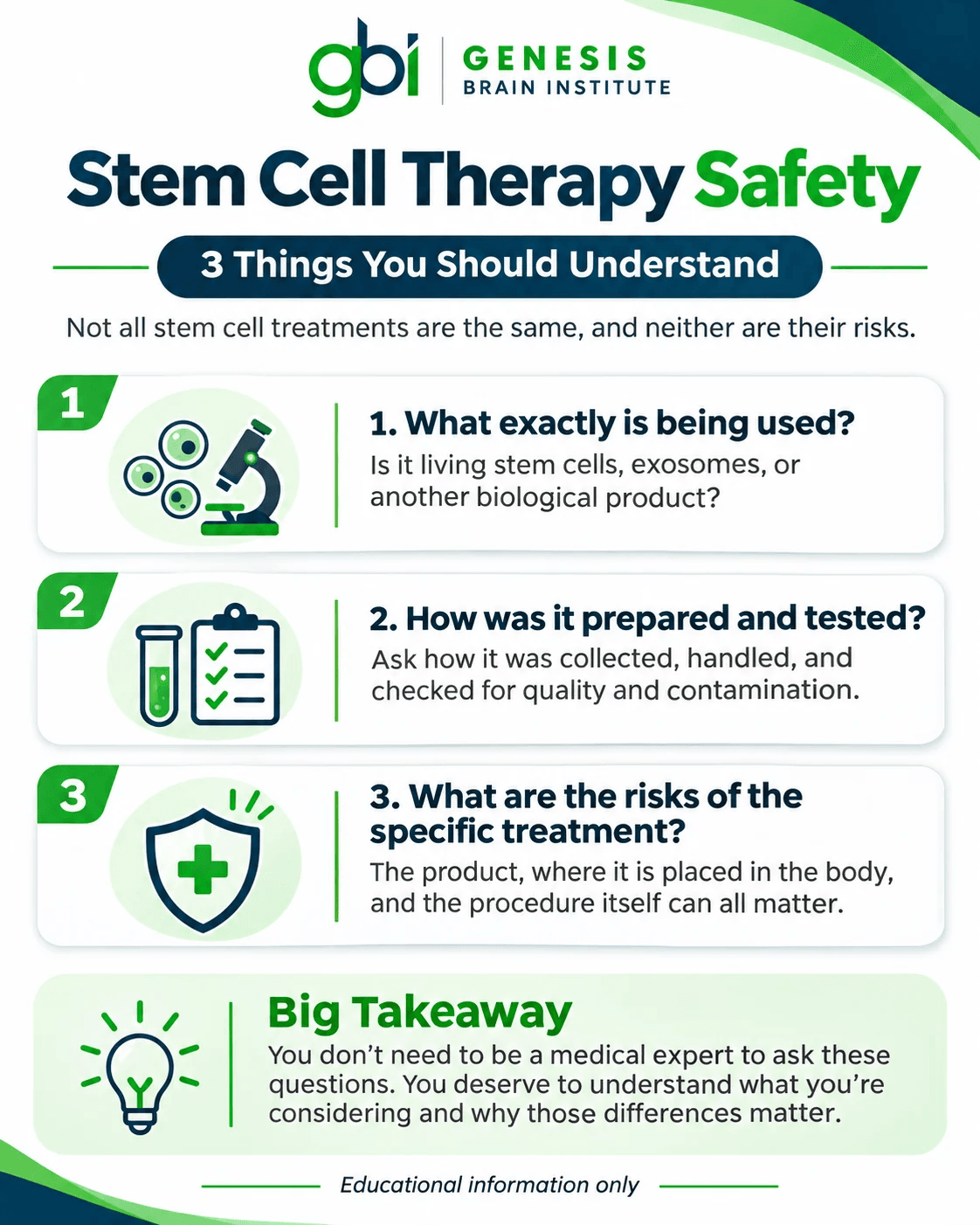
Not all stem cell treatments are the same, and neither are their risks.
One product might contain living stem cells. Another might contain exosomes. Even when two products sound similar, they could be prepared or used very differently.
Before considering treatment, make sure you understand three things:
What exactly is being used?
How was it prepared and tested?
What are the risks of the specific treatment?
You don’t need to be a medical expert to ask these questions.
You simply deserve to understand what you’re considering and why those differences matter.
Do You Have to Travel Outside the USA for Stem Cell Therapy?
You’ve probably heard stories about professional athletes and celebrities traveling to Mexico, Panama, or Costa Rica for stem cell treatments.
But do you really have to leave the United States to explore regenerative medicine?
Not necessarily.
During our conversation, Dr. Chris Gleis discussed how people have traveled overseas to explore different types of stem cells, including MUSE cells.
However, regenerative medicine is also advancing here in the United States, and Florida has taken an interesting step forward.
Is Stem Cell Therapy Available in Florida?
Yes, certain types of stem cell therapy are available in Florida.
In July 2025, Florida introduced a law allowing qualified physicians to offer certain stem cell treatments that have not received FDA approval.
The law focuses on three areas:
Orthopedic conditions, such as joint problems
Pain management
Wound care
There are specific requirements for the products used and how they’re prepared and handled.
This doesn’t mean every stem cell treatment is available in Florida. Exosome and MUSE cell treatments, for example, have different scientific and regulatory considerations.
However, it does mean patients have more reason to explore what options exist closer to home before assuming they need to travel overseas.
Is Stem Cell Therapy in Mexico Different From the USA?
It can be.
But the biggest difference isn’t always the country.
It’s the actual product.
As Dr. Gleis explained, a treatment described as stem cell therapy could involve different kinds of cells or cell-derived products.
One clinic might discuss mesenchymal stem cells. Another might offer exosomes. A third might focus on MUSE cells.
And even when two clinics use the same name for a product, the way it’s collected, grown, and tested can vary.
So before booking a flight or choosing a provider close to home, ask a simple question:
“What exactly is being used, and how do you know what’s in it?”
Where you receive treatment matters, but understanding the product itself matters just as much.
7 Questions to Ask Before Getting Stem Cell Therapy
Thinking about stem cell therapy for knee pain, an old injury, or another health concern?
Before choosing a treatment, there’s something important to understand.
Not all stem cell treatments are the same.
As Dr. Chris Gleis explained, two clinics advertising stem cell therapy could be offering very different products. Even when the names sound similar, the cells, where they come from, and how they’re prepared can be different.
So how do you know what you’re actually getting?
Here are seven questions worth asking before considering stem cell therapy.
1. What Type of Stem Cells Will I Receive?
This is a great place to start.
Are you receiving mesenchymal stem cells (MSCs), MUSE cells, exosomes, or another type of product?
Remember, exosomes aren’t living stem cells. And MUSE cells have different properties from other stem cells.
Just because a clinic advertises stem cell therapy doesn’t tell you exactly what’s inside the treatment.
Ask your provider to explain what you’re receiving in simple terms.
2. Where Do the Stem Cells Come From?
Not all stem cells come from the same place.
Some are collected from your own bone marrow or fat tissue. Others come from donated sources, such as umbilical cord tissue.
Dr. Gleis discussed why these differences matter when comparing regenerative medicine products.
A simple question to ask is:
“Are these cells coming from my own body or from a donor?”
The answer helps you better understand the type of treatment being discussed.
3. How Are Stem Cells Collected, Processed, and Tested?
This is one of the most important questions you can ask.
Think about it.
If something is going to be placed inside your body, wouldn’t you want to know how it was prepared?
Dr. Gleis discussed how stem cells can be grown and multiplied in a laboratory. This is called cell expansion.
He also raised concerns about what can happen when cells are repeatedly grown or aren’t handled properly.
So ask how the product was collected, how it was prepared, and what testing was performed.
You don’t need to understand every laboratory step. You just want to know that your provider understands the product being used.
4. Are More Stem Cells Better?
Imagine one clinic advertises 10 million stem cells while another advertises 100 million.
Does that mean the second clinic offers a better treatment?
Not necessarily.
Dr. Gleis discussed why the way cells are grown matters. Repeatedly multiplying cells in a laboratory can change their characteristics.
That means a bigger number doesn’t automatically tell you whether a product is better.
The type of cells, how they’re prepared, and what is known about their quality all matter.
Before being impressed by a large cell count, ask what that number actually means.
5. How Are Stem Cells Tested for Safety?
This question deserves special attention.
Dr. Gleis shared a story from his medical training about a patient who developed a serious infection after receiving a contaminated stem cell product overseas.
According to his account, the patient died.
His experience highlights why testing for harmful bacteria and other contamination matters.
Whether you’re considering treatment in Florida or another country, ask how the product is tested before it’s used.
You should also ask what information the provider has about where the product was made and how it was handled.
6. Which Stem Cell Treatment Is Right for Me?
If you’re considering treatment for knee pain, would you need the same type of product as someone exploring regenerative medicine for a different condition?
Not necessarily.
Dr. Gleis explained that MSCs, MUSE cells, and exosomes have different biological properties.
Scientists are studying these differences to better understand their possible medical uses.
But that doesn’t mean one type has been proven best for every health problem.
Ask your provider why a particular product is being considered for your condition and what human research supports its use.
The goal is to understand the reason behind the recommendation, not simply choose whichever treatment sounds newest.
7. What Are the Risks of Stem Cell Therapy?
Every medical procedure has potential risks.
But not every stem cell treatment has the same risks.
For example, Dr. Gleis discussed the differences between injecting a product into a joint and placing one into the fluid surrounding the brain and spinal cord.
Those are very different procedures.
He also explained why the type of cells and how they’re prepared matter when thinking about safety.
Before considering treatment, ask what risks are known for the specific product and procedure being discussed.
Why These 7 Questions Matter
Here’s the biggest lesson from Dr. Gleis’s explanations.
Two people can say they received stem cell therapy and still have received completely different products.
One might have received living stem cells. Another might have received exosomes. Even products described as the same type of stem cell can differ in how they’re collected and prepared.
That’s why it’s worth understanding more than just the name of a treatment.
You don’t need to become an expert in stem cells, exosomes, or MUSE cells.
However, you should be able to understand what you’re receiving, where it came from, how it was prepared, and why it’s being considered for you.
Because before deciding whether stem cell therapy is right for you, it’s important to know exactly what you’re getting.
Stem Cells vs. Exosomes vs. MUSE Cells: What Should You Remember?
Medicine is changing. And regenerative medicine is opening the door to questions scientists could only dream of exploring a generation ago.
For years, much of medicine has focused on managing symptoms, reducing pain, and treating damage after it happens.
Today, researchers are asking another exciting question: What if we could better understand and support the body’s own repair processes?
That’s part of what makes stem cells, exosomes, and MUSE cells so fascinating.
As we’ve learned, they aren’t the same thing.
Mesenchymal stem cells (MSCs) are living cells studied for their ability to develop into tissues such as bone, cartilage, and fat. Exosomes aren’t cells at all. They’re tiny particles that carry messages between cells. Meanwhile, MUSE cells are attracting attention because of their ability to develop into a wider range of cell types.
Each offers scientists a different way to study how the body responds to damage and repairs itself.
But here’s the lesson Dr. Chris Gleis emphasized throughout our discussion.
Not all stem cell treatments are created equal.
Two clinics can advertise stem cell therapy while offering completely different products.
Where those products come from, how they’re grown, how they’re tested, and what they actually contain all matter.
And while people have traveled around the world to explore regenerative medicine, exciting developments are happening right here in the United States, including Florida. Research continues to advance, and certain treatment options are becoming more accessible, even as scientists work to understand their long-term benefits and risks.
That progress gives us good reason to be hopeful, without assuming every emerging treatment has already been proven effective.
At Genesis Brain Institute in Tampa, we believe patients deserve to understand the science behind the options they’re exploring.
You don’t need to become an expert in stem cells to ask better questions.
What am I actually receiving? Where did it come from? How was it prepared and tested? What does the research tell us?
Those questions can make a meaningful difference in how you evaluate your options.
The future of medicine isn’t just about discovering new treatments. It’s about gaining a better understanding of the human body’s remarkable potential.
We’re still learning what stem cells, exosomes, and MUSE cells can accomplish. But the questions researchers are asking today could help shape how medicine approaches repair and recovery tomorrow.
And that’s something worth being excited about.
Because the future of medicine is still being written. And understanding what’s possible starts with understanding the science.
Disclaimer: This content is for informational purposes only and does not constitute medical advice. Please consult with a licensed healthcare provider. Genesis Brain Institute is a Brain Treatment Center in Tampa offering non-pharmaceutical solutions that bring clarity, restore function, and offer real hope for those who feel lost, stuck, or simply want more from life.
Medically reviewed by Dr. Christopher Gleis — Genesis Brain Institute, Tampa, Florida