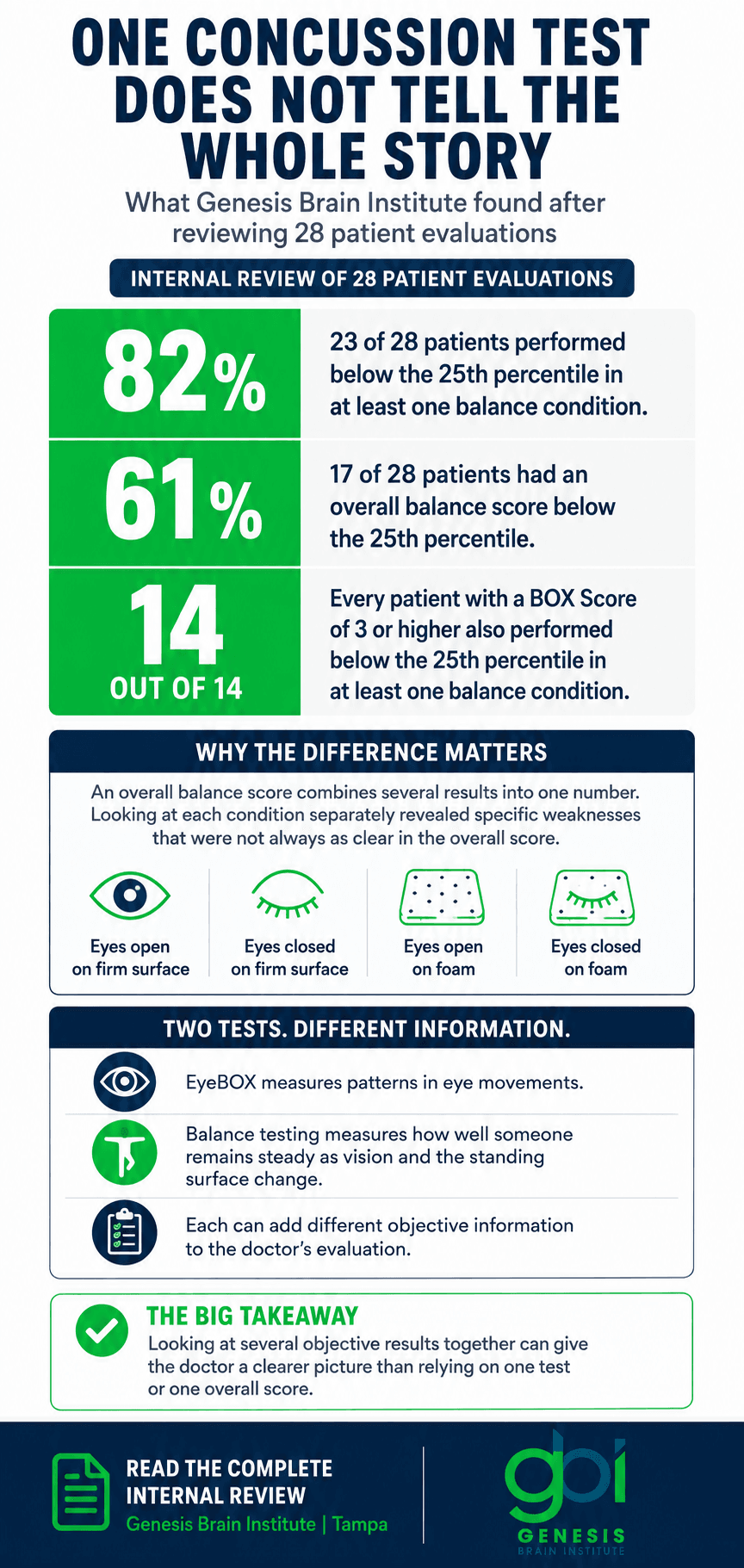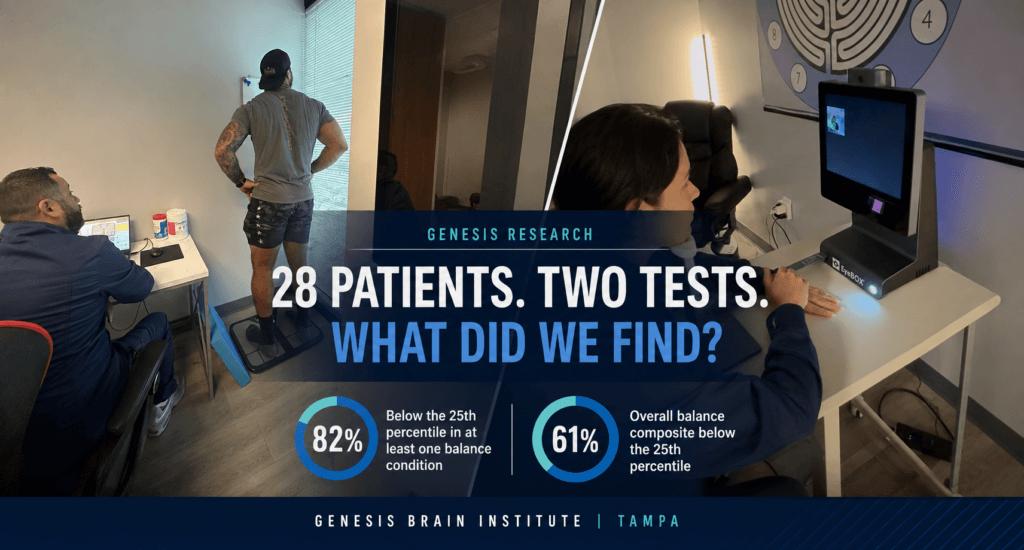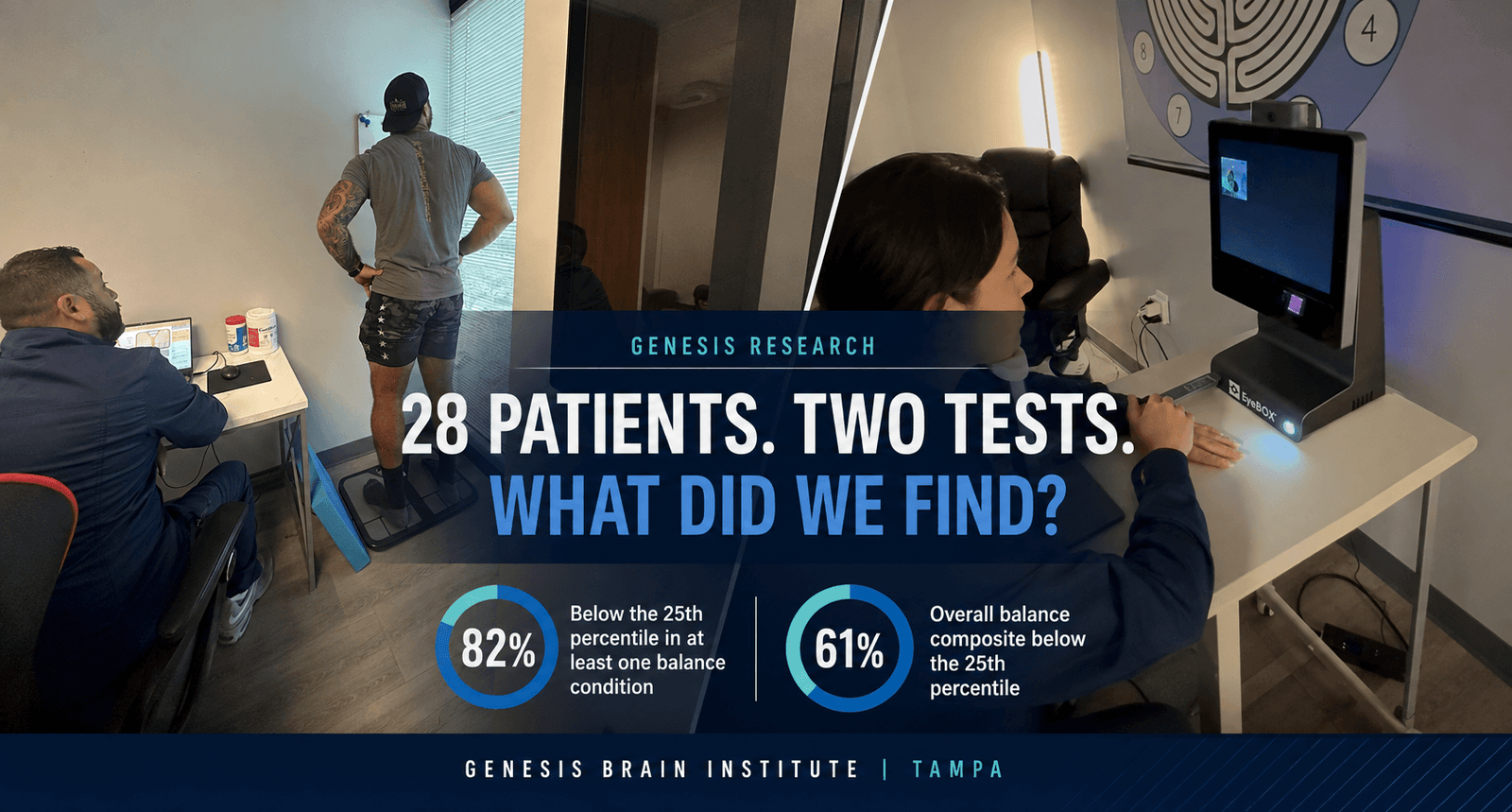
Concussion testing in Tampa revealed an important pattern when Genesis Brain Institute reviewed the results of 28 patient evaluations. Of those 28 patients, 23, or 82%, performed below the 25th percentile in at least one objective balance condition. However, only 17 patients, or 61%, had an overall balance score below the 25th percentile.
That difference raised a question worth exploring. If we had looked only at the overall balance score, what might we have missed?
After a fall, sports injury, car accident, or sudden jolt, most people want one clear answer: “Do I have a concussion?” They may expect one scan, test, or score to settle the question. Yet a concussion can affect eye movements, balance, focus, memory, reaction time, sleep, mood, and other parts of brain and nervous system function. Those changes do not always appear on the same test.
For this internal review, Genesis Brain Institute compared objective eye movement testing and balance testing from 28 patient evaluations alongside each doctor’s evaluation. The balance evaluation measured how well each person controlled their body across four conditions. Patients stood with their eyes open and closed on both a firm surface and foam. Each change made the brain rely differently on information from the eyes, inner ear, feet, joints, and nervous system.
The results showed that an overall score can look at the big picture while still making a weakness in one specific condition harder to see. We also found an important pattern when we compared the balance results with EyeBOX, an FDA cleared test that measures eye movement patterns.
This was not a controlled clinical study. It was an internal review of real patient evaluations completed at Genesis Brain Institute. Our goal was to look for patterns, ask better questions, and better understand what different concussion tests can reveal.
What we found supports one important lesson: concussion testing is not about relying on one number. It is about understanding how several parts of the brain and body are functioning together.
What Could We Learn From 28 Concussion Evaluations?
At Genesis Brain Institute, concussion testing can include several assessments because an injury can affect different parts of the brain and nervous system. For this internal review, however, we focused on two objective tests:
- Eye movement testing using EyeBOX by Oculogica
- Objective balance testing
We reviewed the results alongside the doctor’s evaluation of the patient’s injury, symptoms, history, and overall findings.
EyeBOX measures patterns in eye movements that provide objective information when a concussion is suspected. Our balance testing uses the BTrackS system to measure how well a person maintains balance under different conditions. Although eye movements and balance are connected through the brain and nervous system, these tests do not measure the same function.
We wanted to see what patterns appeared when we looked at the results together. In particular, we asked:
- How many patients performed below the 25th percentile in at least one balance condition?
- Did the overall balance score reveal every weakness found in the individual conditions?
- What did the balance results show in patients with a BOX Score of 3 or higher?
- Did eye movement testing and balance testing always reveal the same part of the picture?
The purpose was not to decide which test was better. Instead, we wanted to understand what each test added to the doctor’s evaluation.
One pattern became clear: the answer could change depending on which result we examined. A patient could have an overall balance score above the 25th percentile but still perform below the 25th percentile in one specific balance condition. Likewise, EyeBOX could provide valuable information about eye movement patterns while balance testing revealed difficulty in another area.
That led us to the central question behind this review:
What can doctors learn by examining several objective results together instead of relying on one test or one score?
Two Concussion Tests Looking at Different Parts of the Picture
Genesis Brain Institute uses several assessments to help doctors evaluate how an injury affected the brain and nervous system. For this review of 28 patients, we focused on two objective tests alongside the doctor’s evaluation: EyeBOX eye movement testing and balance testing.
These tests are connected, but they do not measure the same thing. A person can perform well in one area while showing difficulty in another. Understanding what each test measures helps explain why looking at several results can give the doctor a clearer picture.
What Does EyeBOX Measure?
EyeBOX by Oculogica is an FDA cleared test that measures eye movement patterns. During the four minute test, the patient watches a video while the device tracks how the eyes move together.
The test does not require results from before the injury. Instead, EyeBOX provides an objective BOX Score that doctors can review alongside the patient’s symptoms, medical history, examination, and other test results.
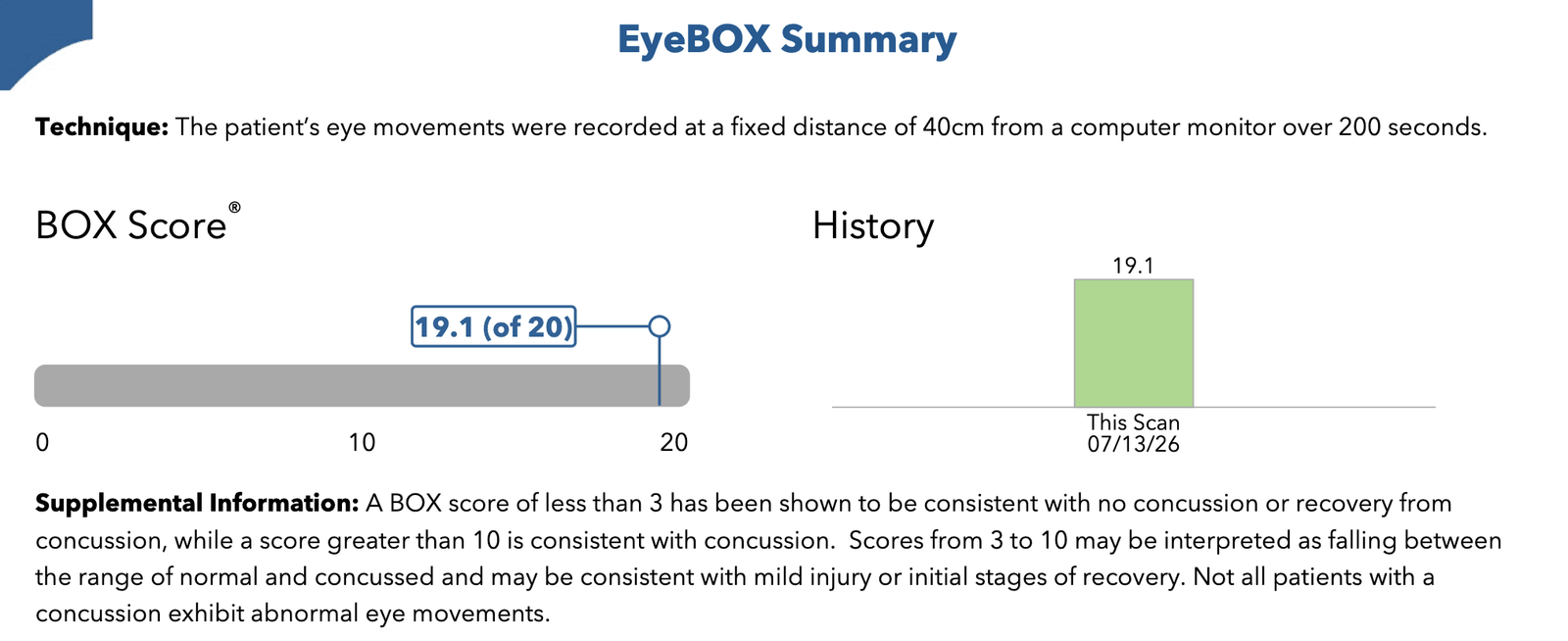
Eye movements provide helpful information because the brain controls how the eyes move, follow objects, and work together. However, not every concussion affects eye movements in the same way. Therefore, EyeBOX gives the doctor valuable information about one part of brain function, rather than the entire picture by itself.
What Does Balance Testing Measure?
Objective balance testing measures how well the brain and body work together to keep someone steady. It helps doctors examine how a person uses information from the eyes, inner ear, feet, joints, neck, and nervous system.
One part of our balance evaluation measures how much the body moves while a person stands on a force plate during four conditions:
- Eyes open on a firm surface
- Eyes closed on a firm surface
- Eyes open on foam
- Eyes closed on foam
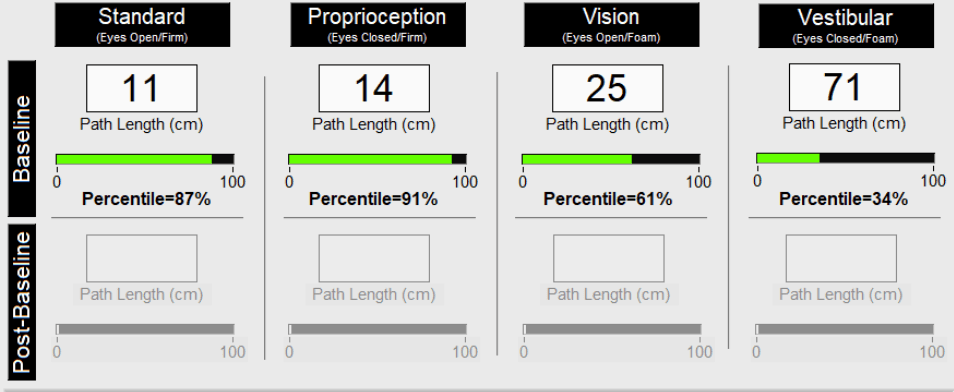
Each condition changes the information available to the brain. With the eyes open, the person can use vision to remain steady. Closing the eyes removes that guidance. Standing on foam also makes information from the feet, ankles, and joints less reliable.
As the conditions become harder, the brain must rely differently on vision, the inner ear, and signals from the rest of the body. Measuring balance this way can reveal a weakness that might not be obvious when someone is simply standing or walking through a doctor’s office.
However, our balance evaluation does not end with those four conditions. We also perform additional testing with the head and neck held in different positions. These tests help the doctor examine whether changing the position of the head or neck affects the person’s stability.
Looking at each result separately is important because one overall balance score can make a weakness in a specific condition harder to see. For this internal review, we focused on performance across the four standard balance conditions. We defined a balance weakness as performing below the 25th percentile in at least one of those conditions.
Why Compare Eye Movements and Balance?
Eye movement testing and balance testing both provide objective measurements, but each examines a different part of function. EyeBOX measures eye movement patterns, while balance testing measures postural control as the information available to the brain changes.
The doctor’s evaluation helps connect those results with how the injury happened, the patient’s symptoms, medical history, and other clinical findings.
Once we compared these two tests across 28 patient evaluations, an important difference appeared between the overall balance score and the individual balance conditions. That is where the findings became especially interesting.
What Did Concussion Testing Reveal in 28 Patients?
When we compared the EyeBOX results, individual balance conditions, overall balance scores, and each doctor’s evaluation, three patterns stood out.
| What we examined | What we found |
|---|
| Patients below the 25th percentile in at least one balance condition | 23 of 28, or 82% |
| Patients with an overall balance score below the 25th percentile | 17 of 28, or 61% |
| Patients with a BOX Score of 3 or higher who also fell below the 25th percentile in at least one balance condition | 14 of 14, or 100% |
82% Showed a Weakness in at Least One Balance Condition
Of the 28 patients reviewed, 23 performed below the 25th percentile in at least one of the four balance conditions. In simple terms, their performance was lower than at least 75% of people in the comparison group for their age.
This does not mean every patient struggled during every part of the balance test. Some performed well while standing with their eyes open on a firm surface but had more difficulty when their eyes were closed or when they stood on foam.
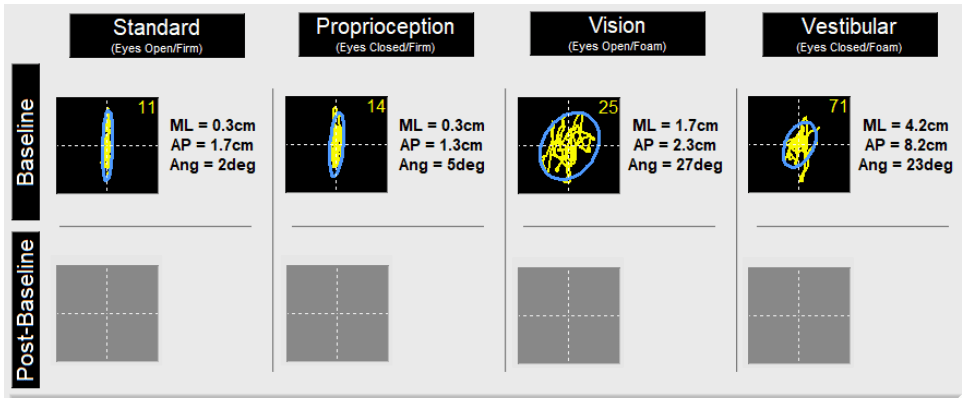
Changing the surface or removing vision forces the brain to use different information to keep the body steady. As a result, one difficult condition can help the doctor see which part of the balance system needs a closer look.
The Overall Balance Score Identified Fewer Patients
Seventeen of the 28 patients, or 61%, had an overall balance score below the 25th percentile. However, looking at each condition separately showed that 23 patients, or 82%, struggled in at least one area.
That 21 percentage point difference was one of the most useful findings in our review.
An overall score combines several results into one number. This can provide a helpful summary, but it can also make a weakness in one condition less obvious. Stronger performance in several conditions can raise the overall score even when the patient has difficulty during another part of the test.
For example, a patient could remain steady with their eyes open but begin to sway much more once vision is removed. If the doctor only reviewed the overall score, that specific change could be easier to overlook.
What Did We Find in Patients With a BOX Score of 3 or Higher?
Every patient with a BOX Score of 3 or higher, 14 out of 14 patients, also performed below the 25th percentile in at least one balance condition.
This does not mean the balance test confirmed the EyeBOX result. It also does not mean that both tests measured the same problem. Instead, it showed that every patient in this group had an objective finding in two different areas of function.
EyeBOX measured eye movement patterns. Balance testing measured how well each person remained steady as the information available to the brain changed. When both results showed an area of concern, the doctor had more information to consider alongside the patient’s symptoms, history, and examination.
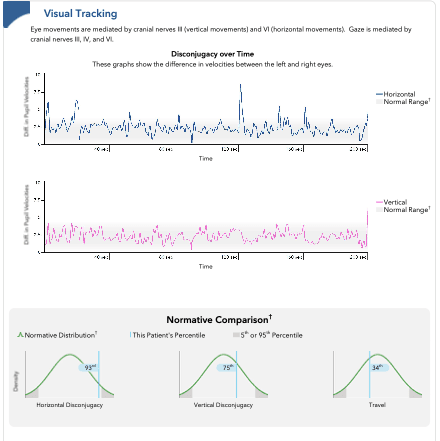
Together, these findings pointed to one clear lesson: the results can look different depending on whether the doctor examines one overall score or looks closely at each part of the evaluation.
Why One Concussion Test Cannot Tell the Whole Story
The biggest takeaway from these 28 patient evaluations is not that one test performed better than another. It is that each test answered a different question.
EyeBOX provided objective information about eye movement patterns. Balance testing measured how well each patient remained steady as vision, the standing surface, and other conditions changed. The doctor’s evaluation helped connect those findings with the patient’s symptoms, medical history, injury, and physical examination.
The balance results also showed why doctors should look beyond one combined score. While 61% of patients had an overall balance score below the 25th percentile, 82% performed below the 25th percentile in at least one individual balance condition. In other words, the overall score did not make every specific weakness obvious.
This does not mean every patient needs the same tests. It means concussion testing should be guided by the individual, the injury, and the doctor’s clinical judgment. For this internal review, we focused on EyeBOX and objective balance testing alongside the doctor’s evaluation. These are two parts of a broader Genesis Brain Institute testing protocol that can include additional objective assessments based on the patient’s symptoms and medical needs.
For patients, the message is simple: one reassuring result does not always explain every symptom or measure every area of brain and nervous system function. For doctors and researchers, these findings raise a larger question: Could examining several objective measurements together help us better understand concussion and track recovery?
What These Findings Could Mean for Future Concussion Research
This internal review gave Genesis Brain Institute a useful starting point, but 28 patient evaluations are only a small sample of the concussion patients we evaluate. The patterns we found deserve to be studied across a much larger group.
Future research could explore questions such as:
- Which balance conditions are most often affected after a suspected concussion?
- Do certain eye movement patterns appear alongside specific balance weaknesses?
- How do these results change as a patient recovers?
- Could combining objective tests give doctors more information when making return to work, school, sports, or activity decisions?
Genesis Brain Institute is interested in collaborating with physicians, universities, researchers, and neurotechnology companies that want to study these questions more closely. Our Tampa facility provides a real clinical setting where objective test results can be compared with the doctor’s evaluation and tracked over time.
The goal is bigger than collecting more data. It is to determine whether combining objective measurements can give doctors a clearer picture of concussion and recovery.
Concussion Testing in Tampa: What Patients and Research Partners Should Know
The 28 evaluations in this review represent only a small sample of the patients Genesis Brain Institute sees each month. Our clinical team regularly evaluates people following car accidents, falls, sports injuries, and other events that can affect the brain and nervous system. This gives us an opportunity to continue studying these patterns across a much larger group over time.
The findings from this first review were clear. Among the 28 patients, 23, or 82%, performed below the 25th percentile in at least one balance condition, while 17, or 61%, had an overall balance score below the 25th percentile. In addition, all 14 patients with a BOX Score of 3 or higher also performed below the 25th percentile in at least one balance condition.
These findings do not suggest that EyeBOX should replace balance testing or that balance testing should replace EyeBOX. Instead, they show how each objective measurement can add different information to the doctor’s evaluation. One score can be valuable without explaining every symptom or every area of function.
For researchers, universities, physicians, and neurotechnology companies, this small sample raises important questions worth exploring across a larger patient group. Genesis Brain Institute is interested in research collaborations examining how objective measurements work together, how results change during recovery, and how better data can support decisions about returning to work, school, sports, and daily life.
For patients, the message is just as important. If you still feel different after a car accident, fall, sports injury, or sudden impact, one test might not provide the complete explanation. Concussion testing at Genesis Brain Institute in Tampa can include several objective assessments chosen according to your injury, symptoms, medical needs, and the doctor’s clinical judgment.
Our goal is not simply to produce another score. It is to help the doctor see more, help the patient understand more, and create a clearer path forward.
If you are interested in concussion testing in Tampa or would like to discuss a potential research collaboration, contact Genesis Brain Institute. Sometimes a new beginning of hope starts by taking a closer look.
Disclaimer: This content is for informational purposes only and does not constitute medical advice. Please consult with a licensed healthcare provider. Genesis Brain Institute is a Brain Treatment Center in Tampa offering non-pharmaceutical solutions that bring clarity, restore function, and offer real hope for those who feel lost, stuck, or simply want more from life.