How can you rewire your brain? That’s what we’ll cover today.
Your brain has more capacity than you realize.
For a long time, people were taught to think of the brain almost like a finished building. You grow up, your brain develops, and after that you mostly try to protect what you have. But that picture is incomplete. Your brain keeps adapting to what you do, what you practice, what you pay attention to, and what you repeat.
That matters whether you are 18, 48, or 78.
In 2025, a study published in Science found evidence that new neurons were still being formed in the hippocampus of adult brains, including in people as old as 78. The hippocampus plays an important role in learning and memory.
The study, adds important evidence to the long running question of whether new neurons continue to form in the adult human brain.
That finding does not mean aging stops, and it does not mean every brain changes in the same way. But it does add to a much bigger story researchers have been building for years:
The adult brain is far more adaptable than many people once believed.
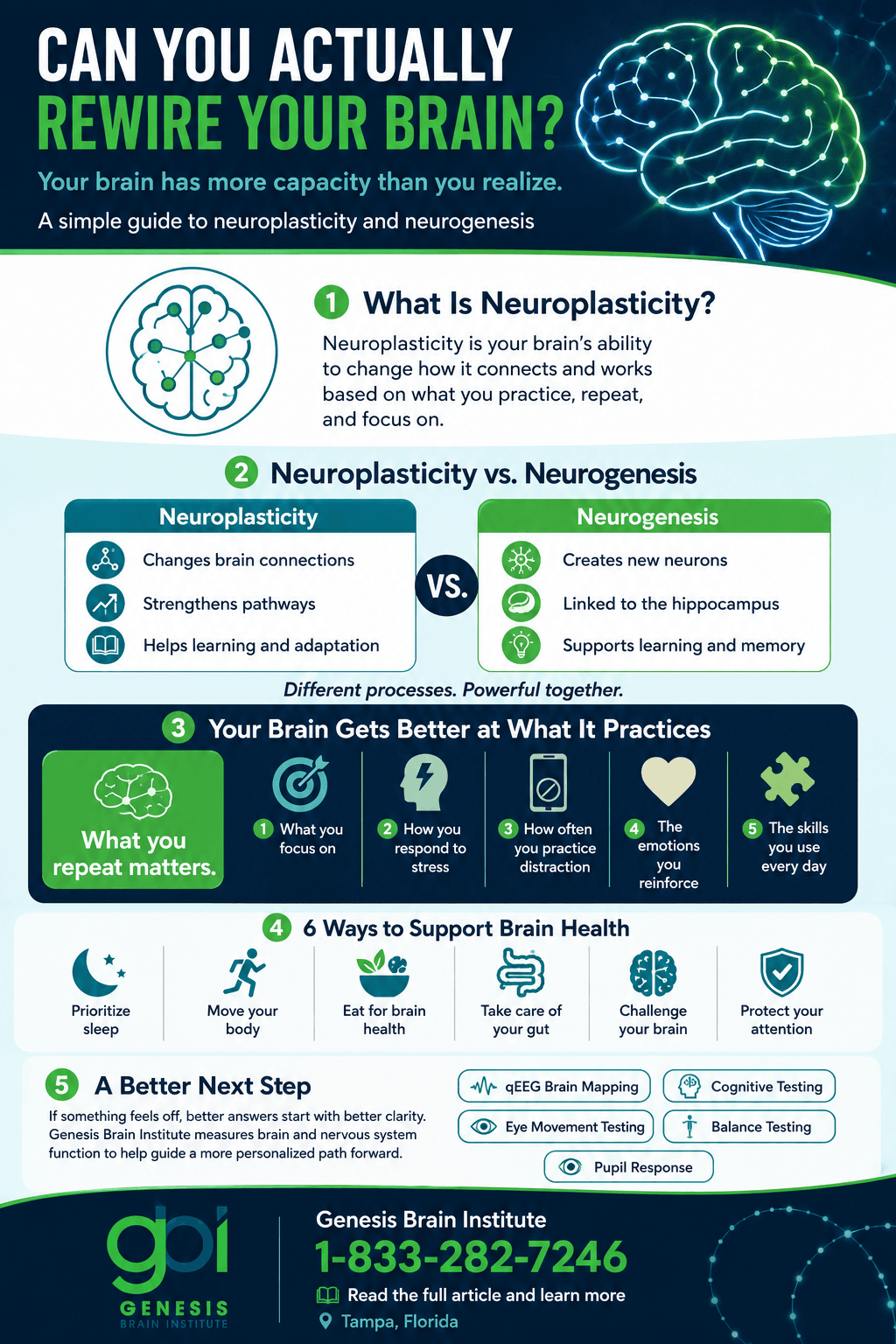
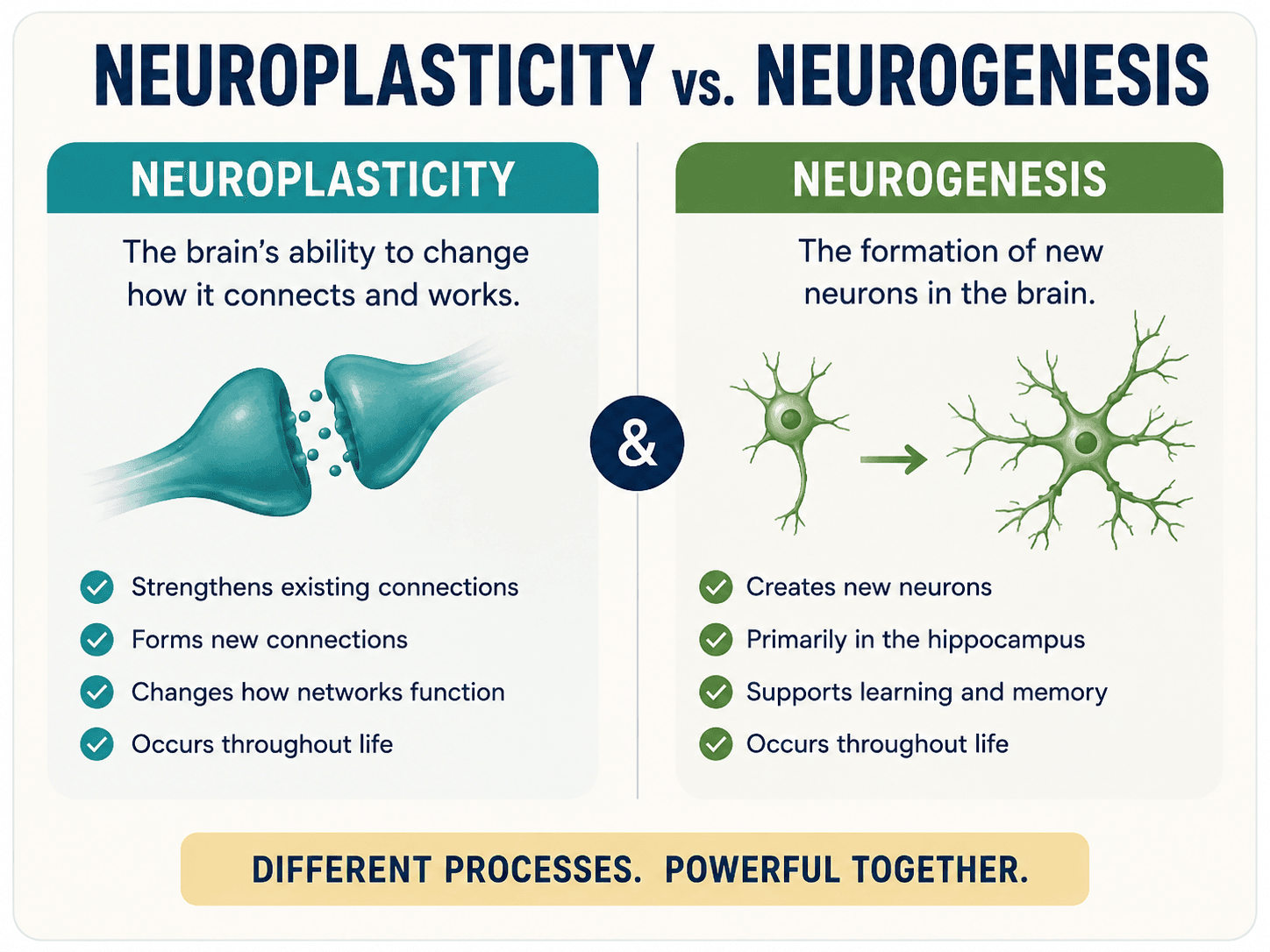
This is where neuroplasticity and neurogenesis become important. Neuroplasticity is the brain’s ability to change how it connects and works. Neurogenesis is the formation of new neurons. They are different processes, but together they raise a powerful question.
If your brain can keep changing, what are you teaching it to do every day?
The way you respond to stress, the things you focus on, the skills you practice, the quality of your sleep, your movement, your environment, and even the health of your gut can all become part of that conversation.
In this article, we are going to look at what “rewiring your brain” actually means, what the science says, how neuroplasticity works, whether adults can build new neural pathways, how long change can take, and 10 practical ways to support brain health over time.
Because the goal is not to chase a magic brain hack.
The goal is to better understand what your brain is capable of and how to support it with intention.
How Can You Rewire Your Brain?
So, how can you rewire your brain?
You do it by giving your brain repeated reasons to build, strengthen, or change certain patterns.
Think about learning to drive. At first, you have to think about everything. Check the mirror. Watch your speed. Stay in your lane. After enough practice, much of it becomes automatic. Your brain has built stronger pathways for the task.
The same basic idea applies far beyond driving. Your brain adapts to what you practice again and again. That can include a golf swing, playing the piano, solving problems, managing your attention, or changing how you respond when stress hits.
However, neuroplasticity does not mean you can simply think about something once and permanently change your brain. Change usually requires repetition, attention, and time.
Here are seven things that can help your brain build and strengthen patterns:
- Repetition. The more often your brain uses a pathway, the more familiar that pathway can become.
- Focused attention. Your brain has a lot of information competing for attention. What you consistently focus on gets more practice.
- Learning something new. A new language, sport, instrument, hobby, or skill challenges your brain to solve problems in new ways.
- Changing familiar responses. If stress normally makes you react one way, practicing a different response can give your brain another pattern to use.
- Quality sleep. Sleep gives the brain important time to support learning, memory, and recovery.
- Physical activity. Movement supports overall brain health and gives the brain constant information about balance, coordination, timing, and the world around you.
- Specific brain or nervous system training. When someone is dealing with an injury, symptoms, or a performance goal, certain forms of rehabilitation or brain training can provide more targeted practice based on the person’s needs.
Here is the important part: your brain does not decide whether the pattern you repeat is helping you.
It learns from repetition.
That is why understanding neuroplasticity matters. Once you understand that your brain can change, the next question becomes much more interesting:
What exactly is neuroplasticity, and what is happening inside your brain when those changes occur?
What Is Neuroplasticity?
Neuroplasticity is your brain’s ability to change how it connects and works in response to learning, experience, repetition, and injury.
A simple way to picture it is to imagine walking through tall grass.
The first time you cross the field, there is no trail. You have to push through the grass and think about every step. If you walk the same route again tomorrow, it becomes a little easier. Keep taking that path and, over time, a clear trail begins to form.
Your brain can work in a similar way.
When you repeatedly practice a skill, focus your attention, or respond to something in the same way, groups of brain cells communicate again and again. With enough practice, those patterns can become easier for your brain to use.
That is why someone can get better at playing an instrument, remembering a routine, improving a golf swing, or learning a new language. The brain is adapting to what it is being asked to do.
But neuroplasticity is not always positive.
Your brain can also become more efficient at patterns you would rather change. Constant distraction can become easier. A repeated stress response can become more familiar. Certain habits can start to feel automatic simply because you have practiced them so many times.
That is what makes neuroplasticity so important to understand.
Your brain is always learning from what you repeatedly ask it to do.
So what is actually happening inside the brain when those pathways begin to change?
How Does Neuroplasticity Work?
Neuroplasticity happens because your brain is constantly responding to the information it receives.
Your brain contains billions of nerve cells called neurons. These cells communicate through large networks. Every time you think, move, learn, remember, or react, different parts of those networks become active.
When the brain uses the same pattern again and again, that communication can become more efficient. Connections can strengthen, other connections can weaken, and the brain can reorganize how different areas work together.
Think about learning to play the piano. At first, finding every key takes effort. Your eyes are watching your hands. Your fingers move slowly. Your brain is working hard to coordinate everything.
Practice the same song for several weeks and something changes. Your fingers begin moving without as much thought. The song did not become easier. Your brain became better at performing it.
The same thing happens when an athlete practices a golf swing. Repeating the movement gives the brain more chances to improve the timing, coordination, and control needed to perform it.
But neuroplasticity is not limited to physical skills.
Imagine something stressful happens at work. Your normal response might be to tense your body, breathe faster, become angry, and react immediately. If that same pattern happens over and over, it can become familiar.
Now imagine practicing something different. You notice the stress, slow your breathing, wait before responding, and listen before speaking. At first, that response might take more effort. With practice, however, your brain has another pattern available.
This is an important part of how we think about the brain at Genesis Brain Institute.
The brain is not simply reacting to the world around you. It is also learning from those reactions.
And that leads to one of the most important lessons about neuroplasticity:
Your brain gets better at what it practices.
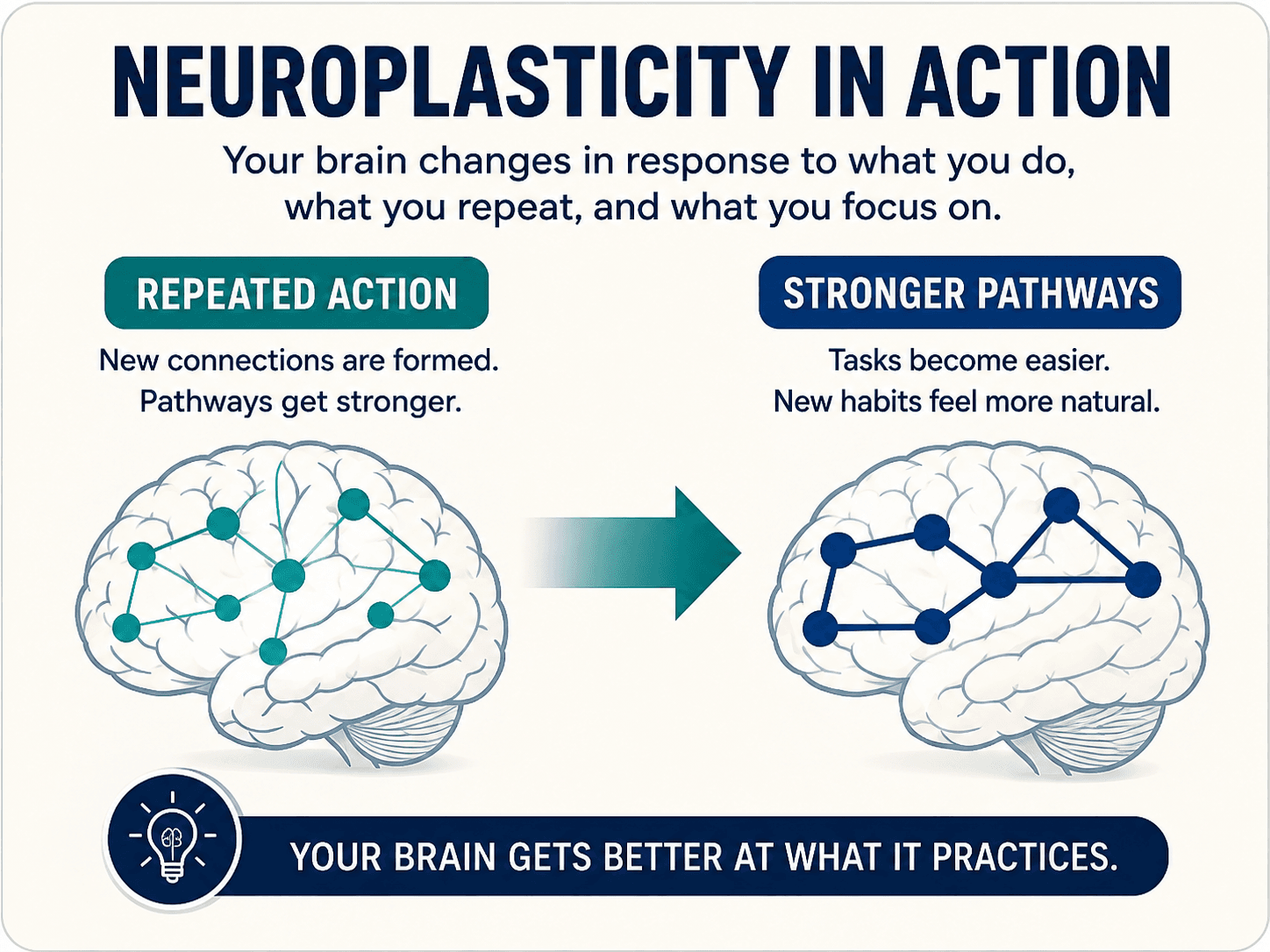
Your Brain Gets Better at What It Practices
One of the most important things to understand about neuroplasticity is that your brain does not ask whether a pattern is good for you before it gets better at using it.
It responds to practice.
If you spend years reacting quickly when you are frustrated, that response can become easier to access. If you constantly jump between texts, email, social media, and work, your brain gets a lot of practice switching attention. On the other hand, if you regularly slow down, listen carefully, and stay with one task, you are practicing a different set of skills.
The same principle can show up in emotional reactions.
Suppose someone cuts you off in traffic. You might immediately become angry, tense your body, and carry that frustration into the next ten minutes of your day. When that reaction happens often enough, it can start to feel automatic.
You can also practice another response. You notice what happened, decide it is not worth carrying with you, and move on. That does not mean pretending you are never frustrated. It means becoming more intentional about what happens next.
This is where brain training becomes much bigger than memory games or puzzles.
You are training your brain when you practice patience. You are training it when you practice deep focus. You are training it when you repeatedly interrupt yourself every few seconds. You are even training it through the way you respond to small frustrations that happen throughout an ordinary day.
None of this means every emotion, mental health challenge, or neurological condition can be changed through willpower. Biology, injury, trauma, sleep, health conditions, environment, and many other factors can affect how the brain functions.
But it does mean repetition matters.
Once a behavior or reaction starts happening without much thought, it can be easy to forget that your brain learned that pattern somewhere along the way.
And you may be training more of those patterns every day than you realize.
5 Ways You May Be Training Your Brain Without Realizing It
Most brain training does not happen while you are sitting in front of a special program.
It happens during ordinary life.
The way you pay attention, react, move, think, and use your time gives your brain information all day long. Some of those patterns are intentional. Others happen so often that you barely notice them anymore.
Here are five examples.
1. What You Choose to Notice
Have you ever thought about buying a certain car and suddenly started seeing that model everywhere?
There are not more of those cars on the road. Your attention changed.
Your brain constantly filters huge amounts of information because you cannot focus on everything at once. When something becomes important to you, your brain becomes more likely to notice it.
The same idea can affect daily life. If you spend most of your time looking for what went wrong, you will probably notice problems quickly. If you intentionally look for progress, gratitude, kindness, or opportunity, you give your attention something different to find.
That is not manifestation. Your thoughts do not magically change the outside world. They can, however, influence what your brain pays attention to inside that world.
2. How You Respond When Stress Shows Up
Stress gives your brain a chance to practice a response.
Maybe your shoulders tighten. Your breathing speeds up. You interrupt people or make decisions before you have had time to think.
Those responses can happen fast.
Learning to recognize them gives you a chance to do something different. Slowing your breathing, listening before answering, or waiting a moment before reacting gives your nervous system another experience to learn from.
The goal is not to eliminate stress. Stress is part of life. The goal is to build more options for how you respond when it arrives.
3. How Often You Practice Distraction
Every notification creates a small decision.
Do you stay with what you are doing, or do you switch?
If you check your phone every few minutes while working, studying, eating, or talking with someone, your brain gets plenty of experience changing direction.
That does not make technology bad. It means attention is worth protecting.
Creating periods where you read, work, pray, study, exercise, or have a conversation without constant interruption gives your brain something different to practice: staying with one thing.
4. The Emotional Reactions You Reinforce
Emotions are not a personal failure, and mental health conditions are not something a person can simply think away.
Still, we can become more aware of what happens after an emotion appears.
You can feel angry without feeding that anger for the next hour. You can feel nervous without judging yourself for being nervous. You can notice a difficult thought without automatically treating it as a fact.
Over time, that awareness can create more space between what you feel and what you do next.
That space can matter.
5. The Skills You Use Every Day
A baseball player trains timing every time they track a pitch. A musician trains hearing and movement while practicing a song. A student trains memory while studying. An executive trains decision making every time a difficult problem needs an answer.
Even simple activities involve the brain working with information, movement, memory, balance, vision, and attention.
The important question is not whether you are training your brain.
You already are.
The better question is:
What is your daily life asking your brain to practice most?
Can You Rewire Your Brain at Any Age?
One of the biggest myths about the brain is that meaningful change belongs mostly to children and young adults.
Age does matter. The brain changes as we get older, and some types of learning can take more effort. But neuroplasticity does not simply shut off when you reach a certain birthday.
Adults can still learn new skills, form new habits, improve coordination, strengthen memory strategies, and adapt after changes in health or injury. The pace and amount of change will differ from person to person, but the brain keeps responding to experience throughout life.
That is one reason the 2025 study we mentioned earlier is so interesting. Researchers studying the human hippocampus found cells involved in the early stages of neuron development in adult brain tissue. Their findings added new evidence that the adult human brain can continue producing neurons later in life.
It is important, though, not to confuse that finding with neuroplasticity itself.
Neuroplasticity and Neurogenesis Are Not the Same Thing
Neuroplasticity is the broader ability of the brain to change its connections, activity, and organization.
Neurogenesis is the process of creating new neurons.
Your brain does not need to create a brand new neuron every time you learn something. Much of learning comes from changing how existing neurons communicate and how brain networks work together.
That distinction matters because the idea of “rewiring your brain” is much bigger than growing new brain cells.
It means the brain can continue adapting.
So whether someone is learning a language at 20, changing a lifelong habit at 50, or working to stay mentally active at 75, age does not make the brain irrelevant to the process.
Your brain is still listening to what you ask it to do.
Can Adults Grow New Brain Cells?
Yes. Evidence now supports that new neurons can continue to form in the adult human hippocampus, the area of the brain closely involved in learning and memory.
As we covered above, this process is called neurogenesis. It is different from neuroplasticity, which describes the brain’s broader ability to change its connections and how its networks work.
The important takeaway is not that every adult is producing the same number of new neurons or that aging no longer matters. It is that the adult brain is more biologically active and adaptable than the old “finished brain” idea suggested.
And that raises a much more practical question:
What can you do today to create a healthier environment for a brain that is still capable of change?
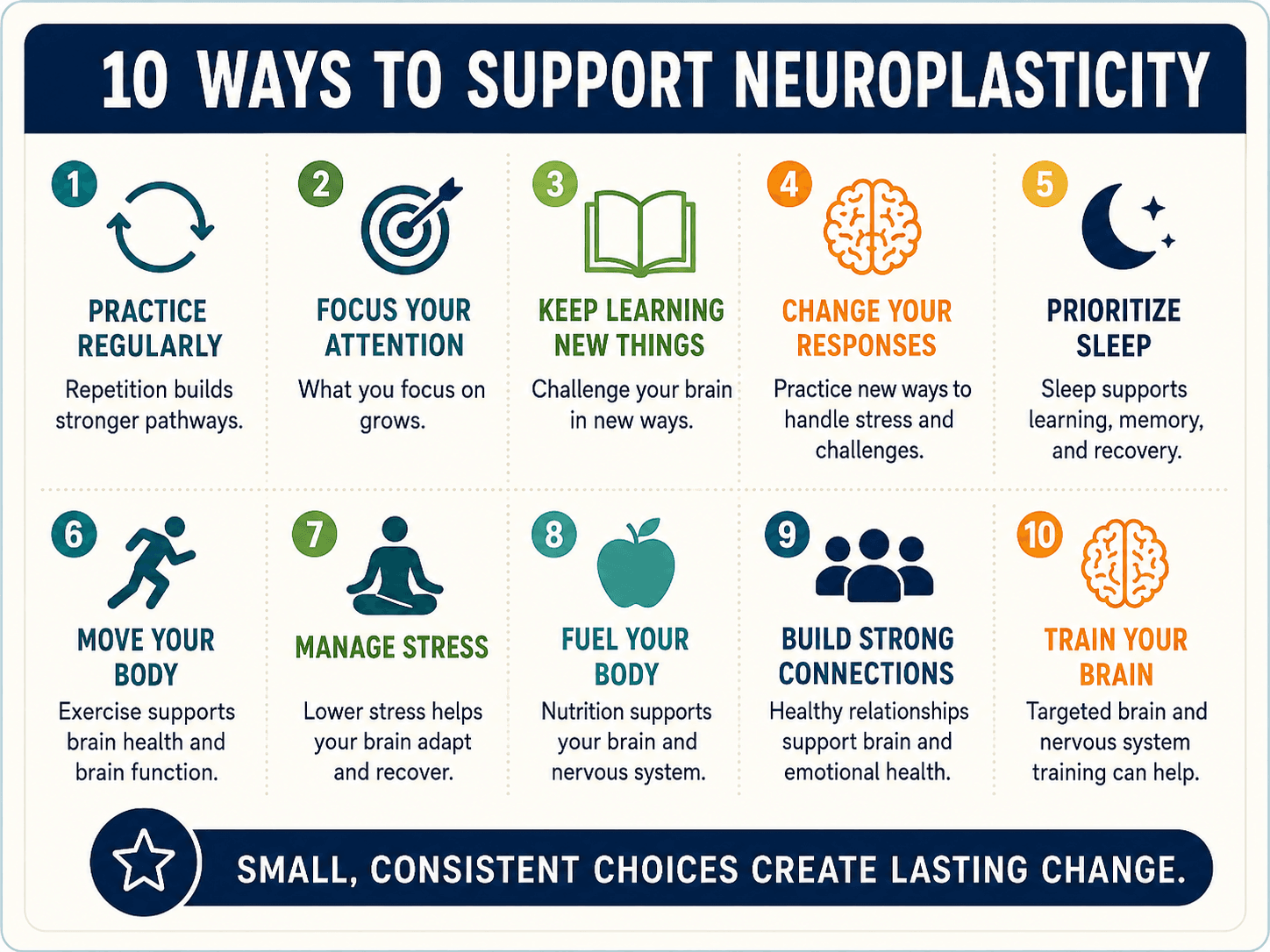
10 Ways to Support Neuroplasticity and Brain Health
Knowing your brain can change is encouraging. The next question is what you can do to support the conditions that help it function, learn, and adapt.
There is no single food, exercise, supplement, or brain hack that creates neuroplasticity on command. Brain health comes from many systems working together. Here are 10 places to start.
1. Make Sleep a Priority
Sleep is not wasted time. Your brain stays busy while you sleep, organizing information, supporting memory, and preparing you for the next day.
If you are constantly cutting sleep short, ask a better question than, “Can I function on this much sleep?”
Ask, “How much better could my brain function if I gave it the recovery time it needs?”
2. Move Your Body
Your brain was built to work with a moving body.
Walking, strength training, sports, dancing, and other forms of exercise challenge the brain to manage movement, timing, balance, vision, and coordination. Physical activity also supports the overall health of the systems that supply your brain with oxygen and nutrients.
You do not need to become an elite athlete. Consistent movement matters.
3. Pay Attention to What You Eat
Your brain needs fuel, and your diet affects much more than your waistline.
Protein, healthy fats, fruits, vegetables, and other nutrient rich foods provide building blocks the body uses to support brain function. At the same time, what you eat helps shape another system researchers are paying close attention to: your gut microbiome.
4. Take Care of Your Gut Too
Your gut and brain are in constant communication, which is why researchers increasingly study what is called the gut brain axis.
A 2025 study involving researchers from the University of South Florida, including Hariom Yadav, PhD, Director of the USF Center for Microbiome Research, looked at older adults with and without cognitive impairment. Researchers found that people with cognitive impairment had higher levels of several inflammatory markers and signs of reduced intestinal barrier integrity. Because the study looked at people at one point in time, it cannot prove that gut changes caused cognitive problems. Still, it adds to growing research connecting gut health, inflammation, and brain health.
This does not mean taking a probiotic will “rewire your brain.” It means brain health is bigger than the brain alone.
5. Keep Learning Things That Challenge You
Doing something you already know well is different from asking your brain to solve a new problem.
Learn a language. Try a new recipe. Pick up an instrument. Take a class. Learn a new piece of technology. Study a part of the Bible you have never explored deeply. Choose something that requires effort rather than something you can do on autopilot.
Challenge gives your brain a reason to adapt.
6. Use Your Brain and Body Together
Some activities ask multiple brain systems to work at the same time.
Think about tennis. Your eyes track the ball, your brain judges its speed, your body moves into position, and your hand controls the racket. Dancing combines memory, rhythm, balance, hearing, and movement.
Activities that combine thinking and movement can challenge the brain in ways that sitting still with a puzzle cannot.
7. Build Time for Recovery From Stress
Stress is not always bad. You need the ability to respond when life demands action.
The problem comes when your system rarely gets a chance to come back down.
Breathing exercises, prayer, quiet time, time outside, mindfulness, and other calming practices can give your nervous system opportunities to shift out of a constant state of alert.
You are not trying to build a life with no stress. You are helping your brain and body become better at moving between challenge and recovery.
8. Protect Your Attention
Attention is one of your brain’s most valuable resources.
You cannot stop every notification, interruption, meeting, or distraction. However, you can create parts of your day where your brain gets to stay with one meaningful task.
Read without checking your phone. Finish a project before opening another tab. Put the phone away during an important conversation.
What deserves your attention should sometimes get all of it.
9. Give Yourself Time to Improve
Brain change does not follow a motivational calendar.
You may see progress quickly with one skill and need months of work with another. Injury, age, sleep, health, stress, the complexity of the task, and how often you practice can all affect the process.
Do not assume that slow progress means nothing is happening.
Consistency often matters more than intensity followed by quitting.
10. Understand How Your Brain Is Functioning
Sometimes healthy habits are enough to support the goal you are working toward. Other times, someone is dealing with brain fog, focus problems, memory changes, an injury, emotional changes, balance problems, or a drop in performance that deserves a closer look.
That is when guessing becomes less useful.
At Genesis Brain Institute in Tampa, we believe the right plan starts with the right information. Looking at brain and nervous system function through objective testing can help provide a more complete picture of what may be happening before deciding what type of support makes sense.
Neuroplasticity gives the brain the ability to change.
The better you understand the brain you have today, the more intentional you can be about how you support it tomorrow.
Can You Rewire Your Brain for Positive Thinking?
You cannot think your way into a perfect life. Positive thoughts do not make problems disappear, and repeating an affirmation does not magically change what is happening around you.
But what you repeatedly look for can influence what your brain notices.
Imagine you decide you want a red car. Suddenly, red cars seem to be everywhere. There are not more red cars on the road. Your brain has simply decided that red cars matter, so you notice them more often.
The same idea can show up in daily life.
If your attention constantly searches for what is wrong, disappointing, or frustrating, those things can become easier to spot. You can also become more intentional about noticing moments of gratitude, kindness, progress, beauty, connection, or joy.
Some people call these positive moments “glimmers.” They are small experiences that give your brain something good to notice. A favorite song. A conversation with someone you love. A sunrise. Your dog running to greet you. A prayer that brings peace.
This is not about ignoring pain or pretending everything is fine.
It is about recognizing that your attention is valuable and becoming more intentional about where you direct it.
You cannot control everything that happens during your day.
But you can practice noticing more than what went wrong.
Can Negative Thought Patterns Change Your Brain Too?
Yes. Neuroplasticity works in both directions.
Your brain does not only learn skills you want to keep. It can also become familiar with patterns of worry, anger, avoidance, fear, or negative self talk when those patterns happen again and again.
That does not mean someone chooses anxiety, depression, PTSD, or another mental health condition. These conditions are complex and can involve biology, trauma, stress, sleep, physical health, environment, and many other factors.
The important distinction is what happens after a thought or feeling shows up.
Imagine you make a mistake at work. One thought might be, “I messed that up.” Another pattern can quickly turn that mistake into, “I always mess things up. I am terrible at this. Everyone probably thinks I am incompetent.”
The event happened once. Your brain can keep replaying it long after the moment has passed.
Becoming aware of that pattern gives you an opportunity to interrupt it. You can look at what actually happened, learn from it, and choose what deserves your attention next.
This is not about forcing yourself to be positive.
It is about recognizing when your brain has started traveling down the same familiar road and asking whether that road is still taking you where you want to go.
Neuroplasticity gives us an encouraging truth: a familiar pattern does not have to be a permanent pattern.
How Long Does It Take to Rewire Your Brain?
There is no magic number of days it takes to rewire your brain.
You may have heard that it takes 21 days, 30 days, or even 90 days to create a new pathway. The problem is that the brain does not follow one calendar. Neuroplasticity depends on what you are trying to change, how often you practice it, how challenging the task is, and what else is happening in your health and life. Research on adult neuroplasticity shows that the brain can continue adapting in response to sustained experience, but the speed and amount of change vary widely.
Learning a simple movement could happen faster than rebuilding a complex skill after an injury. Becoming comfortable with a new software program is different from learning a language. Changing an automatic emotional response can be different again.
Your age can matter. So can sleep, stress, physical health, medications, injury history, the amount of practice you get, and whether the training matches what you are trying to improve.
That is why counting days can become misleading.
A better way to look for progress is to ask whether something that once required a great deal of effort is starting to become easier, faster, smoother, or more automatic.
You may notice that you remember the steps without checking them. Your golf swing feels more natural. You catch yourself before an old reaction takes over. A task that once demanded all of your attention starts requiring less thought.
Those are the kinds of changes that tell you learning is taking place.
So instead of asking, “How many days until my brain is rewired?” ask a more useful question:
“Am I giving my brain enough consistent practice to learn something different?”
Can You Feel Your Brain Rewiring?
Usually, no. You do not feel a neural pathway being built in real time.
What you can notice are the effects of learning and adaptation.
A movement may start to feel smoother. A task that once took full concentration may become easier. You may recover your balance faster, remember a sequence without checking it, or notice that you handle a stressful moment differently than you would have months ago.
Think about learning to ride a bike. You do not feel your brain changing while you practice. You feel awkward, uncertain, and unsteady. Then one day, you stop thinking about every small movement and simply ride.
That shift is what people often mean when they say they can “feel” their brain changing.
The same thing can happen with mental and emotional skills. You might notice that you pause before reacting, stay focused longer, or catch an old habit sooner.
Those experiences do not prove exactly what changed inside the brain. But they can show that learning is becoming more automatic.
So if you are wondering whether you can feel your brain rewiring, look less for a physical sensation and more for a change in what feels easier, faster, calmer, or more natural than it used to.
Can You Reset Your Brain?
Not in the literal sense.
Your brain does not have a reset button that wipes everything clean and starts over. But it can learn new patterns, strengthen different pathways, and become less dependent on old ones.
That is why “reset your brain” can be a useful idea, even if the science is better described as retraining.
Think about a GPS that keeps sending you down the same road because that is the route it knows best. If you keep choosing a different route, the system eventually has more than one option available.
Your brain can work in a similar way.
You are not deleting your history. You are giving the brain new experiences to work with.
That can happen through learning, movement, sleep, stress regulation, focused attention, rehabilitation, and repeated practice.
So instead of thinking:
Reset your brain.
A better phrase may be:
Train your brain differently.
That shift matters because it puts the focus on what neuroplasticity actually involves: practice, repetition, and time.
Can Brain Function Be Measured?
Yes, but there is no single test that tells you everything about how your brain is functioning.
That is an important distinction.
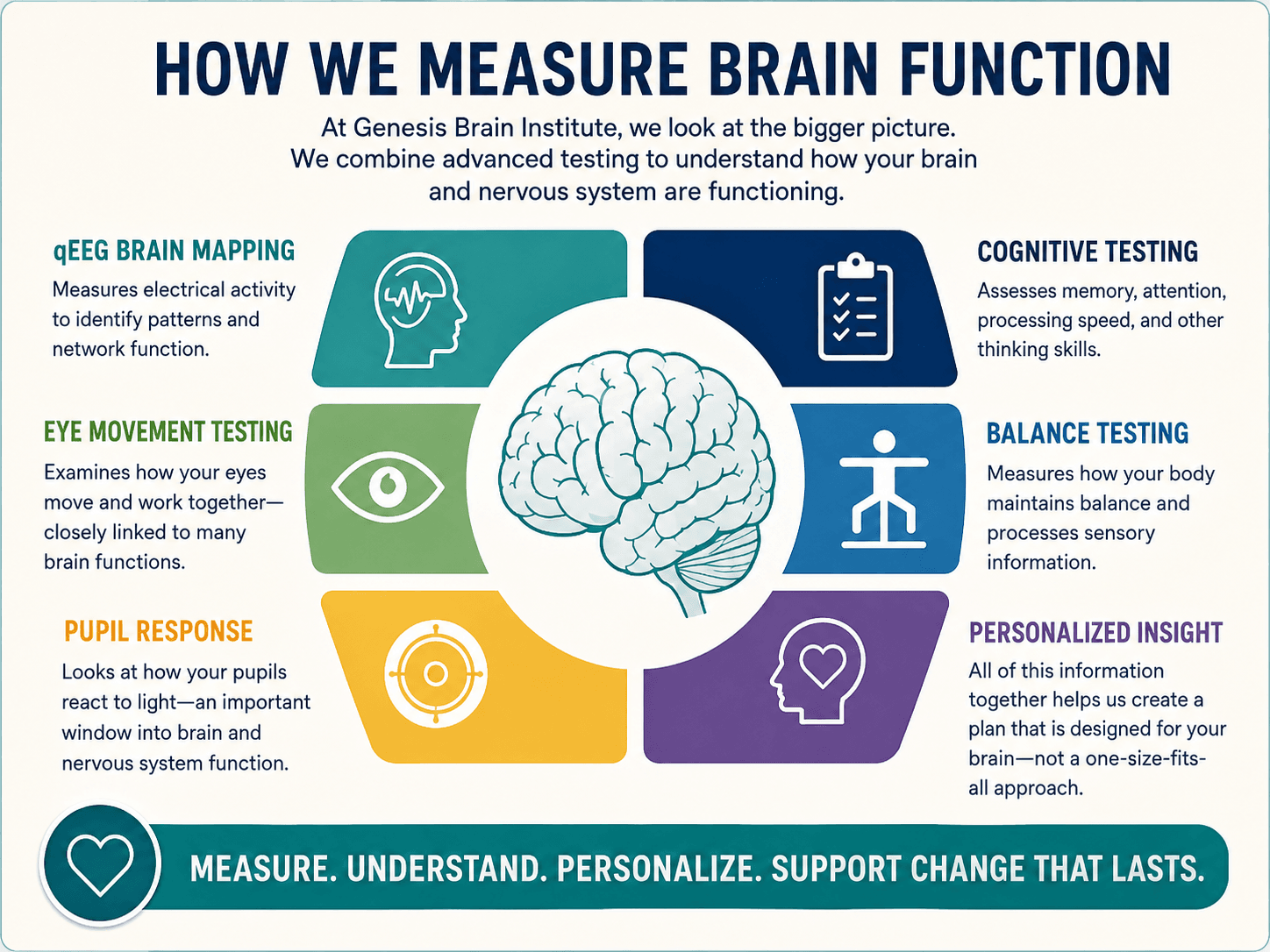
An MRI or CT scan can give doctors important information about the structure of the brain. A qEEG looks at something different. It records electrical activity from the brain and turns that information into data that can help clinicians study patterns of brain activity.
At Genesis Brain Institute, qEEG is not used by itself to diagnose someone. It is one piece of a larger picture that includes the person’s symptoms, medical history, goals, and other testing.
That larger picture can include cognitive testing, eye movement testing, balance testing, pupil response, and other measures of brain and nervous system function.
For example, two people might both say they are having trouble focusing. One person may struggle more with attention. Another may have issues with sleep, stress, visual processing, or another part of brain function.
The symptom sounds the same.
The pattern underneath it may not be.
That is why objective testing can add value. It gives the clinical team more information to consider instead of building a plan from symptoms alone.
And when we are talking about neuroplasticity, that matters.
Neuroplasticity tells us the brain has the ability to change. Testing can help us better understand what the brain is doing before deciding what we want to ask it to change.
We have also written more about how a qEEG brain map can provide information that structural imaging does not (read it here).
How to Retrain Your Brain With Neuroplasticity
If the brain can change, can you intentionally train it to function differently?
In many cases, that is exactly what brain rehabilitation is designed to do.
Neuroplasticity itself is not a treatment. It is the brain’s natural ability to learn, adapt, and change in response to experience and stimulation. Certain therapies use repeated feedback, movement, stimulation, or skill practice to give the brain opportunities to develop different patterns.
The right approach depends on what someone is experiencing, what objective testing shows, and what the clinical team is trying to improve.
1. Neurofeedback
Neurofeedback gives the brain information about its own electrical activity while a person watches a screen, listens to sounds, or completes another simple activity.
The person does not have to consciously control each brainwave. Instead, the brain receives feedback as certain patterns occur and gets repeated opportunities to regulate differently.
Think of it like practicing in front of a mirror. The mirror does not move your body for you. It gives you information that helps you adjust what you are doing.
Neurofeedback works on a similar principle by giving the brain information about its activity while training is taking place.
2. Biofeedback
Biofeedback focuses on signals from the body and nervous system.
It can measure things such as heart rate variability, breathing, muscle activity, or other physical responses. A person can then see or hear those changes while practicing skills such as slower breathing or relaxation.
For example, someone might watch a visual display change as their breathing and heart rate patterns shift.
That feedback can help make something happening inside the body easier to understand and practice.
The goal is to build a skill that eventually becomes easier to use during everyday life, not only while connected to the equipment.
3. Transcranial Magnetic Stimulation
Transcranial magnetic stimulation, commonly called TMS treatment, uses magnetic pulses to stimulate targeted areas of the brain.
TMS is used clinically for specific conditions, and the location, frequency, strength, and pattern of stimulation matter. It is not simply a matter of stimulating the brain and hoping something changes.
Repeated stimulation can influence activity in targeted brain networks, which is one reason neuroplasticity is an important part of understanding how TMS works.
The specific protocol should depend on the person, the clinical goal, and the type of treatment being provided.
4. Vestibular and Oculomotor Rehabilitation
Your brain constantly combines information from your eyes, inner ears, muscles, and joints to understand where your body is and how it should move.
When those systems are not working together well, rehabilitation can use specific eye movements, balance exercises, head movements, and coordination tasks to challenge them.
Imagine having trouble keeping your eyes focused while your head moves. Instead of simply telling the brain to get better at it, rehabilitation can create repeated situations where the brain gets to practice that exact skill.
Over time, the nervous system has more opportunities to adapt to the information it is receiving.
5. Physical and Skill Based Rehabilitation
Physical therapy, occupational therapy, speech therapy, sports training, and other forms of rehabilitation also depend heavily on the brain’s ability to learn.
A person may repeat a movement many times because the goal is not only to strengthen a muscle.
The brain also has to learn the timing, control, coordination, and sequence behind the movement.
The same principle applies to speech, vision, balance, handwriting, athletic skills, and many other abilities.
After certain injuries, the brain may even need to find a different way to complete a familiar task.
At Genesis Brain Institute in Tampa, we do not believe someone should choose a treatment simply because it is described online as a way to “rewire the brain.”
The more important question is: What does your brain need help doing?
One person may need more support with nervous system regulation. Another may struggle with balance, eye movements, attention, or another part of brain function. Someone else may have an entirely different pattern.
That is why understanding brain function first can matter.
Neuroplasticity gives the brain the ability to change. A personalized plan helps determine what we are asking the brain to practice.
Frequently Asked Questions About Rewiring Your Brain
Is Neuroplasticity Real?
Yes. Neuroplasticity is the brain’s ability to change its connections and organization in response to learning, experience, repeated activity, and certain forms of rehabilitation.
Scientists once believed the adult brain was far more fixed than we understand it to be today. We now know the brain continues adapting throughout life.
Can You Create New Neural Pathways?
Your brain can build and strengthen new patterns of communication between neurons.
That is part of what happens when you learn a skill, practice a movement, develop a habit, or train a different response to something familiar.
You are not creating a brand new brain. You are changing how parts of the brain communicate and work together.
Can Neuroplasticity Work Against You?
Neuroplasticity does not automatically move the brain in a healthy direction.
The brain can become more efficient at useful skills, but it can also become familiar with distraction, avoidance, certain stress responses, or other patterns you would rather change.
That is why repetition matters so much. The brain learns from what it experiences often.
Can You Rewire Your Nervous System?
The phrase “rewire your nervous system” is commonly used to describe learning different responses to stress, movement, sensory information, and other experiences.
Your brain and nervous system work together constantly. Through repeated practice, the nervous system can adapt how it responds to certain types of information.
That does not mean you can simply decide to turn off anxiety, trauma, pain, or another health condition. It means the nervous system has the ability to learn and adapt, which is one reason targeted rehabilitation and regulation training can be useful for some people.
Does qEEG Show Neuroplasticity?
A qEEG does not directly measure neuroplasticity.
It records electrical activity from the brain and helps clinicians look at patterns of brain function. When qEEG testing is repeated over time, clinicians can compare the recordings along with symptoms, cognitive testing, and other measures.
That distinction is important. Neuroplasticity describes the brain’s ability to change. qEEG is one tool that can provide information about brain activity.
Do You Have to Be Injured to Work on Neuroplasticity?
No.
Neuroplasticity is involved whenever the brain learns and adapts. Someone recovering from an injury may use that ability during rehabilitation, while an athlete, student, musician, or executive can use the same basic capacity to develop skills and improve performance.
You do not have to wait until something feels wrong to care about how your brain functions.
Your Brain Has More Capacity Than You Realize
Your brain is not a finished product.
It continues learning from what you practice, what you repeat, what you focus on, how you move, how you recover, and how you respond to the world around you.
That is the power of neuroplasticity.
It does not mean you can think your way out of every problem. It does not mean aging, injury, trauma, genetics, or health conditions suddenly stop mattering. And it certainly does not mean there is one trick that can completely “rewire” your brain.
What it does mean is that change remains possible.
Adults can build new neural pathways. The nervous system can learn different responses. Skills can become stronger with practice. The brain can adapt throughout life, and research on neurogenesis is giving us even more reason to rethink the old belief that the adult brain simply becomes fixed with age.
Most importantly, you do not have to wait until something is seriously wrong to start caring about your brain.
Protect your sleep. Move your body. Challenge yourself to learn. Take care of your gut and overall health. Protect your attention. Give your nervous system time to recover from stress. Be intentional about the patterns you repeat.
And if something feels off, do not assume you have to keep guessing.
At Genesis Brain Institute in Tampa, we believe understanding how the brain is functioning can be an important first step toward making more informed decisions about what comes next. Objective testing can help provide a more complete picture when symptoms, performance changes, or unanswered questions deserve a closer look.
Your brain has more capacity than you realize.
You cannot control everything that happens to it. But you can become more intentional about how you care for it, what you repeatedly ask it to do, and when you seek deeper answers about how it is functioning.
That is where hope begins.
Disclaimer: This content is for informational purposes only and does not constitute medical advice. Please consult with a licensed healthcare provider. Genesis Brain Institute is a Brain Treatment Center in Tampa offering non-pharmaceutical solutions that bring clarity, restore function, and offer real hope for those who feel lost, stuck, or simply want more from life.