Treatments for mental health problems should start with better answers.
If you are searching this, you are probably not looking for a textbook answer. You are looking for help. You want to know what can work. You want to know what options exist. Most of all, you want to know why the path you or someone you love has tried has not brought enough relief.
Maybe your child cannot focus, sleep, calm down, or make it through school without falling apart later. Maybe your teen seems anxious, sad, angry, numb, or withdrawn. Maybe it is you. You keep working, parenting, leading, smiling, and pushing through, but you still feel off.
Most people do not search for mental health treatment when life feels easy. They search when the pain becomes too loud to ignore. They want hope. They also want a plan that makes sense.
At Genesis Brain Institute in Tampa, we believe the first step should not be a rushed label or a generic plan. The first step should be a better picture of what is happening in the brain, body, and nervous system.
From there, better treatment decisions can become more personal, more focused, and easier to understand.
This article explains common treatments for mental health problems, why the same symptoms can need different care, how diagnostics can change the plan, and why Genesis Brain Institute starts with a full picture before building a treatment strategy.
What Are Treatments for Mental Health Problems?
Treatments for mental health problems can include counseling, lifestyle support, trauma support, nervous system training, brain based therapies, and medical care when needed. The right option depends on the person, their symptoms, their history, and what testing shows.
That last part matters because symptoms can look simple from the outside while the cause underneath is more complex. A child with focus problems, a veteran with trauma symptoms, an adult with anxiety, and an executive with brain fog can all look overwhelmed. Still, each person can need a different plan.
Some people need help with trauma. Some need help with sleep, stress, or emotional control. Others need counseling, brain training, nervous system support, or a plan that combines several therapies in the right order.
At Genesis Brain Institute, treatment is not viewed as one single tool. It is viewed as a strategy. The goal is to understand the pattern, then build a plan that fits the person.
Why Better Mental Health Treatment Starts With A Full Diagnostic Picture
Most people ask, “What treatment will help?”
Genesis Brain Institute state of the art treatment therapies all start with a better first question.
“What is driving the symptoms?”
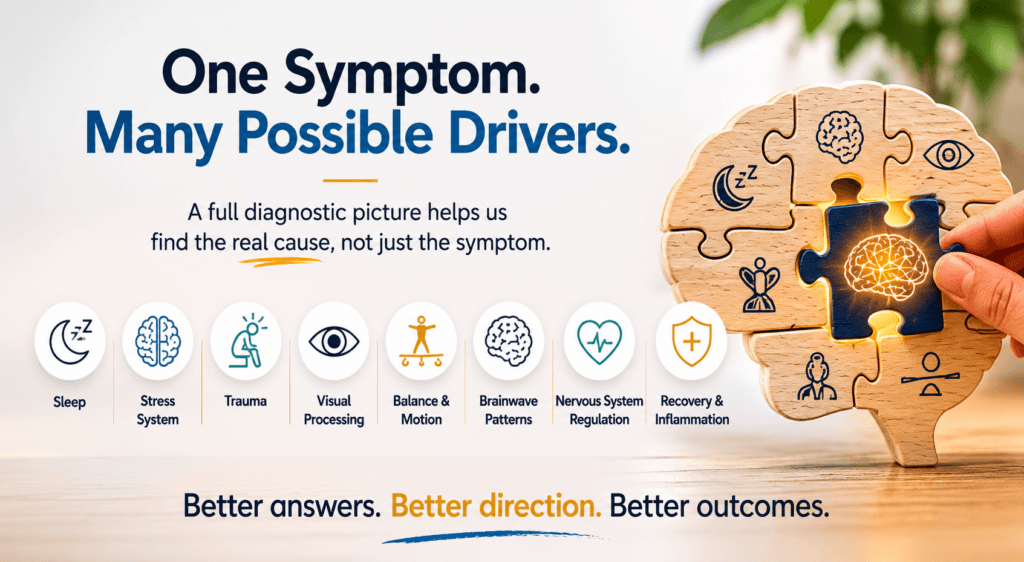
That question matters because one symptom can have several causes. Anxiety can connect to stress, trauma, poor sleep, sensory overload, or a body stuck in high alert. Focus problems can connect to attention, memory, eye tracking, sleep, stress, or emotional control. Brain fog can connect to poor sleep, concussion history, fatigue, inflammation, stress, or slow recovery.
That is why Genesis starts with a full diagnostic picture before choosing a treatment plan.
One test gives one clue. Several tests together can show the pattern.
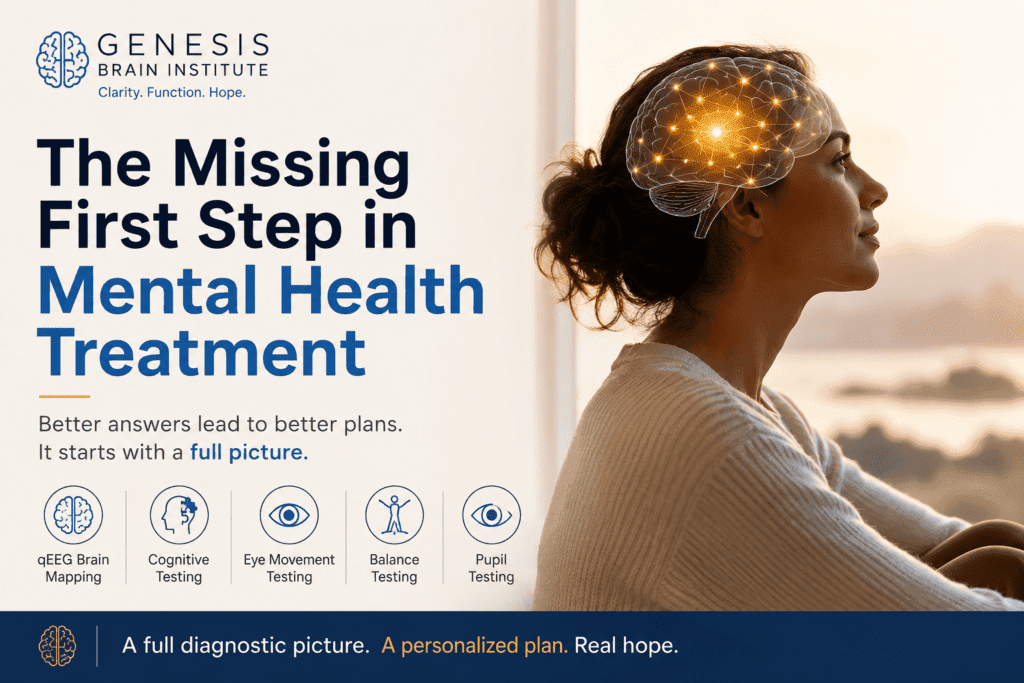
A qEEG Brain Map looks at brainwave patterns. It can help show areas that are running too fast, too slow, or not communicating well. Cognitive testing looks at attention, memory, speed, and decision making. Eye movement testing looks at how well the brain controls the eyes. This matters for reading, focus, movement, and busy places. Balance testing looks at how the brain uses the eyes, inner ear, and body position. Pupil testing gives clues about the stress system and how the body shifts between alert and calm.
Each test gives one piece of the story. Together, they create a clearer picture.
For example, a child who struggles with focus might have more going on than an attention problem. Testing might show weak working memory, poor eye tracking, high stress, and poor sleep. That changes the conversation. The child is not simply struggling to pay attention. Their brain and body are working too hard just to get through the day.
The same idea applies to adults. A person with anxiety can have more than anxious thoughts. Testing can show that the body has trouble calming down. It can show that busy places feel overwhelming because the brain struggles with motion, balance, or visual input. It can also show poor sleep, slow recovery, or a brain that is using too much energy to stay organized.
That person does not need a random treatment list. They need a plan that matches the pattern.
This is the Genesis difference. A treatment list tells you what options exist.
A full Quant360 Functional Analysis helps create the diagnostic picture. It helps show which options fit, which ones should come first, and why the plan makes sense.
“The value is not one test by itself. The value comes from seeing how the brain, body, and nervous system work together.”
What Most Mental Health Treatment Plans Miss
Many mental health treatment plans focus on how a person feels. However, they do not always check what could be driving those feelings.
That is where people get stuck. They try one thing. Then they wait. Then they try another thing. Then they wait again. Over time, they start to wonder if anything will help.
Sometimes the issue is not effort. Sometimes the plan was built without enough information.
Genesis Brain Institute looks for the missing pieces. Is the brain struggling to regulate? Is the body staying in stress mode too long? Is sleep poor? Are eye movements making reading, focus, or busy places harder? Is balance affecting how safe the body feels? Is attention really the issue, or is memory, speed, or fatigue the bigger problem?
These questions create better care decisions. They move the focus from symptom management to function.
When the full picture is clearer, the plan can become more specific.
Neurofeedback treatment can support brain regulation. Biofeedback can support nervous system control. TMS can stimulate targeted brain areas when appropriate. Hyperbaric Oxygen Therapy can support oxygen delivery and recovery. EMDR can help with trauma. Vestibular and oculomotor therapies can support balance, eye movement, and visual processing. Vagus nerve support can help the body shift toward recovery and calm.
The value is not having more tools. The value is knowing how to combine the right tools in the right order.
That is how mental health treatment becomes more than trial and error. It becomes a strategy built around the person.
How The Genesis Diagnostic Process Creates A Better Treatment Plan
The Genesis diagnostic process helps turn symptoms into a clearer plan.
That matters because symptoms alone can be misleading. A person can say, “I have anxiety,” but that does not tell the full story. Is the brain running too fast? Is the nervous system staying in stress mode too long? Is sleep poor? Is the visual system overwhelmed? Is balance making the body feel unsafe? Is trauma part of the story?
A person can also say, “I cannot focus,” but that does not give enough detail. Is the problem attention, working memory, processing speed, eye tracking, sleep, stress, or emotional control?
Diagnostics help answer those questions.
Dr. Emily Kalambaheti has explained that qEEG Brain Mapping, cognitive testing, balance testing, video oculography, and clinical review are stronger together than they are apart. One test can show one part of the picture. A full diagnostic process can help the team see how the parts connect.
That is where treatment becomes more intelligent.
One person with anxiety might need biofeedback treatment, vagus nerve support, sleep work, and counseling. Another might need neurofeedback, TMS, eye movement work, and support for sensory overload. Another might need trauma focused therapy and nervous system training. The symptoms can sound similar, but the plans can look different.
The same is true for students struggling with ADHD. Two students can both say, “I am not doing well in school.” One might struggle because of attention. Another might struggle because of depression and motivation. Another might struggle because reading takes too much energy. Another might struggle because the brain is tired, slow, or overloaded.
From the outside, it all looks like school trouble. Under the surface, the pattern can be very different.
That is why Genesis does diagnostics first.
The goal is not to label a person faster. The goal is to understand what kind of help fits.
Brain Based Treatments for Mental Health Problems
Brain based treatments for mental health problems are gaining attention because mood, focus, trauma, sleep, stress, and emotional control are connected to brain networks, nervous system function, and how the body responds under pressure.
This is where research supports the bigger conversation.
A 2023 review on neurofeedback for PTSD found that neurofeedback showed moderate benefit for PTSD symptoms, with positive effects also seen for depression and anxiety symptoms. That matters because it supports what Genesis sees clinically. When trauma, mood, and stress regulation involve the brain, brain based training deserves a serious place in the treatment conversation.
Biofeedback also has strong research support. Heart rate variability biofeedback helps train the body to shift out of stress mode and back toward regulation. A 2021 meta analysis found that HRV biofeedback improved depressive symptoms in adults. A 2023 review also described HRV biofeedback as a way to train breathing and autonomic regulation.
TMS is another brain based treatment backed by major medical sources. The National Institute of Mental Health explains that repetitive transcranial magnetic stimulation uses repeated magnetic pulses to stimulate brain circuits. NIMH also notes that brain stimulation therapies are used for certain mental disorders, often when other treatments have not helped enough.
Balance also matters more than most people realize. A 2025 systematic review and meta analysis of 85 studies found that adults with vestibular disorders had higher rates and risks of anxiety and depression than people without those disorders. In plain English, when the brain struggles with balance, motion, and body position, emotional health can suffer too.
This is why Genesis Brain Institute does not treat these therapies like separate one off options.
The value is not one therapy by itself.
The value is knowing how the therapies work together.
Neurofeedback can train brain regulation. Biofeedback can train nervous system control. TMS can stimulate targeted brain circuits. Hyperbaric Oxygen Therapy can support oxygen delivery and recovery. EMDR can help process trauma. Vestibular and oculomotor therapies can support balance, eye movement, visual processing, and sensory integration. Vagus nerve support can help the body shift toward recovery and calm.
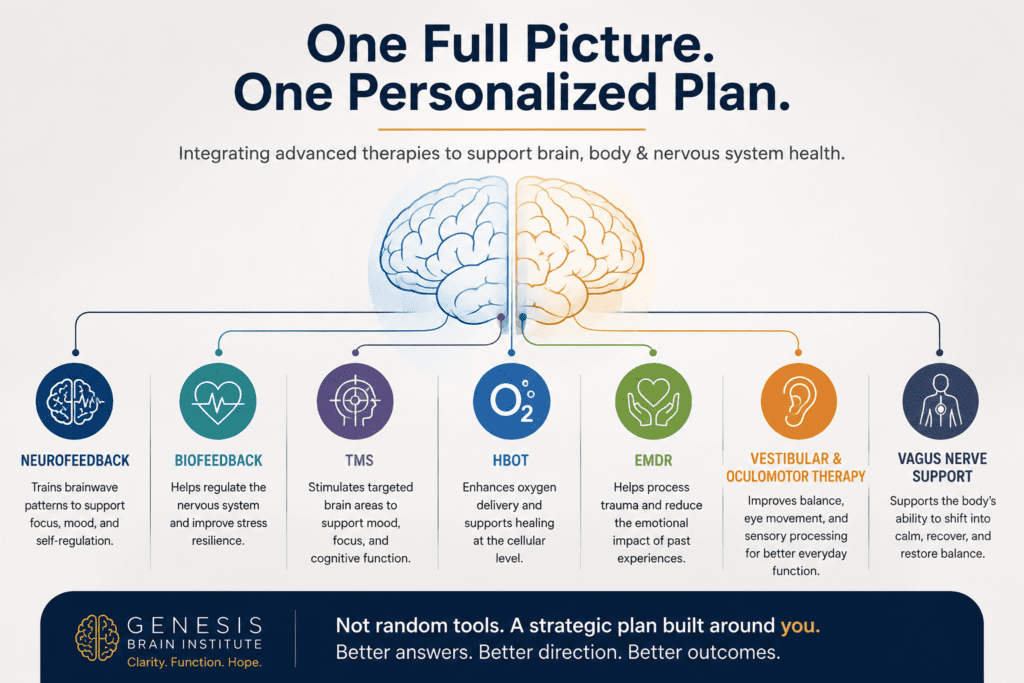
When these therapies are chosen from the full diagnostic picture, they are not random treatments sitting next to each other. They become part of one state of the art treatment plan for Mental Health.
That is the Genesis difference. A person is not handed one tool and told to hope it works. The Genesis team looks at the pattern, chooses the therapies that fit that pattern, and builds a plan where each part supports the next.
A full picture. A combined strategy. A plan built around the person.
Why Medication Should Not Be The Default First Answer
Medication can be part of mental health care for some people. Many people have used it, and no one should feel shamed for that.
But medication should not be the only conversation.
Too often, people are given a label and then moved straight toward symptom management. The deeper question can get skipped. Why is the person anxious? Why is the child distracted? Why is sleep so poor? Why does the body stay tense? Why does the brain feel foggy? Why does the person still feel off after trying the standard path?
Those questions matter.
Genesis Brain Institute is not anti doctor (we are doctors). Genesis is not anti counseling (we have a counselor for patients). Genesis is not here to shame any family for the choices they have made. The goal is to give people more information before the next decision is made.
This is especially important for parents. A child with ADHD symptoms can have several possible patterns. Dr. Emily has explained that even when children meet criteria for the same diagnosis, the symptoms can come from different areas of struggle. One child can be inattentive because of poor regulation. Another can struggle because of slower processing. Another can struggle because mood, sleep, or sensory overload is affecting school.
If the pattern is different, the plan should be different.
That is why Genesis believes the first step should be better answers. When the diagnostic picture is clearer, the care plan can become more thoughtful. For some people, that plan can include counseling. For others, it can include neurofeedback, biofeedback, TMS, HBOT, EMDR, vestibular therapy, oculomotor therapy, lifestyle support, or several tools together.
The goal is not to replace every path. The goal is to stop making medication the default answer before the brain and body have been understood.
What If You Have Tried Mental Health Treatment And Still Feel Stuck?
Many people come to Genesis Brain Institute in Tampa after they have already tried other options.
They have tried mental health counseling. They have tried lifestyle changes. Some have tried medication. Some have tried vision therapy, occupational therapy, biofeedback, or other forms of support on their own. They are not new to effort. They are tired of trying pieces that never seem to come together.
That is an important point.
Sometimes people do not need another isolated tool. They need a team that can look at the full picture and build one plan.
Biofeedback is a good example. By itself, it can help people learn how their nervous system responds to stress. But inside the Genesis model, biofeedback can work with other therapies. Neurofeedback can help the brain regulate. TMS can stimulate targeted regions. HBOT can support recovery. Vestibular and oculomotor therapies can help with balance, eye movement, and sensory processing. Vagus nerve support can help the body return toward calm.
When the tools work together, the person is not chasing one thing after another.
They are following a strategy.
That is why people who feel stuck should not assume they are out of options. Sometimes the missing piece is not effort. Sometimes the missing piece is integration.
Genesis looks at how the systems connect. Then the team builds a plan that supports the person from more than one angle.
Is There A Cure For Mental Health Problems?
Many people search for cures for mental health, cures for mental illness, how to cure mental illness, remedies for mental illness, and how to heal mental illness because they want relief.
That is human.
When someone is hurting, they do not want a lecture. They want hope. They want their child back. They want their sleep back. They want their focus back. They want to feel like themselves again.
Still, no honest clinic should promise one cure for every mental health problem.
Mental health challenges can involve the brain, body, nervous system, trauma, sleep, inflammation, relationships, stress, and life history. Because of that, the answer should be personal.
The better goal is not to chase a miracle word. The better goal is to understand what is happening, build the right plan, and support better function over time.
For some people, that means less stress. For others, it means better sleep, focus, emotional control, memory, school function, work performance, or resilience. For others, it means finally having language for what their body has been trying to tell them.
At Genesis Brain Institute, hope is not hype. Hope comes from a better picture, a better plan, and the belief that people deserve to be seen, heard, and helped.
When Mental Health Symptoms Need Immediate Help
Some situations need urgent support.
If someone is in danger, talking about self harm, planning to hurt themselves, planning to hurt someone else, or unable to stay safe, do not wait. Call 988 in the United States for the Suicide and Crisis Lifeline. Call 911 in an emergency. You can also go to the nearest emergency room.
There is no shame in urgent help.
A crisis needs fast support. After safety is restored, a deeper care plan can begin.
Treatments For Mental Health Problems In Tampa
If you are searching for treatments for mental health problems in Tampa, you do not need another generic answer.
You need a better first step.
Genesis Brain Institute helps people look at mental health through the brain, body, and nervous system. The process begins with diagnostics because the team wants to understand the pattern before building the plan.
That can matter for children with focus or behavior struggles, teens with anxiety or depression symptoms, adults with stress or brain fog, veterans with trauma symptoms, athletes seeking stronger performance, and aging adults who want better brain health.
The goal is not to force every person into the same path. The goal is to build care around what the person is showing.
That is why Genesis starts with a full picture.
Frequently Asked Questions About Treatments for Mental Health Problems
What are the most common treatments for mental health problems?
Common treatments for mental health problems can include counseling, lifestyle support, trauma support, nervous system training, brain based therapies, and medical care when needed. At Genesis Brain Institute, the plan starts with diagnostics so the team can better understand what kind of support fits the person.
How are mental health problems treated?
Mental health problems are treated in different ways based on the person. Some people need counseling. Others need help with sleep, stress, trauma, focus, brain regulation, or nervous system control. Genesis Brain Institute uses testing to help guide a plan that fits the person’s pattern.
Why does Genesis Brain Institute start with diagnostics?
Genesis starts with diagnostics because symptoms alone do not always explain what is happening. qEEG Brain Mapping, cognitive testing, eye movement testing, balance testing, pupil testing, history, and clinical review can help show how the brain and body are working together.
What is the value of doing several tests together?
Each test gives one part of the story. When the tests are put together, the team can see a fuller pattern. That can help explain why a person feels anxious, distracted, foggy, overwhelmed, or unlike themselves. It can also help guide which therapies should work together.
Are brain based treatments used for mental health problems?
Yes, brain based treatments are used in mental health care. Research supports options such as neurofeedback, biofeedback, TMS, and vestibular related care for certain symptoms and conditions. At Genesis, these tools are chosen based on the diagnostic picture.
What if I tried treatment before and still feel stuck?
If you tried mental health treatment before and still feel stuck, it does not mean you are out of options. It can mean the plan needs a better picture. Genesis Brain Institute looks at the brain, body, and nervous system together so the next step can be more personal.
The Bottom Line: Better Treatment Starts With Better Understanding
Treatments for mental health problems should not start with a guess.
They should start with a better understanding of the person.
That is the heart of the Genesis Brain Institute approach. A symptom tells you something needs attention, but it does not always tell you what kind of help fits. A label can name the struggle, but it does not always explain the pattern. A treatment list can show what options exist, but it does not tell you which options belong together.
That is why diagnostics matter.
A qEEG Brain Map, cognitive testing, eye movement testing, balance testing, pupil testing, history, and clinical review can each give part of the picture. When those pieces come together, the plan can become more than trial and error. It can become a strategy.
Genesis Brain Institute is here to help people move from confusion to clarity, from surface level answers to deeper understanding, and from feeling stuck to seeing a real path forward.
If you or someone you love has tried the usual path and still feels off, it might be time for a better first step.
Not more guessing. A fuller picture. A plan built around the person.
Disclaimer: This content is for informational purposes only and does not constitute medical advice. Please consult with a licensed healthcare provider. Genesis Brain Institute is a Brain Treatment Center in Tampa offering non pharmaceutical solutions that bring clarity, restore function, and offer real hope for those who feel lost, stuck, or simply want more from life.