How to get rid of the yips can feel impossible when a skill you have trusted for years suddenly stops working under pressure.
That is what makes the yips so frustrating. The athlete usually knows what to do. The brain and body have practiced the movement hundreds or even thousands of times. Yet when the moment arrives, the hands tighten, the mind speeds up, and a movement that once felt automatic starts to feel forced.
J.T. Poston recently gave sports fans a powerful example of how quickly elite performance can unravel.
Only three weeks after winning the Memorial Tournament in a playoff, Poston reached a greenside bunker in two shots on the par five 13th hole at the Travelers Championship. He was only about 80 feet from the cup, but his third shot stopped short of the green. His next chip went into the water. Two more attempts after penalty drops rolled back into the pond, and Poston eventually recorded a 12.
We do not know whether J.T. Poston had the yips. One disastrous hole does not give us enough information to make that claim.
However, what happened next makes the story worth studying.
Poston bounced back with a par on the 14th hole, but he could not fully regain control of the round. He double bogeyed the 15th and finished with a 6 over 76, dropping to 69th place.
It happens to the best.
A golfer can lose trust in a putt. A pitcher can suddenly struggle to make a routine throw. A basketball player can freeze at the free throw line. A kicker can miss once and begin thinking about that miss before every attempt that follows.
The skill may still be there. The problem may be that pressure has changed how the brain and body access it.
Below, we will return to J.T. Poston’s round and look at what may happen inside an athlete’s brain when one mistake starts affecting the next. We will also explore what causes the yips, how athletes can interrupt a performance spiral, and how breathing, visualization, neurofeedback, recovery support, and personalized care may help create a path back to peak performance.
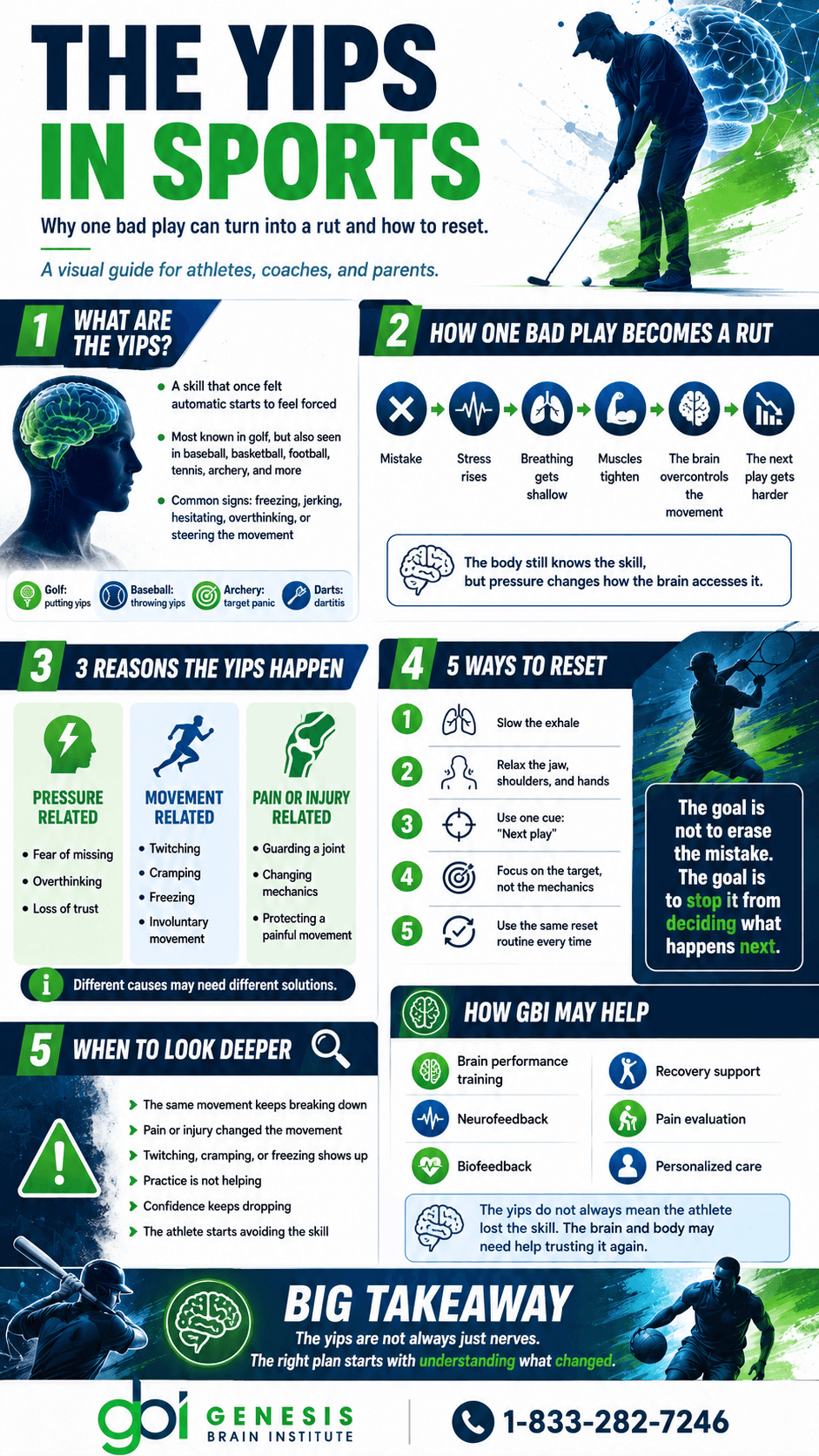
What Are the Yips in Sports?
The term yips is most closely linked to golf, especially putting and chipping. A golfer may stand over a short putt they have made hundreds of times, yet suddenly jerk the club, freeze before contact, or feel unable to complete a smooth stroke.
However, the same type of performance block can appear in many sports.
In baseball, it is often called the throwing yips. A pitcher may lose control of the strike zone, or a catcher may struggle to make a routine throw back to the pitcher. Archers often use the term target panic when they freeze, rush the shot, or release before they are ready. In darts, a similar problem is commonly called dartitis, which may make it difficult for a player to release the dart. Researchers have also reported yips related problems in cricket, tennis, basketball, bowling, and other sports that depend on precise timing and control.
The name may change, but the experience often feels similar.
A movement that once happened without much thought suddenly becomes difficult to trust.
Some athletes feel a twitch, tremor, cramp, or sudden freeze.
Others begin thinking about every small part of the movement. Instead of letting the body perform a skill it already knows, the athlete tries to guide, force, or control it.
Still, not every missed shot, wild throw, or bad game is the yips. Every athlete makes mistakes, including the best athletes in the world. The yips become a greater concern when the same movement keeps breaking down, often in the same situation or under the same type of pressure.
One athlete may be dealing with fear and overthinking. Another may have an involuntary movement. Someone else may be protecting an injury or changing the movement because of pain. From the stands, these problems can look alike. Inside the athlete’s brain and body, they may be very different.
That is why the word yips is only the start of the conversation. It describes what the athlete is experiencing, but it does not always explain the cause or reveal the best path forward.
What Causes the Yips in Athletes?
There is no single cause of the yips.
For years, many people treated the problem as a simple case of nerves. An athlete became anxious, started thinking too much, and lost confidence. That explanation may fit some people, but it does not fit everyone.
Researchers often place the yips into three broad groups: performance related, movement related, or a combination of both.
Performance Related Yips
Some athletes experience the yips when pressure pulls a trained movement out of automatic mode.
Think about walking down a staircase. You normally do not tell each muscle when to move. Your brain and body handle the pattern in the background.
Now imagine trying to control the angle of your ankle, the bend of your knee, and the placement of every toe. A movement you have performed your entire life would start to feel awkward.
The same thing can happen during a putt, throw, serve, kick, or free throw. The athlete begins watching and controlling every part of the motion. Instead of trusting the skill, the athlete starts steering it.
Fear can add another layer. The athlete remembers the last miss and starts thinking about what could go wrong before the next attempt begins. That thought can change breathing, muscle tension, grip, attention, and timing.
The last result starts predicting the next one.
As stress rises, the nervous system may move toward fight or flight. The brain begins preparing the body to escape danger when the athlete actually needs calm focus, control, and precision.
Movement Related Yips
Other athletes experience movements they do not feel able to control.
These may include jerking, twisting, cramping, shaking, freezing, or unusual muscle tightening during one specific task. In some cases, this may be connected to a condition called task specific dystonia.
Task specific means the problem appears during one movement. An athlete may move normally throughout the day but struggle when holding a putter, throwing a baseball, releasing a dart, or drawing a bow.
This is one reason the problem should not always be dismissed as anxiety. An athlete may become anxious because the hand jerks or freezes, rather than anxiety causing the movement in the first place.
Mixed Yips
Many athletes may fall somewhere between the two groups.
A small physical mistake creates fear. Fear creates tension. Tension changes the movement. The next mistake then creates more fear.
Soon, the athlete becomes trapped in a loop.
A 2025 study in Frontiers in Sports and Active Living described the yips as potentially physical, psychological, or a mix of both. The researchers also stressed that much remains unknown about the causes and best treatments. Their study involved only 14 golfers, including four with the yips, so the findings should guide future questions rather than provide a final answer.
Pain and past injuries can also play a role. An athlete may shorten a swing, change a release, or guard a joint because the movement once hurt. Even after the pain improves, the protective pattern may remain.
The main lesson is simple: two athletes can show the same outward problem for very different reasons.
One may need help reducing pressure and rebuilding trust. Another may need a closer look at involuntary movement. Someone else may need care for pain, injury, or recovery.
That is why understanding the cause matters before anyone decides how to fix the yips.
How the Yips in Sports Can Turn One Mistake Into a Performance Spiral
One mistake can change more than the score. It can change what the athlete expects to happen next.
J.T. Poston’s round gives us a strong example. We cannot say he had the yips, but after recording a 12 on the 13th hole, he made par on the next hole and then double bogeyed the 15th. Only weeks earlier, he had won a PGA Tour event. His skill had not vanished, but the round had become harder to regain.
This type of spiral can happen in any sport. A pitcher throws one wild pitch and begins aiming instead of throwing. A basketball player misses two free throws and starts thinking about the crowd. A quarterback misses an open receiver and becomes hesitant on the next pass. A kicker misses once and feels the leg tighten before the next attempt.
Under pressure, attention can shift away from the target and toward the mistake. The athlete may start thinking about mechanics, embarrassment, the score, or what could go wrong. Breathing becomes shallow, muscles tighten, and a movement that normally feels automatic starts to feel controlled.
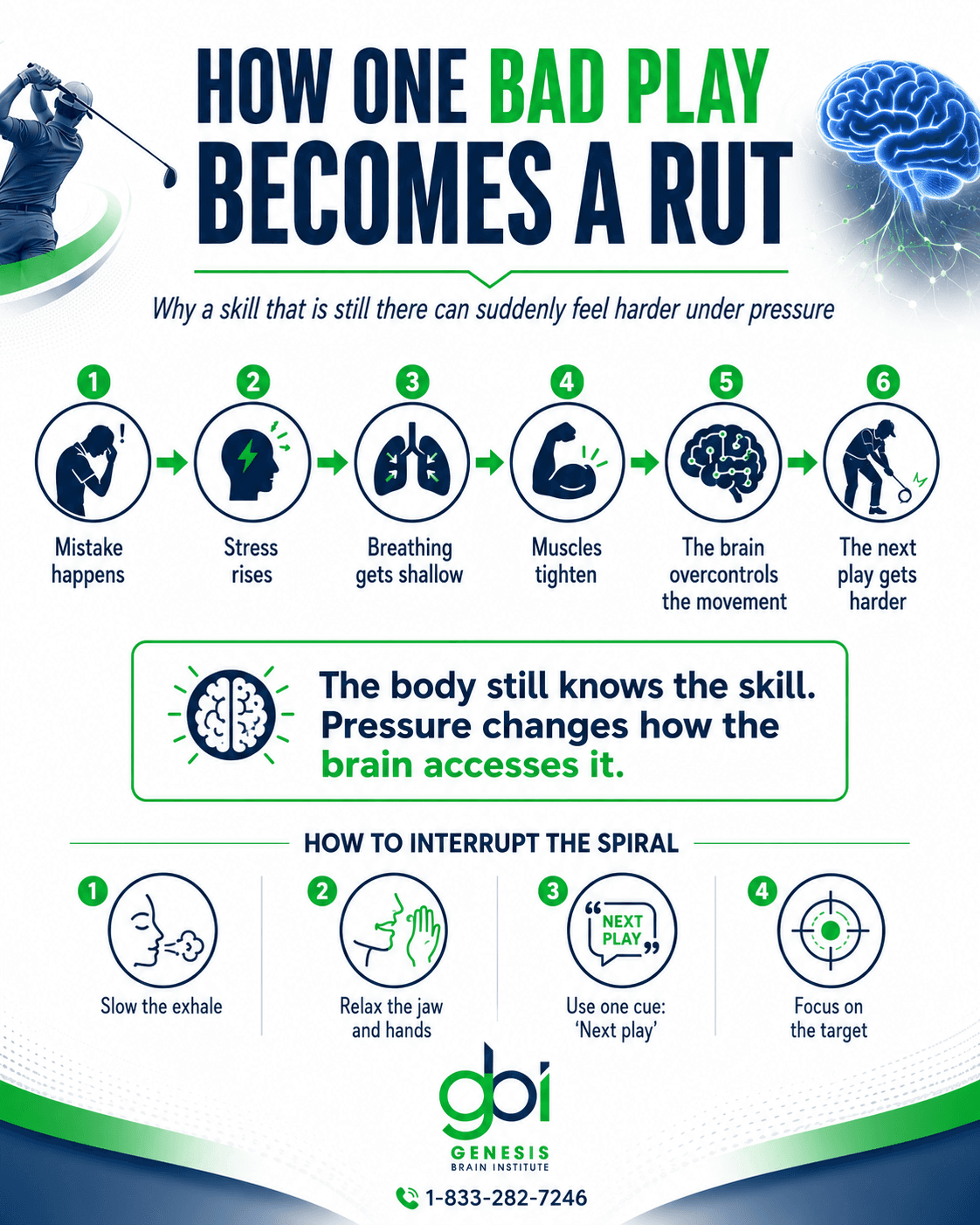
That is why recovery is a performance skill.
Sports teams use timeouts to slow the game down, reset attention, and prepare for the next play. Individual athletes need their own version of a timeout. It may be one slow breath, a short phrase, a step away from the action, or a clear visual target.
The goal is not to erase the mistake. It is to stop the mistake from deciding what happens next.
The next play begins with how well the athlete recovers from the last one.
How to Stop the Yips During Competition
Learning how to stop the yips starts with helping the brain and nervous system return to a more controlled state.
At Genesis Brain Institute, we view the yips as more than a confidence problem. An athlete may still have the skill, but pressure can change breathing, muscle tension, attention, timing, and movement.
The goal during competition is to interrupt that stress response before it takes over the next play.
Use Breathing to Regulate the Nervous System
Slow breathing can help reduce physical tension and move the body away from a fight or flight state.
Try breathing in for four seconds, then breathing out for six to eight seconds. Repeat this two or three times before the next shot, throw, serve, or kick.
The longer exhale matters because it helps the body slow down. This is one reason breathing and biofeedback for athletes can be useful. Biofeedback allows athletes to see changes in heart rate and stress responses while learning how to regulate them.
Use One Performance Cue
When the brain feels overloaded, more instructions usually create more tension.
Choose one short cue:
“Next play.”
“Trust the movement.”
“Smooth and steady.”
“See it and go.”
A simple cue gives the brain one job. It also helps move attention away from the mistake and back toward the next action.
Focus on the Target
Athletes with the yips often begin thinking about every part of the movement. That can turn an automatic skill into a forced one.
Instead, direct attention outside the body.
A pitcher can focus on the catcher’s glove. A basketball player can focus on the back of the rim. A golfer can focus on the line. A kicker can focus beyond the uprights.
This helps the brain return to performance mode instead of staying trapped in self correction.
Release Muscle Tension
Pressure often shows up in the body before the athlete notices it.
Check the jaw, shoulders, hands, and grip. Then release the tension before the next attempt.
This matters because the brain, body, and nervous system work together. A tight grip or stiff shoulder can change timing even when the athlete knows the correct movement.
Use a Repeatable Reset Routine
A short reset routine gives the brain something familiar to follow under pressure.
Step away.
Take one slow breath.
Relax the hands.
Choose the target.
Use one cue.
Then perform.
The routine should stay simple. Athletes should practice it before they need it in competition.
Train the Brain Between Competitions
An in game reset can help in the moment, but athletes with repeated performance blocks may need deeper training.
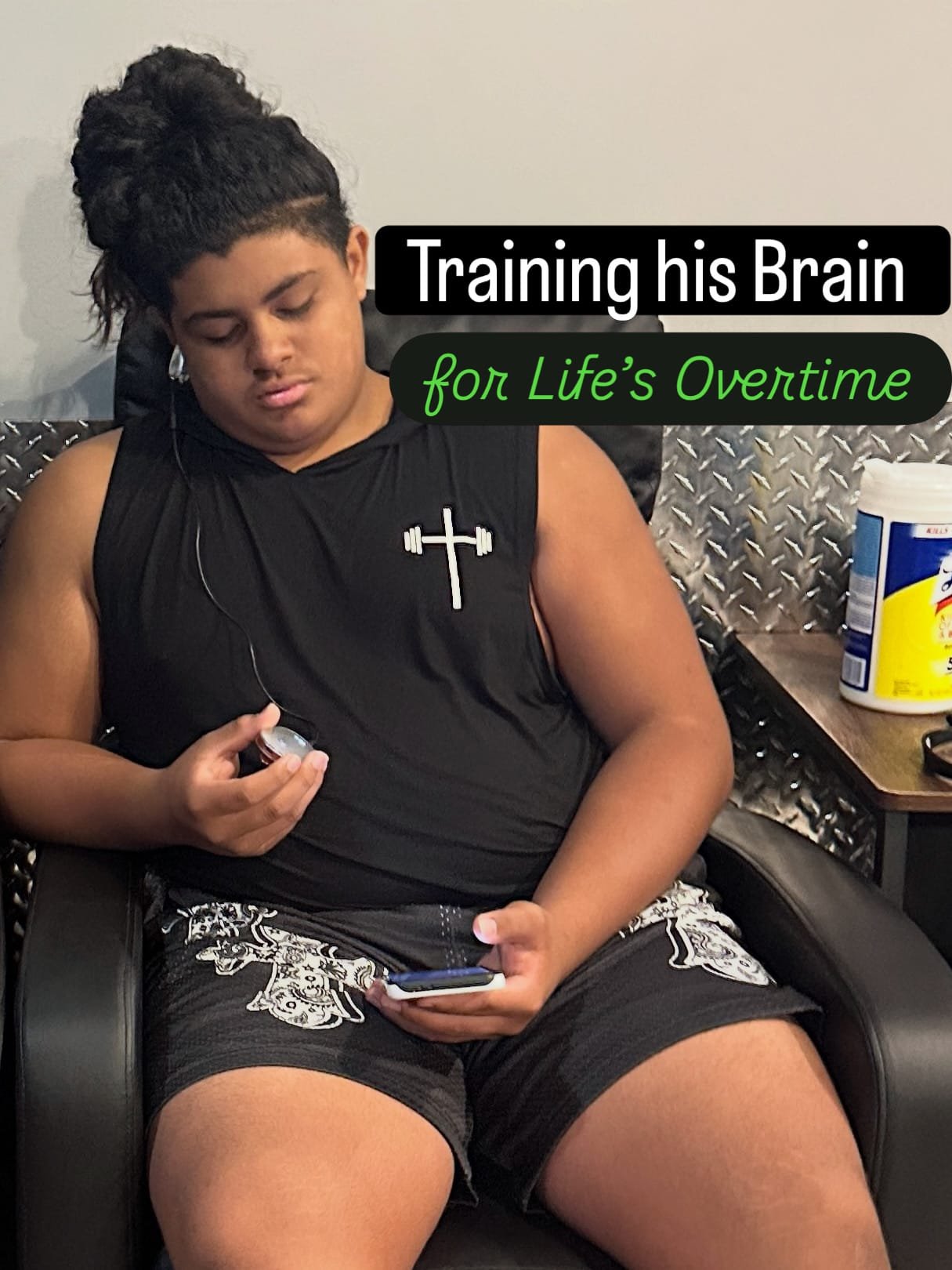
At Genesis Brain Institute, brain performance training for athletes may include neurofeedback, biofeedback, nervous system regulation, visualization, reaction training, recovery support, and objective testing when needed.
Neurofeedback can help athletes train brain activity tied to focus and regulation. Biofeedback can help them see how stress affects the body. Together, these tools may help the athlete practice staying composed before pressure reaches its highest point.
The goal is not to make an athlete think less.
The goal is to help the brain and body work together again.
Can Neurofeedback Help Athletes Overcome the Yips?
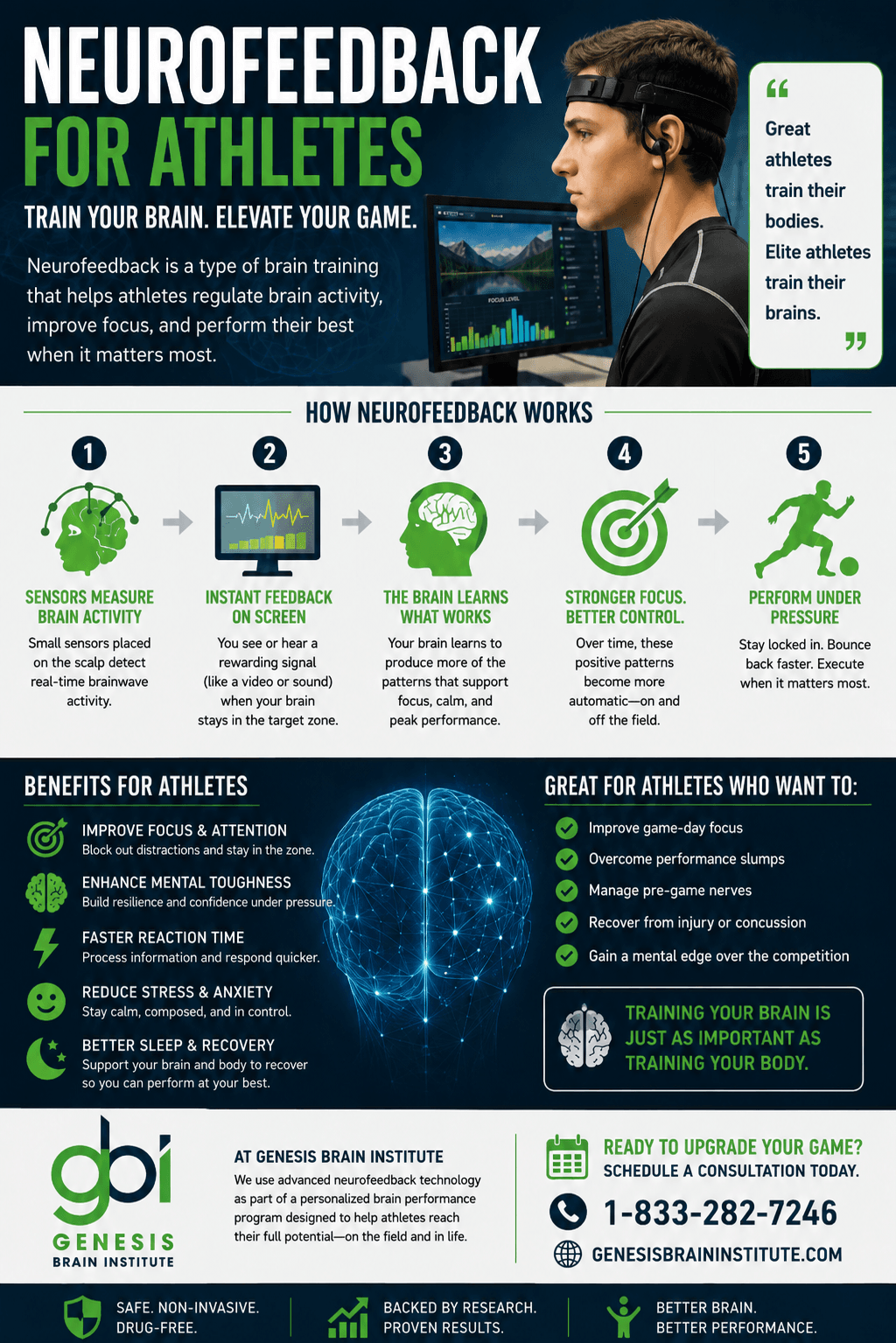
Neurofeedback trains the brain to recognize and change patterns linked to focus, movement, and self regulation.
Sensors placed on the scalp measure brain activity while the athlete watches a video or completes a task. The feedback changes in real time. For example, the screen may become clearer when the brain moves toward the desired pattern and dim when it moves away.
Think of it as a mirror for brain activity. The athlete is not being told to “calm down.” The brain receives immediate feedback and practices returning to a more useful state.
That may matter for the yips because skilled performance depends on neural efficiency. The brain needs to focus on the target, prepare the movement, block distractions, and avoid using more effort than the task requires. When an athlete begins overthinking, the brain may add noise to a movement that once ran automatically.
What a 2025 Golf Study Found
A 2025 randomized trial studied 42 competitive golfers. Half completed 16 neurofeedback sessions, while the other half received no training. After the program, the neurofeedback group showed changes in brain activity connected to motor execution, visual processing, emotional control, and spatial awareness.
The researchers said the pattern suggested less cortical overload and more efficient use of brain resources.
The study did not test the yips directly, and it did not prove that neurofeedback improves every athlete’s performance. It does show why neurofeedback is gaining attention in precision sports where focus, timing, motor control, and emotional regulation must work together.
A separate 2025 systematic review and meta analysis found an overall positive effect of EEG neurofeedback on sports motor performance. However, the researchers also noted that study methods and training protocols still vary, which means stronger research is needed.
How Genesis Brain Institute Uses Neurofeedback for Athletes
At Genesis Brain Institute, neurofeedback is not treated as a generic relaxation program.
The team first looks at the athlete’s history, the movement that breaks down, when the problem appears, and whether pain, injury, sleep, stress, or past concussion may be involved. Objective brain and performance testing may also help identify patterns that deserve attention.
The athlete may then complete neurofeedback while watching the sport or movement connected to the problem. This creates a chance to mentally rehearse performance while the brain practices staying regulated.
The goal is not to erase pressure. Competition will always create pressure.
The goal is to help the athlete’s brain stay efficient enough to access the skill already built through years of training.
How Connor Used Neurofeedback to Get Over the Yips
Connor, a lead neurotherapy technician at Genesis Brain Institute, already knew how to play golf. His problem was not a lack of skill. It was a mental block that began interrupting a game he had worked hard to improve.
He described the frustration clearly:
“I was in a good spot, and I just had mental blocks. They were so weird. I needed to do something, or I wasn’t going to play this game anymore.”
During neurofeedback sessions, Connor watched skilled golfers compete. He focused on how they approached each shot, moved through the swing, and handled the game mentally.
Connor explained it this way:
“I felt like I was processing my way through the golf swing and watching it happen.”
The training gave him a chance to rehearse golf while his brain received feedback about its activity. Instead of only practicing the physical swing, he also trained the focus and regulation needed to perform it.
Connor said he began noticing improvement after roughly five focused neurofeedback sessions. He continued training from there as his golf game became more consistent.
His experience highlights an important point about how to get over the yips: the athlete may not need to rebuild the entire movement. In some cases, the brain state connected to that movement may need to be retrained.
Connor’s results are personal to him. They do not mean every athlete with the yips will need neurofeedback or experience the same outcome. However, his story shows how brain training may become part of a broader sports performance plan.
How to Fix the Yips When Pain or Injury Changes Movement
Not every case of the yips starts with fear. Sometimes pain changes the movement first.
An athlete may grip harder to protect a sore wrist, shorten a swing because of shoulder pain, shift weight away from an injured knee, or hesitate because a motion once caused a sharp jolt. After enough repetition, that protective movement can become the new pattern.
Even when the pain improves, the brain may still expect the movement to hurt.
That is why Dr. Christopher Gleis, Medical Director and Director of Interventional Pain at Genesis Brain Institute, starts by listening to the athlete rather than assuming the problem is mental.
“I listen to the patient first and forget everything else. I forget what I know and what I think, and I don’t try to diagnose the patient before they even get to start to tell me what’s wrong.” — Dr. Christopher Gleis
A physical evaluation may explore when the pain started, which part of the movement triggers it, whether the athlete changed technique, and whether the body can complete the motion without guarding.
For example, a baseball player may struggle with the throwing yips because the shoulder no longer moves freely. A golfer may slow down through impact because the wrist or back expects pain. A kicker may lose timing after changing the motion to protect a hip or knee.
In those cases, telling the athlete to relax does not address the full problem.
Can Stem Cell Therapy Help an Athlete With the Yips?
Stem cell therapy is not a direct treatment for the yips. However, regenerative medicine may play a role when pain or damaged tissue is changing the athlete’s movement.
Dr. Gleis may discuss restorative or regenerative options for carefully selected patients. Depending on the injury, these options may include platelet rich plasma or stem cell therapy as part of a larger medical plan.
The goal is not to treat a mental block with stem cells. The goal is to determine whether a joint, tendon, ligament, or other physical problem is forcing the athlete to guard the movement.
That distinction matters.
An athlete may believe the problem is confidence when the shoulder cannot move through its normal range. Another may blame anxiety when the wrist tightens because the body expects pain. Over time, the physical change and the fear of another mistake can become tied together.
Regenerative medicine for athletes continues to be studied, and the evidence differs by injury, treatment, and patient. A careful evaluation should come before any recommendation.
The better question is:
Is pain or an old sports injury causing the yips by changing how the athlete moves?
At Genesis Brain Institute, in Tampa Florida, the goal is to understand the full pattern before choosing the treatment. The brain, nervous system, joints, muscles, pain response, and movement history may all be part of the same performance problem.
What Is the Best Treatment for the Yips?
There is no single best treatment for the yips because athletes can reach the same performance block for different reasons.
At Genesis Brain Institute, the first goal is to identify what is disrupting performance. The plan should match the cause rather than treating every athlete as though the problem is only confidence.
When Pressure Is Taking Over
An athlete who tightens up only during competition may benefit from nervous system training.
This can include breathing exercises, biofeedback, mental performance coaching, visualization, and a repeatable reset routine. Biofeedback helps the athlete see how stress changes heart rate and regulation, then practice returning to a more controlled state.
When the Brain Is Overthinking the Movement
Neurofeedback may help when focus, emotional control, or performance anxiety interferes with an automatic skill.
The athlete can train brain regulation while watching the sport, visualizing the movement, or preparing for the situation that usually causes the block. The goal is to help the brain stay efficient under pressure rather than consciously controlling every part of the motion.
When Pain or Injury Changes the Movement
Pain care, physical rehabilitation, and movement retraining may be more important when the athlete is guarding a shoulder, wrist, hip, knee, or back.
Dr. Christopher Gleis may also evaluate restorative or regenerative options when an underlying tissue or joint problem affects movement. Treating the physical problem may help the athlete rebuild trust in the motion.
When Recovery Is Part of the Problem
Poor recovery can affect reaction time, focus, decision making, muscle control, and emotional regulation.
Depending on the athlete’s health and injury history, Genesis may consider Hyperbaric Oxygen Therapy for athletic recovery as one part of a larger plan. HBOT allows the athlete to breathe oxygen inside a pressurized chamber, increasing the amount of oxygen available in the bloodstream.
HBOT is not a direct treatment for the yips. Its possible role is to support recovery when muscle injury, physical stress, inflammation, or a past concussion may be affecting performance.
A 2025 systematic review and meta analysis examined seven clinical trials involving exercise related muscle injury and soreness. The findings suggest HBOT may support some parts of physical recovery, but the research remains limited and results differ across studies.
When the Movement Is Involuntary
Twitching, cramping, tremors, twisting, or freezing should not automatically be treated as performance anxiety.
These symptoms may require an evaluation from a neurologist or movement disorder specialist to rule out task specific dystonia or another medical condition.
The best yips treatment is not the one with the most technology. It is the one that fits what is actually stopping the athlete from performing.
At Genesis Brain Institute, that may involve brain performance training, nervous system regulation, recovery support, pain care, physical rehabilitation, or collaboration with another specialist. The athlete’s history, symptoms, goals, and testing should guide the plan.
How Long Does It Take to Get Over the Yips?
There is no universal timeline because the yips do not affect every athlete in the same way.
A golfer who recently developed a putting problem may respond quickly to a reset in routine and attention. A baseball player who has struggled with throwing for years may need a longer process that includes movement work, pressure training, and nervous system regulation.
Progress often happens in stages.
First, the athlete begins to notice the trigger. Next, the body learns how to stay calmer during the movement. Finally, the new response has to hold up when the pressure returns.
That last step matters most.
An athlete may look better in practice but still struggle when the score counts, the crowd is watching, or the fear of another mistake returns. Real progress means the skill becomes reliable again in the setting where it broke down.
Some athletes feel a shift within a few sessions. Others need a longer period of focused training. The goal is not to chase a perfect timeline.
The goal is to make the movement feel automatic, trusted, and available again when it matters.
Can You Cure the Yips?
Some athletes fully overcome the yips. Others learn how to manage the trigger so it no longer controls their performance.
The word cure can be misleading because the yips are not one single condition. A golfer who begins overthinking a putt may need a different approach than a baseball player whose hand freezes during a throw.
A better sign of recovery is not simply making one good shot or completing one clean movement. It is being able to perform the skill again without fear taking over before every attempt.
An athlete may be moving in the right direction when:
- The movement feels less forced
- Mistakes no longer create panic
- Confidence begins returning
- The skill holds up under pressure
- The athlete stops avoiding the movement
- A bad attempt no longer ruins the next one
Sudden twitching, cramping, tremors, freezing, weakness, or pain deserve a closer medical evaluation. Those signs may point to more than a performance block.
At Genesis Brain Institute, the goal is not to promise a quick cure for the yips. The goal is to understand what changed and help the athlete build a path back to reliable performance.
Getting past the yips does not always mean the athlete never feels pressure again.
It means pressure no longer decides the outcome.
How to Get Rid of the Yips in Baseball
Baseball yips often appear during a throw that should feel easy.
A catcher may fire the ball to second base without trouble, yet struggle to toss it back to the pitcher. An infielder may make a difficult diving stop, then hesitate on the routine throw to first. A pitcher may feel smooth in warmups but lose control once a batter steps into the box.
That pattern reveals something important: the arm may still know exactly what to do, but the brain has stopped trusting the movement.
After one bad throw, the brain can begin treating the next attempt like a threat. Attention shifts away from the target and toward the fear of another mistake. The player may start thinking about the elbow, wrist, grip, release point, and throwing path all at once.
A movement that once ran automatically now has too many instructions.
Find the Exact Throw That Triggers the Brain
The first step is to identify the situation that causes the breakdown.
Does it happen only when throwing back to the pitcher? Only on short throws? Only during games? Only after an error?
The brain often links the fear to one very specific situation. That is why a catcher may complete a hard throw to second base but struggle with the easy return throw.
The more clearly the athlete identifies the trigger, the easier it becomes to retrain the response.
Rebuild the Brain’s Trust in the Throw
The athlete can begin with a version of the throw that feels safe and controlled.
A catcher might practice the return motion without a pitcher standing on the mound. An infielder might throw toward a larger target before aiming at a glove. A pitcher may focus on smooth rhythm before worrying about the strike zone.
These successful repetitions matter because the brain learns from experience. Each calm, accurate throw gives the nervous system new evidence that the movement can be completed without panic.
The goal is not to prove the yips are gone in one practice.
The goal is to help the brain trust the throw again.
Move Attention Outside the Body
Players with the yips often become trapped inside the movement.
Instead of seeing the target, they monitor every part of the arm. This can interfere with timing and make the throw feel stiff or forced.
Attention should move back outside the body.
A player may focus on the center of the glove, a teammate’s chest, or a small point beyond the target. One simple cue, such as “see the glove,” can help the brain stop controlling every detail and return to the task.
Add Pressure in Small Steps
A throw that works only during private practice is not fully restored.
Once the brain begins trusting the movement again, pressure can return in small amounts. The athlete may add a teammate, a timer, a simulated inning, or a controlled game situation.
This step teaches the brain that the throw can still be trusted when the heart rate rises and the result matters.
The goal is not perfect throwing.
The goal is to help the player make the next throw without the brain replaying the last mistake.
Frequently Asked Questions About the Yips
Are the Yips Psychological or Neurological?
They can be either, and sometimes they involve both.
Some athletes experience a performance block caused by fear, pressure, or overthinking. Others experience involuntary movements such as twitching, cramping, shaking, or freezing. In those cases, the problem may involve the way the brain controls a specific movement.
This difference matters because mental coaching alone may not help an athlete with a movement disorder. In the same way, medical treatment may not be necessary when the main problem is pressure and lost confidence.
A careful evaluation should look at when the problem happens, what the athlete feels, whether the movement is voluntary, and whether pain or injury is involved.
Should an Athlete Keep Practicing Through the Yips?
More practice is not always the answer.
Repeating the movement while tense, frustrated, or afraid can strengthen the same pattern the athlete is trying to escape. The brain learns through repetition, including unsuccessful repetition.
Instead of forcing hundreds of attempts, the athlete may need to reduce the difficulty, remove some pressure, and rebuild the movement in smaller steps. Quality matters more than volume.
Practice should help the athlete feel more organized and in control. When every repetition increases fear or makes the movement worse, it may be time to stop and review the plan.
Can the Yips Go Away on Their Own?
A brief performance block may fade when pressure decreases or the athlete stops focusing on the mistake.
However, repeated yips may continue if the athlete avoids the movement, changes mechanics without understanding why, or keeps expecting the next attempt to fail. Over time, the brain may connect the movement with tension and fear.
Early attention can help prevent one difficult moment from becoming a long term pattern. That does not always require medical treatment. Sometimes a coach, trainer, or mental performance professional can help. Other athletes may need brain based testing, pain care, rehabilitation, or a neurological evaluation.
Can the Yips Come Back After an Athlete Improves?
Yes. Improvement does not mean the athlete will never feel pressure or make another mistake.
The yips may return during a high pressure event, after time away from the sport, or when pain, fatigue, poor sleep, or stress changes performance. That does not mean all progress has been lost.
A practiced reset routine can help the athlete respond early. The athlete should notice the trigger, regulate breathing, return attention to the target, and avoid rebuilding the entire technique after one bad attempt.
The goal is not to guarantee that the feeling never returns. It is to prevent the feeling from taking control again.
When Should an Athlete Get Professional Help for the Yips?
Professional support may be helpful when the problem continues for several weeks, affects competition and practice, causes the athlete to avoid the sport, or does not improve with coaching and basic reset strategies.
A medical or neurological evaluation becomes more important when the athlete experiences:
- Pain or weakness
- Repeated twitching or shaking
- Cramping or twisting
- Loss of control over the movement
- Numbness or changes in sensation
- Symptoms after a concussion or injury
- Problems that also appear outside the sport
The yips can look simple from the outside, but the cause may involve the brain, nervous system, body, or several factors working together. Getting the right help begins with finding out what is actually interrupting the movement.
How to Get Rid of the Yips and Return to Peak Performance
Learning how to get rid of the yips begins with understanding that the problem is not always a lack of skill or confidence.
The movement may be breaking down because pressure has pulled it out of automatic mode. The brain may be replaying a past mistake, protecting an old injury, reacting to pain, or struggling with an involuntary movement. Two athletes can look the same from the outside while needing completely different solutions.
That is why more practice is not always the answer.
An athlete may need a better reset routine during competition. Another may benefit from neurofeedback, nervous system training, movement retraining, pain care, or a neurological evaluation. The right path depends on what is actually interrupting the skill.
J.T. Poston’s difficult hole showed how quickly one mistake can affect the next. Connor’s experience showed that brain training may help an athlete reconnect with a movement that no longer feels natural. Both examples point to the same lesson:
Peak performance depends on more than physical talent. It depends on how well the brain and body work together when pressure rises.
At Genesis Brain Institute in Tampa, we help athletes look deeper at changes in focus, regulation, movement, recovery, and performance. The goal is not to promise a quick cure or remove every nervous feeling. It is to identify the possible cause, create a more personal plan, and help the athlete build trust in the movement again.
The yips can make an athlete feel as though years of training have disappeared.
They have not.
The skill may still be there. The next step is helping the brain and body access it again when it matters most.
Disclaimer: This content is for informational purposes only and does not constitute medical advice. Please consult with a licensed healthcare provider. Genesis Brain Institute is a Brain Treatment Center in Tampa offering non-pharmaceutical solutions that bring clarity, restore function, and offer real hope for those who feel lost, stuck, or simply want more from life.