

What causes continuous headaches, and why do they keep coming back even after taking medication?
The answer may have less to do with finding a stronger pain reliever and more to do with understanding what type of headache you’re experiencing.
From migraines and tension headaches to neck problems and even grinding your teeth while sleeping, there are several reasons you may be experiencing frequent or recurring headaches. And what works for one type may not work for another.
Gabriela Vieira, a brain injury and neurorehabilitation specialist here at Genesis Brain Institute in Tampa, Florida, explains why identifying the type of headache matters before choosing a treatment.
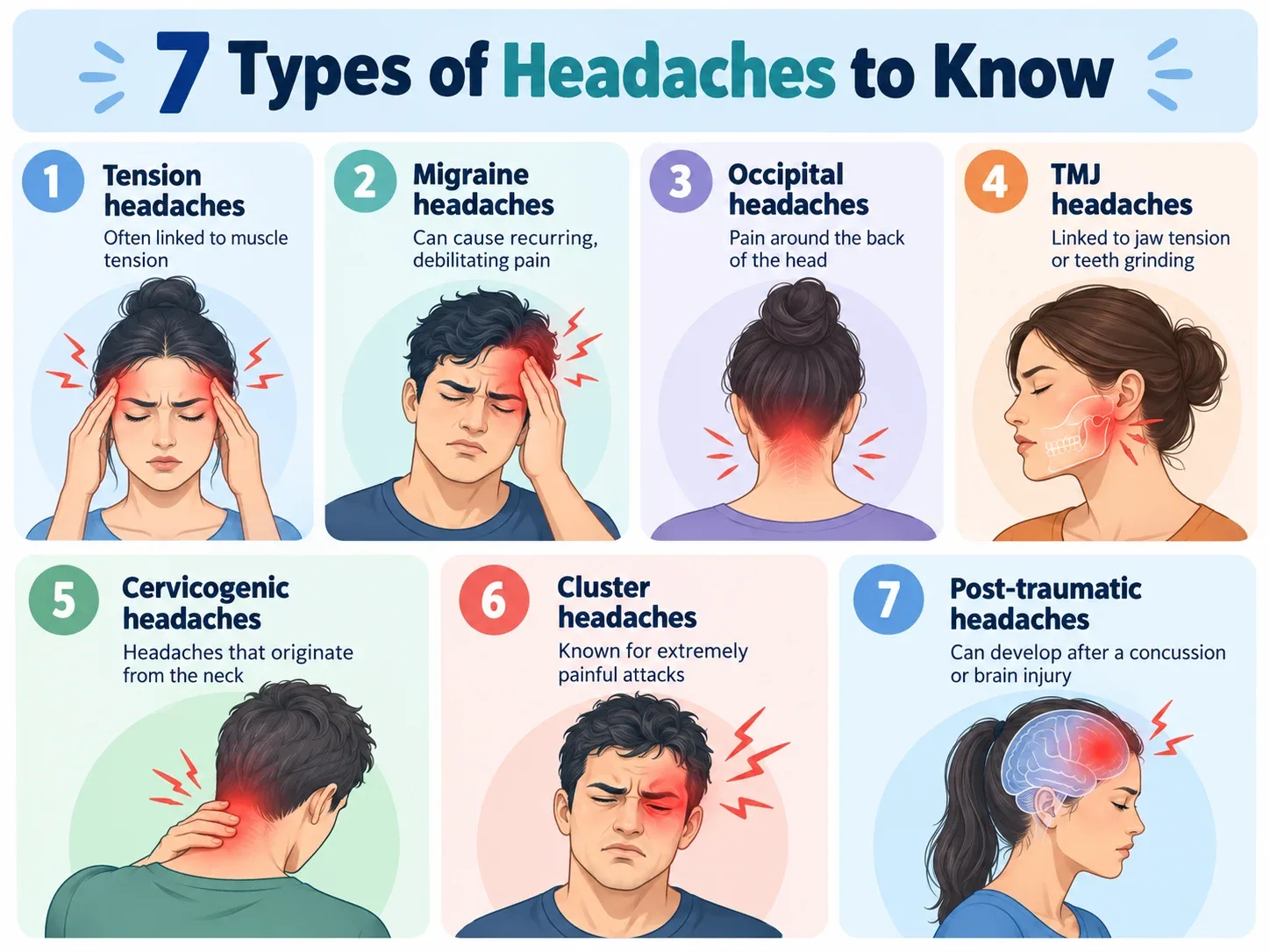
Here are 7 types of headaches you should know:
Tension headaches: Often associated with muscle tension.
Migraine headaches: A neurological condition that can cause recurring, debilitating pain.
Occipital headaches: Pain around the back of the head, sometimes associated with tight neck muscles.
TMJ headaches: Headaches associated with jaw tension or grinding your teeth during sleep.
Cervicogenic headaches: Headaches that originate from problems in the neck.
Cluster headaches: A distinct headache disorder known for extremely painful attacks.
Post-traumatic headaches: Headaches that can develop following a concussion or other brain injury.
But how do you know which type you’re experiencing? And could the headache medication you’re taking be part of the problem?
Keep reading as Gabriela shares what to look for, how a simple headache diary can help uncover patterns, and why understanding your headaches may be the first step toward finding more effective relief.
Why Do I Keep Getting Headaches Even After Taking Medication?
Walk down the pain relief aisle at Walgreens, CVS, or Walmart, and you’ll find shelves filled with headache medications. Tylenol, Advil, Motrin, Aleve, Excedrin Migraine, and plenty more.
But what’s the difference between them? And why does one medication work for some headaches but not others?
Gabriela Vieira of Genesis Brain Institute explains:
Many people spend money on headache medications without understanding what they actually do.
Here’s a simple breakdown of the medications she discussed:
Tylenol (acetaminophen): Helps reduce pain, but doesn’t reduce inflammation or swelling.
Advil and Motrin (ibuprofen): The same medication sold under different brand names. Both help reduce pain and inflammation.
Aleve (naproxen): Another medication that helps reduce inflammation and pain.
Excedrin Migraine: Contains caffeine, which can help some types of headaches but may also trigger migraines in certain people.
Here’s something Gabriela wants people to understand about caffeine.
Although it’s included in some headache medications, caffeine can actually be a migraine trigger. Something that helps one person’s headache may not be helpful for someone experiencing migraines.
Gabriela also explained that not all headache treatments work the same way. Some medications are taken regularly to help prevent frequent headaches, while others are taken when a migraine begins to help stop it.
The takeaway?
The best medication for headaches isn’t necessarily the one with the biggest promises on the box.
Understanding what kind of headache you’re experiencing is an important part of finding the right approach.
Can Neck Problems or Grinding Your Teeth Cause Headaches?
What if the reason you keep getting headaches has nothing to do with your brain, but everything to do with your neck, shoulders, or even your jaw?
Gabriela Vieira of Genesis Brain Institute explains that some people live with frequent headaches without realizing that the source of their pain could be somewhere else entirely.
And surprisingly, something you’re doing while sleeping could be contributing to those headaches.
Here are three headache types she discussed that many people may not recognize:
TMJ headaches: Do you wake up with headaches? You could be grinding your teeth while you sleep and not even know it. Gabriela explains that some people experience headaches throughout the day without realizing their jaw may be contributing to the pain.
Cervicogenic headaches: These headaches come from problems in your neck. Gabriela frequently sees this following car accidents, when an injury to the neck can contribute to ongoing headaches.
Occipital headaches: These are often felt toward the back of your head. Gabriela explains that extremely tight neck and trapezius muscles, which extend across your upper shoulders and back, can contribute to this type of pain.
But here’s something even more interesting: You can have more than one type of headache.
Gabriela described how someone recovering from a car accident might experience severe migraines, tension headaches on other days, and occasional headaches related to their neck injury.
Imagine taking the same headache medication every time, even though the headaches you’re experiencing may have different causes.
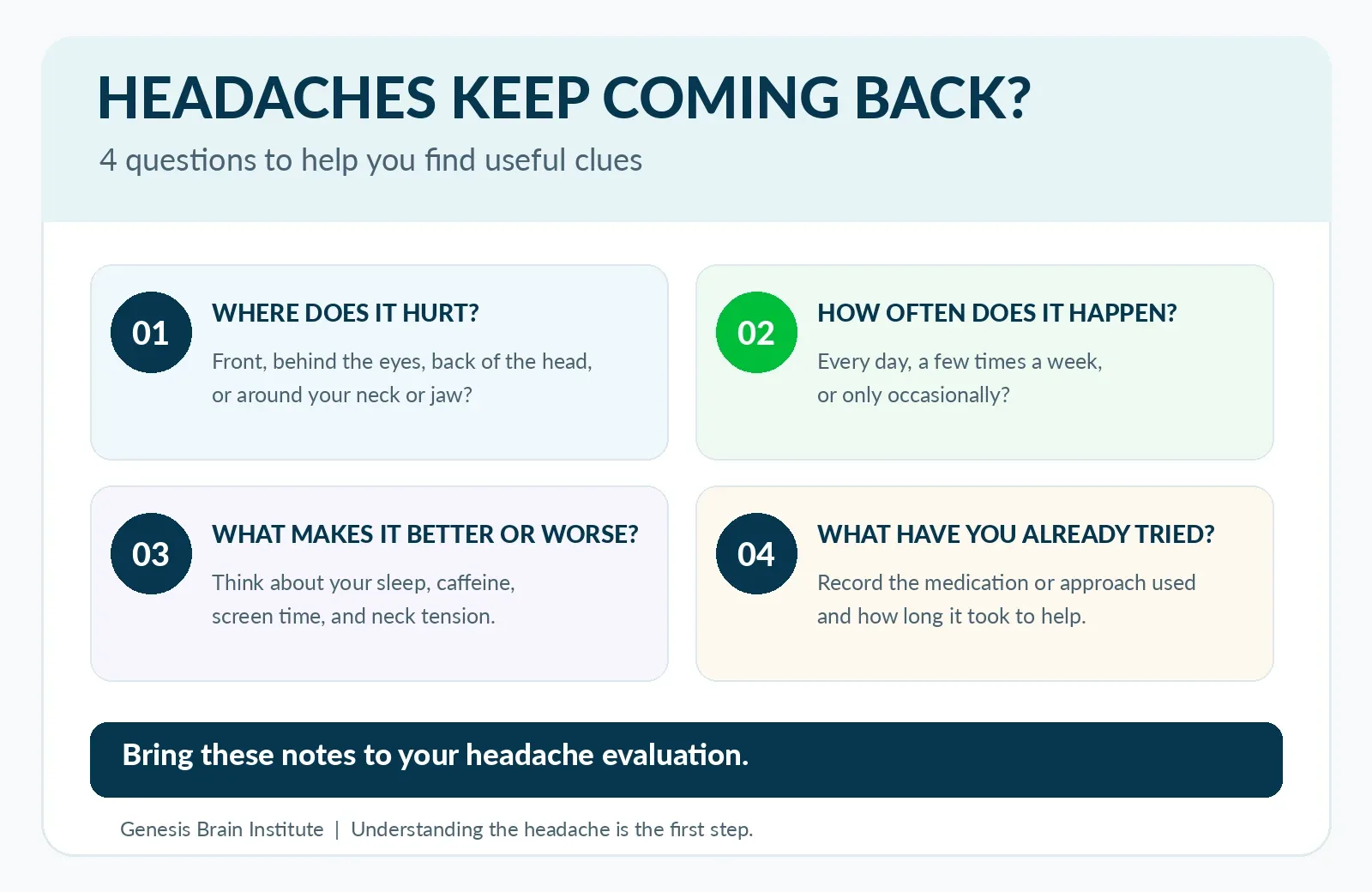
That’s why understanding where your headaches hurt, when they happen, and what might be triggering them can provide important clues about why they keep coming back.
How Can a Headache Diary Help You Figure Out What’s Causing Your Headaches?
What if something as simple as writing down your headaches could help you understand why they keep happening?
Gabriela explained that one of the first things she asks patients to do is keep a headache diary.
Why? Because remembering that you had a headache is one thing. Remembering exactly when it happened, how bad it was, and what made it better or worse is another.
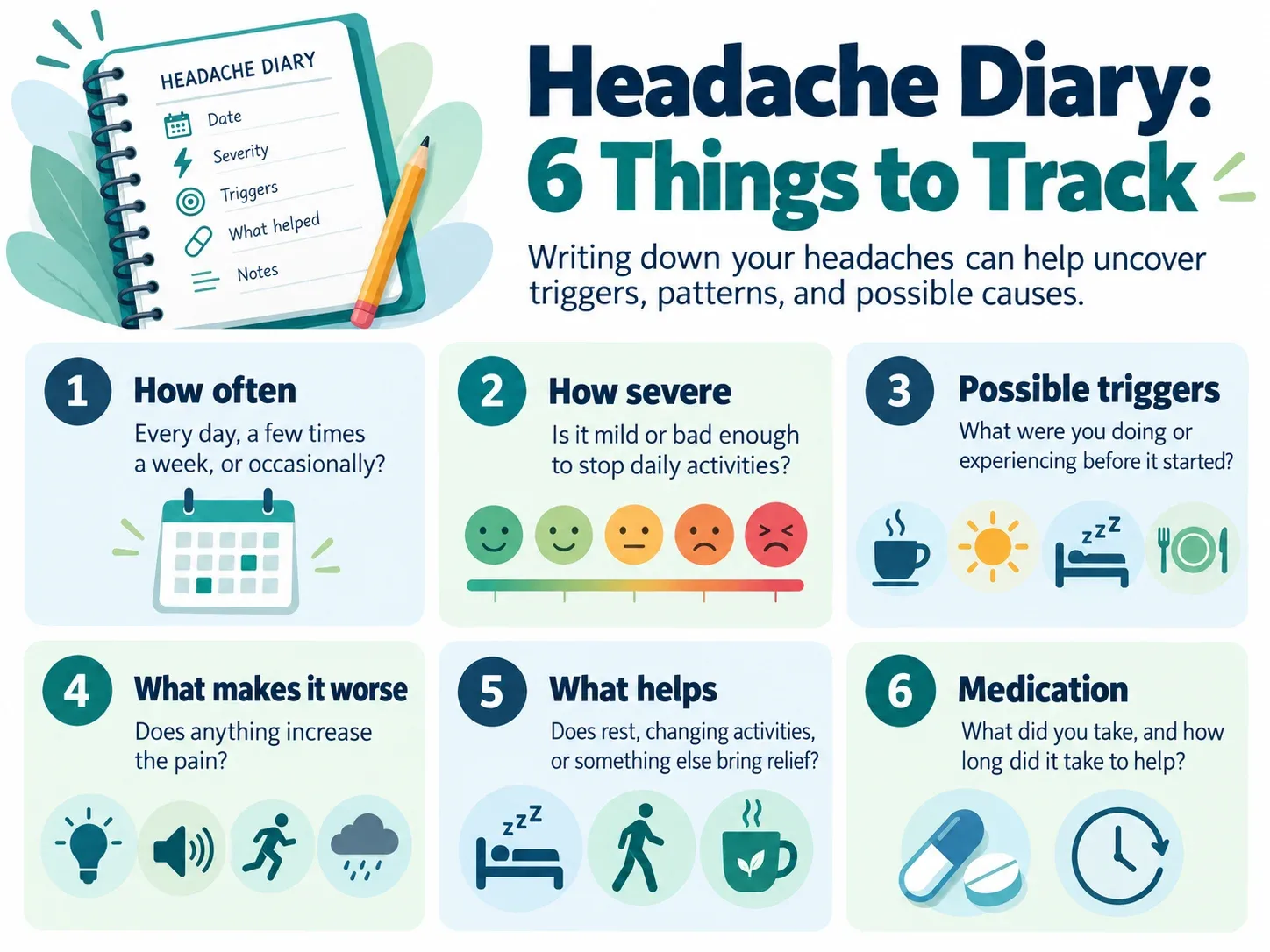
Here are 6 things to track in a headache diary to help identify possible headache triggers, patterns, and causes:
How often: Are you getting headaches every day, a few times a week, or occasionally?
How severe: Is it a mild headache or one that stops you from doing everyday activities?
Possible triggers: What were you doing or experiencing before the headache started?
What makes it worse: Does anything seem to increase the pain?
What helps: Does resting, changing activities, or something else provide relief?
Medication: What did you take, and how long did it take before you felt better?
Here’s why this matters.
When you’re experiencing frequent or continuous headaches, it’s easy to focus only on making the pain go away.
But Gabriela explains that a detailed headache history can help identify patterns and give her a better understanding of which treatment approach may be appropriate.
You don’t need anything fancy to get started. A notebook or a note on your phone can help you keep track of the details.
The next time you experience a headache, don’t just remember that it happened. Write down what happened around it.
The more you understand your headache patterns, the more useful that information becomes when trying to determine what’s causing your headaches and how to address them.
How Can You Relieve Headaches Naturally Without Medication?
What if something as simple as changing your sleep schedule or putting a cold wrap around your head could help reduce your headaches?
Gabriela explained that medication isn’t the only option for managing frequent headaches and migraines. There are several practical things you can try, and some may surprise you.
5 Ways to Manage Headaches Without Medication
Keep a consistent sleep schedule. Going to bed and waking up at different times can trigger migraines in people who are prone to them. Gabriela emphasizes that maintaining a regular sleep routine is especially important for frequent headache sufferers. Poor sleep can also affect how your brain functions throughout the day. Learn more about the connection between sleep quality and brain health in our guide to sleep and brain function.
Try a cold headache cap. These are soft, stretchy caps that you keep in the freezer and then wear around your head. They provide cooling and gentle compression, which Gabriela says can be very helpful for some people experiencing headaches.
Pay attention to screen time and light. If you experience headaches or pain behind your eyes after looking at screens at night, Gabriela suggests trying blue-light-filtering glasses. She also discussed rose-colored glasses designed for people who experience migraines.
Consider neck massage or trigger point therapy. Tight muscles around the neck and shoulders can contribute to certain headaches. Gabriela explained that massage and treatments targeting tight areas in the neck may help reduce the pain.
Reduce caffeine if it triggers your migraines. Gabriela specifically recommends minimizing caffeine for people who find that it contributes to their migraine attacks.
Here’s the part worth remembering: You don’t necessarily need an expensive solution to find relief.
Some of the approaches Gabriela discussed are simple things you can try at home, from keeping a regular bedtime to using an inexpensive cooling cap.
And if you’ve been wondering what causes continuous headaches, paying attention to your daily habits may help you recognize factors that contribute to your symptoms.
Sometimes a small change in your routine can make a meaningful difference in how often you experience headaches.

Can Continuous Headaches Be Treated After Living With Persistent Pain?
Imagine suffering from debilitating migraines after an accident, only to discover that a medication that’s been available for years could make a life-changing difference.
Gabriela Vieira shared the story of a patient who had been suffering from severe migraines following an accident.
His headaches had become so debilitating that he had even considered taking his own life.
Gabriela prescribed a nasal spray containing sumatriptan, also known as Imitrex, a medication used to treat migraine attacks.
The difference it made in his life was remarkable.
Gabriela shared that the patient was in tears, telling her how much the treatment had changed his life.
He asked, “Why has no one given me this before?”
What makes this story especially powerful is that sumatriptan wasn’t a newly discovered treatment. Gabriela explained that it had been available for a long time.
Headaches following car accidents can also be part of a larger pattern of post-concussion symptoms, as we’ve seen in our work with patients recovering from serious injuries.
She also shared how surprised she is by the number of patients who come to her following brain injuries and report that their headaches have never been treated.
According to Gabriela, established headache treatment guidelines provide different options, and some patients may benefit from seeing a headache specialist.
The important takeaway: Just because you’ve been living with frequent headaches or migraines doesn’t mean you’ve exhausted your treatment options.
For people wondering what causes continuous headaches or why their migraines won’t go away, Gabriela’s patient’s experience offers an important reminder: There may still be options worth exploring.
What Causes Continuous Headaches? Finding Answers and Hope at Genesis Brain Institute
What if the answer to your continuous headaches involves looking beyond your head?
That’s an important part of our approach at Genesis Brain Institute in Tampa, Florida.
Gabriela Vieira, PA-C, CBIS-T, emphasizes the importance of listening to patients, understanding their symptoms, and identifying the type of headache they’re experiencing.
Our team also includes Dr. Christopher Gleis, MD, a board-certified anesthesiologist and pain management specialist who evaluates how pain in the neck, spine, nerves, and other areas of the body may be contributing to someone’s symptoms.
For people experiencing frequent headaches, migraines, or ongoing pain a broader approach can be especially valuable.
And sometimes, exploring treatment options means looking beyond traditional headache medications.
Depending on a patient’s individual needs, our team can explore:
Pain management: Identifying and addressing pain in the neck, spine, muscles, or other areas that may be contributing to headaches.
Regenerative medicine: Exploring options such as stem cell-based treatments for pain-related conditions.
IV therapy: Evaluating whether hydration or certain nutritional deficiencies may be contributing to how a patient feels and whether IV therapy could be beneficial.
What causes continuous headaches can be different for everyone. That’s why we believe in taking the time to understand the whole person, not just one symptom.
At Genesis Brain Institute, our goal is to help people explore their options and find a better path forward.
If you’ve been living with headaches that keep coming back, we’d welcome the opportunity to listen, understand what you’re experiencing, and help you explore what may be possible.
Because a new beginning of hope starts with believing there’s a better tomorrow.
Disclaimer: This content is for informational purposes only and does not constitute medical advice. Please consult with a licensed healthcare provider. Genesis Brain Institute is a Brain Treatment Center in Tampa offering non-pharmaceutical solutions that bring clarity, restore function, and offer real hope for those who feel lost, stuck, or simply want more from life.