

Why do I forget things so quickly? Most people blame their memory, but memory is only part of the story.
Attention and working memory affect nearly every part of life. They help children learn in school, athletes react quickly, professionals stay organized, parents juggle responsibilities, and older adults maintain independence.
When these systems struggle, people often blame themselves. They may wonder, Am I getting older? Am I distracted? Do I have ADHD? Is something wrong with me?
But forgetfulness is not always a memory problem.
Think of attention as a flashlight and working memory as a whiteboard.
Your flashlight decides what information gets noticed. Your whiteboard holds that information long enough to use it.
Without attention, nothing gets written on the whiteboard.
Without working memory, the information disappears before you can use it.
That is why some people forget names moments after hearing them. Others lose track of conversations, reread the same paragraph three times, or walk into a room and forget why they went there in the first place. Many people begin to worry they are getting older or losing their memory when something else may be happening.
The truth is that memory depends on many systems working together. Sleep, stress, anxiety, ADHD, brain injuries, processing speed, and attention can all affect how well the brain stores and uses information.
The encouraging news is that forgetfulness is often more understandable and more common than people realize.
In this article, we will explore why people forget things so quickly, how attention and working memory shape everyday life, what recent research teaches us about forgetfulness, and when memory changes may deserve a closer look.
What Does It Mean If You Forget Things Easily?
Forgetting things once in a while is part of being human. Everyone misplaces their keys, forgets a name, or walks into a room and suddenly loses track of why they went there.
But if you keep asking, “Why do I forget things so easily?” or “Why do I keep forgetting things?” it can start to feel frustrating. You may worry you are getting older. You may wonder if you have ADHD. You may even start to think something is wrong with you.
The truth is, memory is more complicated than most people realize.
Memory is not just one thing. Attention, working memory, sleep, stress, processing speed, mood, and overall brain health all work together. If one of those systems struggles, remembering things can become harder.
Think of your brain like a team. Memory is one player, but it cannot win the game by itself. Attention helps information get noticed. Working memory holds information long enough to use it. Processing speed keeps everything moving. Sleep helps the brain organize and strengthen what you learned during the day.
That means forgetting things easily does not always mean you have a memory problem.
Sometimes poor sleep is the issue. Sometimes stress overwhelms the brain. Sometimes anxiety, ADHD, depression, concussion history, or normal aging affects how the brain takes in and uses information.
Research continues to show that sleep plays an important role in learning and memory. During sleep, the brain helps organize and strengthen new information so it can be used later. That is one reason poor sleep can make focus, recall, and mental sharpness feel harder the next day.
So if you forget things easily, the better question may not be, “What is wrong with my memory?”
The better question may be:
Why is my brain having trouble holding onto information in the first place?
That question opens the door to a more useful answer.
Why Do I Forget Things So Quickly?
If you find yourself asking, “Why do I forget things so quickly?” the answer is usually more complicated than simply having a bad memory.
Many factors affect how the brain takes in, stores, and recalls information. Sometimes the problem is memory itself. Often, it is something affecting memory behind the scenes.
Stress
Stress can make forgetfulness worse.
Think about the last time you felt overwhelmed. Maybe you forgot an appointment, lost your train of thought, or walked into a room and couldn’t remember why.
That happens because the brain prioritizes survival over storage.
If your house alarm went off all day long, it would be hard to sit down and read a book. Chronic stress can work the same way. When the brain stays in a constant state of alertness, it becomes harder to focus and remember information.
Poor Sleep
Sleep is one of the brain’s most important jobs.
During sleep, the brain organizes and strengthens memories from the day. Poor sleep can affect attention, working memory, and processing speed. That is why many people notice they are more forgetful after a bad night’s sleep.
Sometimes the problem is not a lack of hours. Sometimes it is poor quality sleep.
Anxiety
People experiencing anxiety often say:
“I feel like my brain is scattered.”
That feeling is real.
Anxiety competes for attention. When the brain is busy worrying about tomorrow or stuck in anxiety, it becomes harder to focus on what is happening today. Information that never receives attention cannot be remembered later.
ADHD
Many people with ADHD do not have a problem storing memories.
They have trouble getting information onto the whiteboard in the first place.
If attention wanders during a conversation or while reading, the brain never fully captures the information. It is hard to remember something that was never completely processed.
This is one reason children and adults with ADHD often ask, “Why do I forget things all the time?”
Depression
Depression affects more than mood.
People experiencing depression may notice slower thinking, brain fog, poor concentration, and trouble recalling information. Tasks that once felt simple may require much more mental effort.
Concussions and Brain Injuries
Even mild concussions can affect attention, processing speed, and memory.
Dr. Christopher Gleis and the team at Genesis Brain Institute often see patients who struggle with brain fog, forgetfulness, and trouble concentrating after an injury. Sometimes people assume these symptoms are normal or expect them to disappear quickly, but the brain may need time and support to recover.
Aging
Some changes in memory happen with normal aging.
Occasionally forgetting a name or misplacing your keys is common.
However, increasing forgetfulness, repeating questions, difficulty following conversations, or changes that interfere with daily life deserve attention and should not simply be dismissed as “getting older.”
The encouraging news is that forgetfulness does not always mean something serious is happening.
More often, it is a clue.
And clues are meant to be understood.
Why Forgetfulness Is Not Always A Memory Problem
When people say, “My memory is terrible,” memory is often getting blamed for something it did not do.
That is because memory does not work alone.
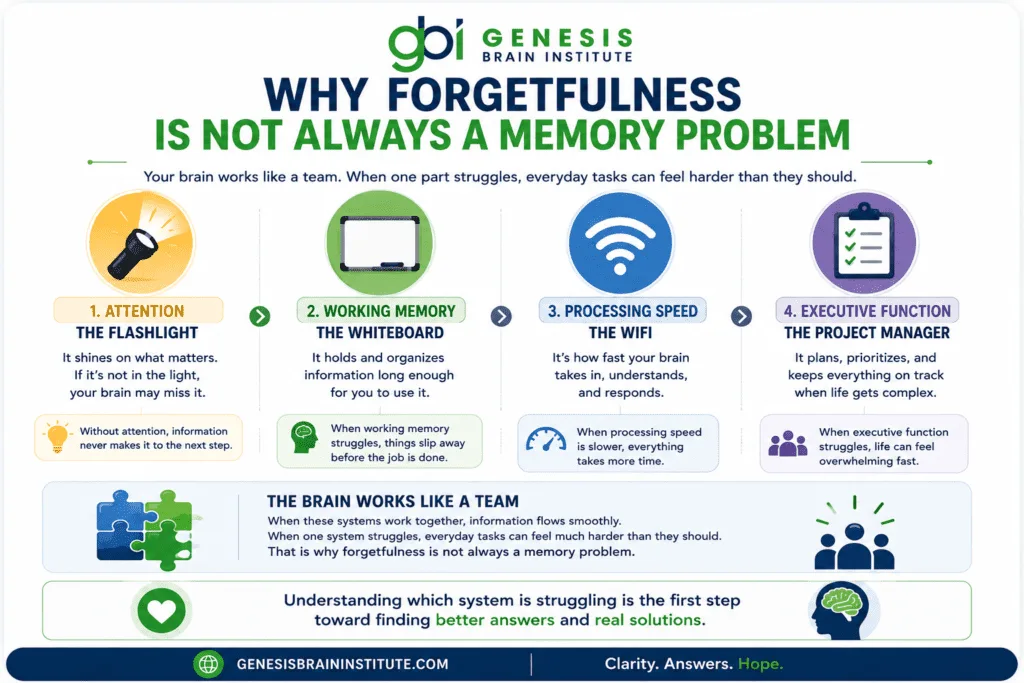
Think of your brain like a team. Each player has a different job. If one player struggles, the whole team feels it.
Attention is the flashlight.
Working memory is the whiteboard.
Processing speed is the WiFi.
Executive function is the project manager.
When those systems work together, information flows smoothly. When one system struggles, everyday tasks can feel harder than they should.
Attention Is The Flashlight
Attention acts like a flashlight.
Whatever the flashlight shines on gets noticed. Whatever stays in the dark gets missed.
Imagine someone introduces themselves at a busy party. If your mind is thinking about work, your children, or the drive home, you may forget their name seconds later.
That does not necessarily mean you have a memory problem.
The information never received enough attention to make it onto the whiteboard.
Working Memory Is The Whiteboard
Working memory is your brain’s temporary workspace.
Think of it like a whiteboard.
It holds information long enough to use it.
When someone gives you a phone number and you repeat it while dialing, that is working memory.
When your boss gives you three instructions and you remember them long enough to complete the task, that is working memory.
When you read one sentence and still remember it by the time you reach the next sentence, that is working memory.
People with working memory challenges often say:
“I lose my train of thought.”
“I have to reread everything.”
“I forget what I was about to say.”
“I feel scattered.”
Those are working memory questions, even if people never use those words.
Processing Speed Is The WiFi
Processing speed is like the internet speed in your home.
When your WiFi is fast, everything loads smoothly.
When it slows down, nothing stops working, but everything takes longer.
The same thing can happen in the brain.
People with slower processing speed may know the answer, but need more time to think, respond, and organize information.
That has nothing to do with intelligence.
The brain simply needs more time.
Executive Function Is The Project Manager
Executive function helps you organize, plan, prioritize, and manage several tasks at once.
Think about getting your family ready for vacation.
Reservations, packing, directions, schedules, and airport times all have to come together.
Executive function is the project manager keeping everything moving.
When it struggles, life can feel overwhelming.
The Brain Works Like A Team
Imagine trying to write on a whiteboard while someone keeps turning the flashlight off, the WiFi is buffering, and the project manager called in sick.
Everything becomes harder.
That is why forgetfulness is not always a memory problem.
Attention, working memory, processing speed, and executive function all work together. Understanding which system is struggling can help explain why some people forget conversations, lose track of tasks, reread the same page several times, or wonder why life suddenly feels more mentally exhausting.
The encouraging news is that understanding the problem is often the first step toward finding better answers.
What Is Working Memory?
Most people have never heard the term working memory.
Yet they use it hundreds of times every day.
Working memory is your brain’s temporary workspace. Think of it like a whiteboard. It holds information long enough for you to use it before moving on to the next task.
For example, if someone tells you a phone number and you repeat it while dialing, you are using working memory.
If your spouse asks you to stop at the grocery store and pick up milk, eggs, and bread, working memory helps you remember those items long enough to get to the store.
When you read a paragraph and remember the first sentence by the time you reach the last sentence, you are using working memory.
Children use working memory when solving math problems. Athletes use it to react during competition. Professionals use it to manage meetings, emails, and schedules. Parents use it every day while juggling responsibilities.
Without working memory, life becomes much harder.
People with working memory challenges often say:
“I lose my train of thought.”
“I forget things immediately.”
“I have to write everything down.”
“I read the same thing three times.”
“I walk into a room and forget why I’m there.”
“I forget what someone just told me.”
Sound familiar?
Many people blame themselves.
They think they are lazy.
They think they are distracted.
They think they are getting older.
But working memory problems are not character flaws.
Think about trying to cook dinner without any counter space. Every ingredient, measuring cup, and recipe card ends up piled on top of each other. Eventually something gets dropped.
Working memory works the same way.
If the brain’s temporary workspace becomes overloaded, information gets lost before it can be used.
That does not mean someone lacks intelligence.
In fact, many bright, successful people struggle with working memory.
Research shows that working memory affects learning, reading comprehension, problem solving, attention, and decision making. It plays an important role in school, work, sports, and everyday life.
Which raises an important question:
What causes working memory to struggle in the first place?
Why Do I Forget What I Walked Into The Room For?
Almost everyone has experienced it.
You walk into the kitchen, bedroom, or garage and suddenly stop.
“Why did I come in here?”
A few seconds later, you remember.
Or maybe you don’t.
If that sounds familiar, you are not alone. In fact, researchers have a name for this phenomenon. It is called the Doorway Effect.
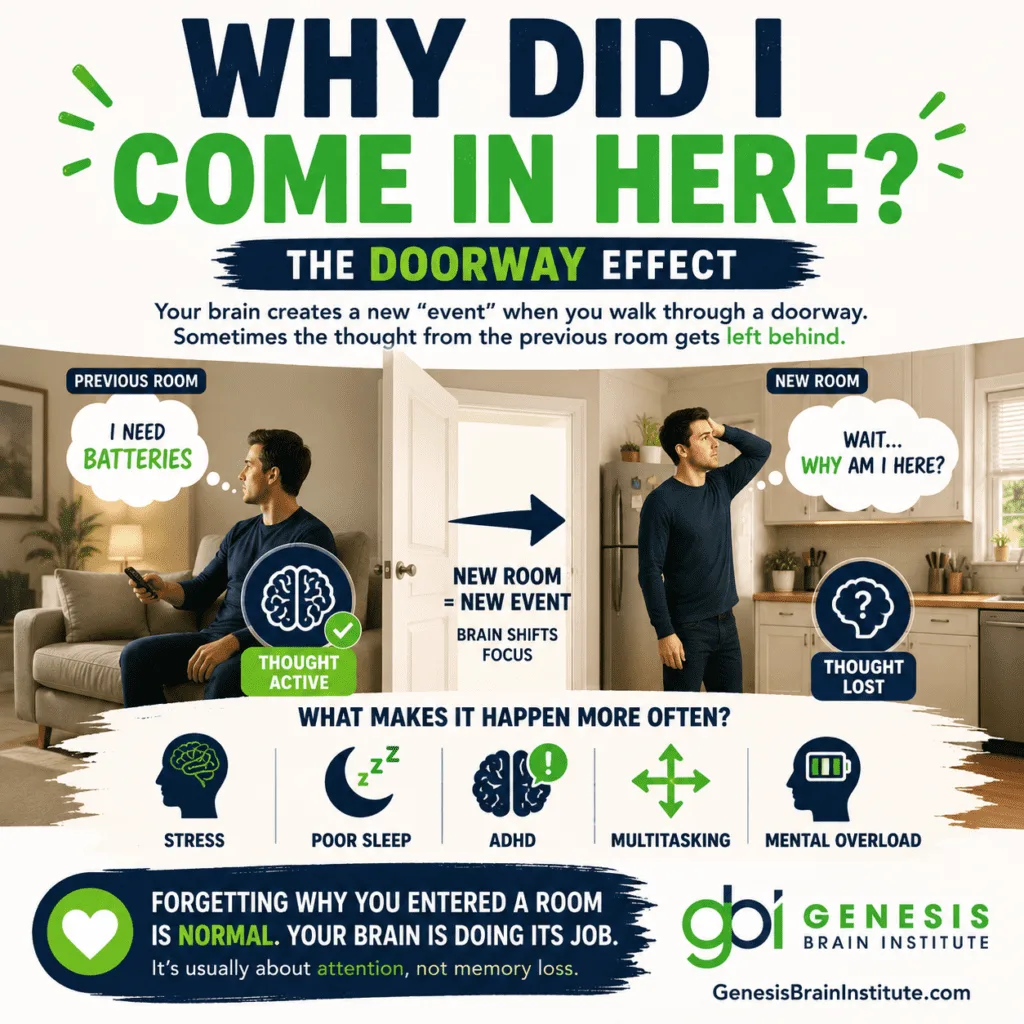
Think of your brain like an internet browser with multiple tabs open.
As you move from one room to another, your brain updates what is important. The change in environment acts like opening a new tab. Sometimes the thought you were carrying gets pushed into the background while your attention shifts to new sights, sounds, and tasks.
That does not mean you are losing your memory.
It means your brain is constantly deciding what deserves attention.
Stress, multitasking, poor sleep, ADHD, and mental overload can make this happen more often.
Parents juggling children, professionals managing busy schedules, and students balancing assignments all experience this. The brain only has so much workspace available. When too many thoughts compete for attention, information can get lost before it reaches long term storage.
Think about trying to carry ten grocery bags into the house at once.
Eventually, something gets dropped.
Your brain works the same way.
People often ask:
Why do I forget what I was going to do?
Why do I forget things immediately after thinking of them?
Why do I keep forgetting simple things?
Why do I always feel like I forgot something?
Many times, these experiences are related more to attention and working memory than to memory loss itself.
That is encouraging because it means forgetfulness does not automatically mean something serious is happening.
However, there is another factor that many people overlook.
Stress and anxiety.
And they may affect memory more than most people realize.
Can Stress And Anxiety Cause Forgetfulness?
Yes.
In fact, stress and anxiety may affect memory more than most people realize.
People experiencing anxiety often say:
“I feel scattered.”
“I can’t think straight.”
“I keep forgetting everything.”
“I lose my train of thought.”
“I feel like I’m in a fog.”
Those feelings are real.
Think about trying to read a book while someone keeps pulling the fire alarm.
You might be able to force yourself to read the words, but it would be hard to understand them, remember them, or focus on what comes next.
Stress can affect the brain in a similar way.
When the brain senses danger, it shifts its priorities. Survival becomes more important than remembering where you put your keys or what someone said five minutes ago.
That response can be helpful during an emergency.
But modern stress rarely looks like a tiger chasing you.
It looks like deadlines.
Financial pressure.
Relationship problems.
Poor sleep.
Health concerns.
Constant notifications.
Too much information and not enough rest.
Over time, living in a constant state of stress can make it harder to focus, process information, and hold onto memories.
That is one reason people with anxiety often say:
“I know I’m smart. I just don’t feel like myself.”
Dr. Christopher Gleis often reminds patients that symptoms are clues.
Forgetfulness, brain fog, and trouble concentrating do not automatically mean something is permanently wrong. Sometimes they are clues that the brain and body have been under too much stress for too long.
Research over the past several years has shown that chronic stress can affect areas of the brain involved in attention, learning, and memory, including the hippocampus and prefrontal cortex. Stress hormones like cortisol are helpful in short bursts, but they were never designed to stay elevated all day long.
That is why reducing stress is not simply about feeling better.
It is about helping the brain function better.
The encouraging news is that many causes of forgetfulness are not fixed.
The brain has an amazing ability to adapt and change.
Scientists call this neuroplasticity.
And that raises another important question:
Can attention and working memory improve?
Can Attention And Working Memory Improve?
One of the most encouraging things about the brain is that it can change.
Scientists call this neuroplasticity.
Think about walking through a field of tall grass.
The first time you walk through it, the path is difficult to see. But if you walk the same path every day, it becomes easier. Over time, a clear trail forms.
The brain works in a similar way.
The connections we use often become stronger. New pathways can develop. Old habits can change. That is why learning a new language, practicing an instrument, or improving athletic skills becomes easier with repetition.
Attention and working memory are no different.
That does not mean everyone improves the same way or at the same speed. It does mean that forgetfulness is not always a permanent condition.
Research over the past several years has shown that sleep, exercise, stress management, and cognitive stimulation all play important roles in brain health.
Sleep helps organize memories.
Physical activity increases blood flow to the brain.
Managing stress helps free up mental resources that would otherwise be spent in survival mode.
Learning new skills challenges the brain and keeps important networks active.
For some people, improving attention and memory may involve addressing anxiety, depression, ADHD, concussion history, or poor sleep.
For others, it may involve personalized therapies designed to strengthen specific areas of brain function.
Dr. Christopher Gleis and the team at Genesis Brain Institute often remind patients that symptoms are not character flaws.
Difficulty concentrating does not mean someone is lazy.
Forgetfulness does not automatically mean someone is getting dementia.
Brain fog does not mean someone is broken.
Symptoms are clues.
And understanding those clues can help guide the next step.
The goal is not to blame yourself.
The goal is to understand what your brain may be trying to tell you.
Which raises another important question:
How do you know which system is struggling in the first place?
How Are Memory Problems Tested?
If you’ve ever wondered, “Why do I forget things so quickly?” you may have also wondered whether there is a way to measure what is happening.
The answer is yes.
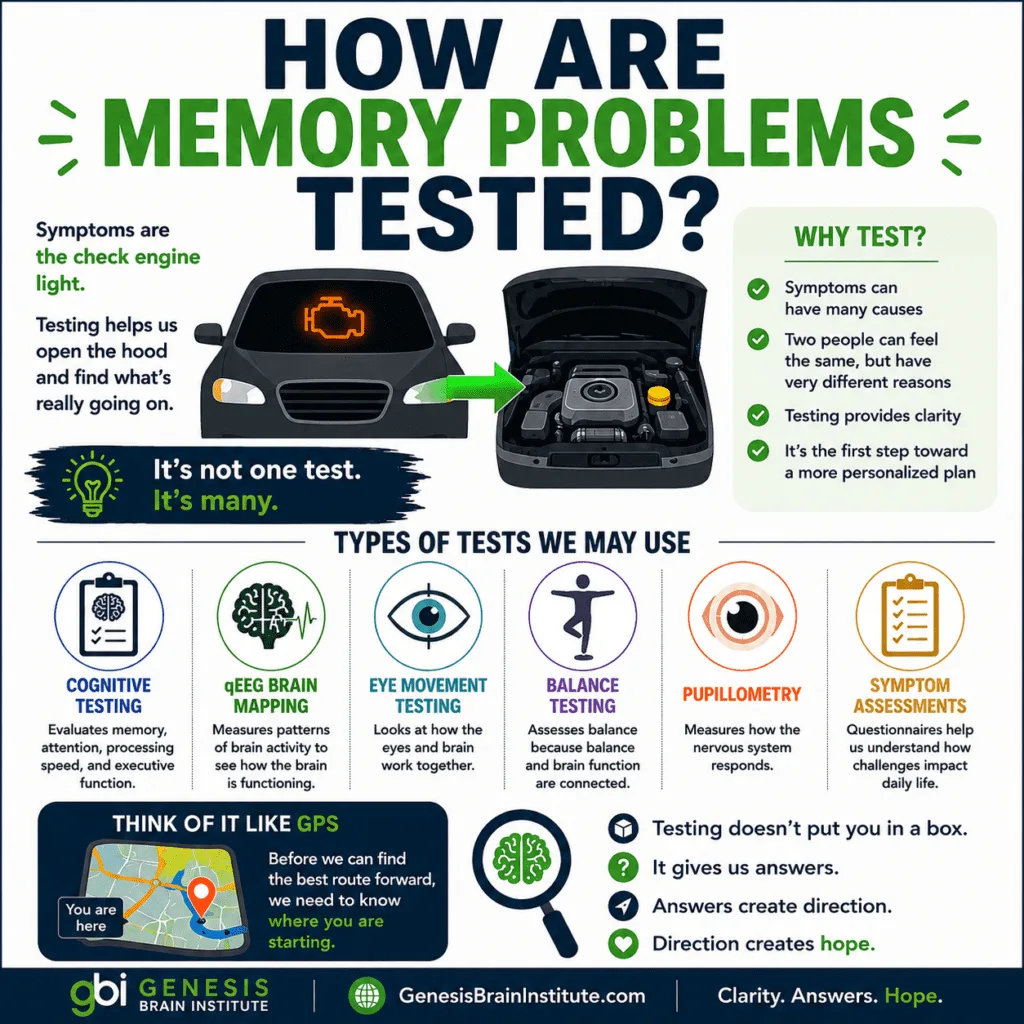
Think about the check engine light in your car. The light tells you something needs attention, but it does not tell you whether the problem is the battery, a sensor, or something deeper under the hood.
Forgetfulness can work the same way.
Symptoms are clues.
But symptoms alone do not always explain why someone is forgetting things, losing focus, or feeling mentally exhausted.
Two people may complain about brain fog and trouble remembering names. Yet the reason behind those symptoms may be completely different.
One person may be struggling with poor sleep. Another may have ADHD. Someone else may be dealing with stress, anxiety, depression, concussion history, or age related changes.
That is why testing matters.
The goal is not simply to label symptoms. The goal is to understand what may be contributing to them.
A thorough evaluation often starts with a detailed history and a conversation about what someone is experiencing. Questions about sleep, stress, mood, injuries, medications, and daily function can provide important clues.
Depending on the person, additional testing may help paint a clearer picture.
This may include:
Cognitive testing to evaluate memory, attention, processing speed, and executive function.
qEEG brain mapping to measure patterns of brain activity.
Eye movement testing to evaluate how the eyes and brain communicate.
Balance testing because balance and brain function are closely connected.
Pupillometry to assess how the nervous system responds.
Questionnaires and symptom assessments to understand how challenges affect daily life.
Dr. Christopher Gleis often reminds patients that testing does not exist to put people in a box.
It exists to provide clarity.
Think of it like a GPS.
If you are driving somewhere new, you first need to know where you are starting.
The same principle applies to brain health.
Measuring attention, memory, and other systems does not guarantee an answer to every question. But understanding the starting point can help guide more informed decisions and a more personalized path forward.
Because treating symptoms without understanding what may be causing them is a little like trying to fix a check engine light without opening the hood.
The good news is that forgetfulness does not automatically mean something serious is happening.
But it does raise an important question:
When should forgetfulness become something worth paying attention to?
When Should You Be Concerned About Forgetfulness?
Everyone forgets things.
You might misplace your keys, forget a name, or walk into a room and lose track of why you went there. Those experiences are common and usually nothing to worry about.
But some changes deserve attention.
One helpful question to ask is:
“Is this affecting my daily life?”
For example, occasionally forgetting where you parked your car is normal.
Forgetting how to drive home is not.
Forgetting a person’s name and remembering it later is common.
Having the same conversation multiple times because you do not remember having it before is different.
Usually Normal Forgetfulness
Many everyday memory lapses are simply part of life.
These may include:
Forgetting where you put your keys.
Walking into a room and forgetting why.
Forgetting a name but remembering it later.
Losing your train of thought during a stressful day.
Having trouble concentrating after a poor night’s sleep.
Feeling mentally overloaded during busy seasons of life.
Signs That Deserve Attention
It may be worth talking with a healthcare professional if you notice:
Forgetfulness that seems to be getting worse.
Trouble following conversations.
Frequently asking the same questions.
Missing appointments or important events.
Difficulty managing finances or medications.
Getting lost in familiar places.
Struggling with tasks that once felt easy.
Family members noticing changes before you do.
Brain fog that developed after a concussion or illness.
Memory problems that interfere with work, school, or relationships.
These symptoms do not automatically mean dementia.
In fact, many things can affect memory and concentration, including stress, anxiety, depression, ADHD, poor sleep, medications, hormone changes, and brain injuries.
That is why context matters.
Dr. Christopher Gleis often reminds patients that symptoms should not be ignored, but they should not be feared either.
The goal is understanding, not guessing.
And signals are meant to be understood.
The encouraging news is that many causes of forgetfulness are treatable, manageable, or simply part of normal life.
The key is knowing when to stop guessing and start asking questions.
Because understanding what is causing the problem is often more helpful than assuming the worst.
And that brings us to some of the most common questions people ask about forgetfulness.
Frequently Asked Questions About Forgetfulness
Why do I forget things so quickly?
Forgetfulness is not always a memory problem. Attention, working memory, stress, sleep, anxiety, ADHD, medications, and overall brain health all affect how information is stored and recalled. Sometimes the issue is not that memories are disappearing. The problem is that information never had a chance to stick in the first place.
Why do I forget things immediately after thinking of them?
This experience is surprisingly common. Working memory acts like a whiteboard that temporarily holds information. If too much information arrives at once or attention shifts, what was on the whiteboard can disappear before it is used.
Why do I walk into a room and forget why I went there?
Researchers call this the Doorway Effect. Changing environments causes the brain to shift attention. Stress, multitasking, poor sleep, and mental overload can make this happen more often. Forgetting why you entered a room does not automatically mean something serious is wrong.
Why do I lose my train of thought when someone is talking?
Attention and working memory work together during conversations. If your mind becomes distracted or overwhelmed, thoughts can disappear before they are fully processed. Stress, anxiety, ADHD, and brain fog can all contribute.
Why do I have to reread everything?
Reading requires attention, working memory, and processing speed to work together. If attention drifts or the brain becomes overloaded, information may not stick. Many people who reread paragraphs are experiencing problems with attention rather than memory itself.
Why do I feel like my brain is scattered?
People often describe feeling mentally scattered when they are stressed, sleep deprived, anxious, overwhelmed, or dealing with ADHD. Brain fog can make thoughts feel disorganized even though intelligence and long term memory remain intact.
Why do I forget conversations but remember things from years ago?
Long term memory and working memory are different systems. Many people can remember childhood events but struggle to remember what someone told them yesterday. Attention, stress, sleep, and working memory often play a larger role than people realize.
Why do I know something but can’t remember it?
Almost everyone has experienced having something “on the tip of their tongue.” The information may still be stored, but the brain is temporarily having trouble retrieving it. Stress, distractions, fatigue, and anxiety can make this happen more often.
Is it stress, ADHD, brain fog, or something else?
That depends on the person. Similar symptoms can have different causes. Poor sleep, stress, anxiety, ADHD, depression, concussion history, medications, and age related changes can all affect memory and attention. Understanding the cause often matters more than simply labeling the symptom.
Should I be worried about my memory?
Occasionally forgetting names, misplacing your keys, or walking into a room and forgetting why you went there are common experiences. However, memory changes that interfere with work, school, relationships, or daily life deserve attention.
The encouraging news is that forgetfulness does not automatically mean dementia or permanent decline.
More often, it is a clue.
And clues are meant to be understood.
Why Do I Forget Things So Quickly? The Answer Is Often More Hopeful Than You Think
If you have read this far, one thing should be clear:
Forgetfulness is not always a memory problem.
Think back to the flashlight and the whiteboard.
Attention is the flashlight. Working memory is the whiteboard.
Without attention, nothing gets written on the whiteboard.
Without working memory, the information disappears before it can be used.
That is why two people can both say, “I keep forgetting things,” yet have completely different reasons behind their symptoms.
One person may be dealing with stress. Another may have poor sleep. Someone else may be struggling with ADHD, anxiety, depression, brain fog, a concussion, or simply trying to juggle too much.
Many people blame themselves. They think they are lazy. They think they are distracted. They think they are getting older. They wonder if they are losing their mind.
But symptoms are not character flaws.
And symptoms are not always permanent.
As Dr. Christopher Gleis often reminds patients, symptoms are signals.
Signals are not meant to be feared. They are meant to be understood.
That does not mean every cause of forgetfulness is simple. It does not mean everyone needs the same answer. And it does not mean memory changes should be ignored.
It means asking a better question.
Not:
“What is wrong with me?”
But:
“What might my brain be trying to tell me?”
Because understanding the “why” behind forgetfulness can lead to better decisions, better conversations, and a clearer path forward.
And perhaps most importantly, it can replace fear with hope.
After all, if you have a brain, you have the ability to improve it.
And forgetting things does not mean you are broken.
It may simply mean your brain is asking to be understood.
Disclaimer: This content is for informational purposes only and does not constitute medical advice. Please consult with a licensed healthcare provider. Genesis Brain Institute is a Brain Treatment Center in Tampa offering non-pharmaceutical solutions that bring clarity, restore function, and offer real hope for those who feel lost, stuck, or simply want more from life.