Personality changes after head trauma can be one of the hardest things for a family to understand because the person may look the same while acting nothing like themselves. A spouse notices more anger. A parent sees someone pulling away. Memory slips. Sleep changes. Patience disappears. Yet from the outside, there may be no obvious injury at all.
That came through again and again at the International Summit on Repetitive Brain Trauma. Former NFL player Robert Gallery described years of repeated head impacts followed by changes in anger, memory, sleep, alcohol use, and behavior that his wife was seeing at home.
Military leaders shared a different path to a similar concern: repeated blast exposure over years of training and combat, where there may not be one single injury that explains everything.
Different people. Different exposures. Yet families kept describing the same problem: something changed.
That does not mean every change in mood, memory, or behavior is caused by a brain injury. It does mean those changes deserve to be taken seriously, especially when there is a history of concussion, repeated head hits, blast exposure, or other head trauma. At Genesis Brain Institute, that is where we believe the better question begins: What changed, and what have we not looked at yet?
Why Personality Changes After Head Trauma Happen
What we call personality depends in part on brain systems that help us control emotions, make decisions, stop impulses, pay attention, and respond to other people. When those systems are disrupted after head trauma, the change does not always look like a “brain problem.” It may look like anger, poor judgment, anxiety, forgetfulness, less patience, or behavior that feels completely out of character.
One area researchers pay close attention to is the frontal part of the brain. During the summit, research involving special operations service members was discussed showing why this area matters. The researchers explained that regions involved in higher level thinking also help regulate emotions and control behavior. Problems in these systems were associated with trouble making decisions, controlling anger, and stopping impulses.
Think about what that means in everyday life. Before the injury, someone gets frustrated and their brain helps them slow down, think through the situation, and choose how to respond. After head trauma, that same process may not work as smoothly. The emotion may come faster, while the brain’s ability to put on the brakes struggles to keep up.
Memory problems can add another layer. Someone may forget a conversation, lose track of what they were doing, or have trouble following several steps at once. Attention problems can even feel like memory loss because information that was never fully taken in is difficult to remember later. Genesis Brain Institute clinicians see this distinction as important because “forgetful” does not always tell us what part of the process is actually struggling.
This also explains why two people with head trauma may look very different afterward. The location of the injury, direction of the impact, number of exposures, previous health, and other factors can all differ from person to person. There is no single personality change that proves someone has a brain injury.
The bigger point is simpler: when a person starts thinking, reacting, remembering, or behaving differently after head trauma, it is worth asking whether the brain is part of the reason.
Repetitive Head Trauma Does Not Always Look Like One Big Injury
One of the most important lessons from the summit was that brain trauma does not always begin with one dramatic hit. Sometimes there is a clear concussion, car crash, fall, or explosion. Other times, the concern comes after years of smaller head impacts or repeated blast exposure.
That difference matters. General Bryan Fenton spoke about special operations service members who had long histories of repeated blasts and blows to the head. Researchers were not looking at one event they could circle on a calendar. They were trying to understand the possible effect of exposure that happened again and again during training and service.
The same question is being asked in contact sports. A football player does not need to be knocked unconscious every time the head is hit. Many impacts never become a diagnosed concussion. That does not mean every hit causes lasting brain injury, but it does explain why researchers are studying the total history of exposure instead of looking only for the worst collision someone remembers.
Fenton made another important point: no single test or snapshot in time gave researchers a complete answer. That is a useful way to think about repetitive head trauma. Instead of asking only, “When was your concussion?” it may be just as important to ask, “What has your brain been exposed to over the years, and what has changed since then?”
For some people, the story is one major injury. For others, the harder question is whether many smaller exposures are part of the picture.
Does a TBI Get Worse Over Time?
This is where families often get confused. The injury happened months or even years ago, but now the anger seems stronger, memory seems worse, or the person is struggling in ways they did not before. It is easy to wonder, “Is the brain injury getting worse, or am I imagining this?”
Those are not the only two possibilities.
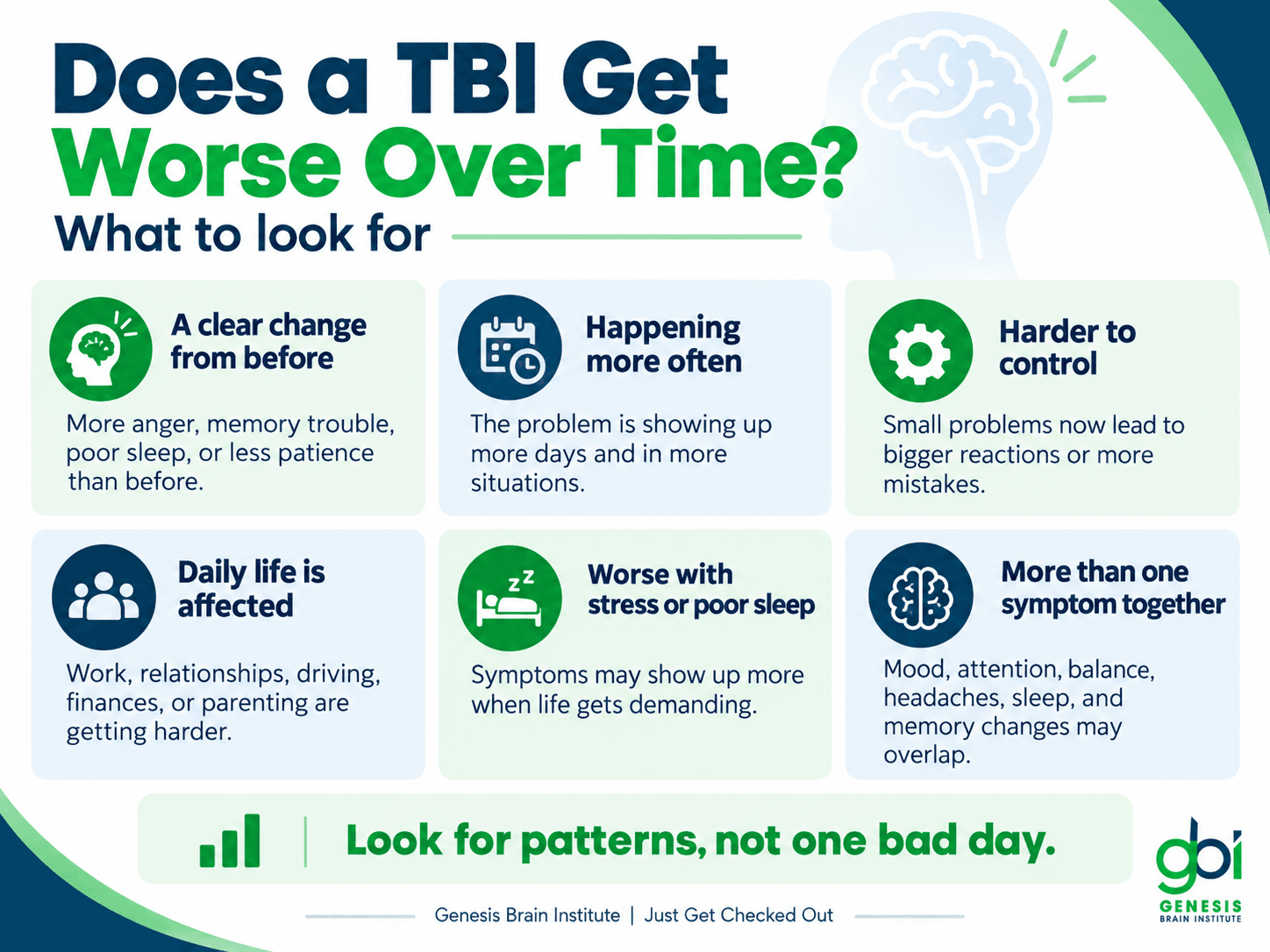
Sometimes the original injury is not getting worse, but the problems become easier to see as life becomes more demanding. A person might look fine during a short appointment or pass a routine TBI test. Then they go back to work, manage a family, deal with poor sleep, make hundreds of decisions, and handle stress all day. That is where problems with attention, memory, judgment, or emotional control often become much harder to hide.
General Bryan Fenton described a similar challenge with special operations service members. Some felt fine and passed routine testing, yet researchers still had questions about the effects of years of repeated blast exposure and head impacts. That is one reason he stressed the difference between one acute injury and cumulative exposure over time.
There is another layer families should understand. Sleep, stress, fatigue, pain, anxiety, and depression all affect how the brain performs. If someone already has a history of head trauma, a period of poor sleep or heavy stress may make existing problems with focus, memory, patience, or emotional control much more noticeable. That does not automatically mean the brain injury itself is progressing. It means the whole picture matters.
This is also why a normal scan does not always settle the question. At the summit, a British military TBI program described evaluating people whose standard imaging looked normal but whose symptoms continued. A scan answers certain structural questions. It does not explain every problem with attention, balance, sleep, memory, mood, or behavior.
For families, one of the most useful things is to stop asking only, “What is wrong with them?” and start noticing the pattern. When did the change begin? What seems different from before? Is it worse after poor sleep or stress? Are memory problems affecting work? Is anger showing up in situations that were never a problem before?
Those observations are not a diagnosis. They are information.
And when several people close to someone keep noticing the same change after head trauma, it is reasonable to take that pattern seriously rather than dismiss it as personality, attitude, or imagination.
What Personality Changes After Head Trauma Look Like at Home
Personality changes after head trauma are often easier to spot at home than in a short medical visit. A doctor may spend 30 minutes with someone. A spouse, parent, or child has known that person for years. They know what “normal” looked like before the injury.
That difference matters. A family member may notice that someone who rarely raised their voice now loses their temper over small things. The person who handled the bills without thinking starts missing payments. Someone who loved being around people begins avoiding friends. A parent who was patient with the kids becomes easily overwhelmed. None of those changes proves a brain injury, but together they create a pattern worth understanding.
Gabriela Vieira, a Board-Certified Physician Assistant at Genesis Brain Institute, spoke about this at the summit. Sometimes the person being evaluated cannot fully describe what has changed, so a spouse helps fill in the missing pieces. That is not the family trying to diagnose them. It is the family providing something extremely valuable: a before and after picture.
Think of a medical appointment as a photograph. Family members have watched the movie.
That is also why vague statements like “he is different” or “she is not herself” are only the starting point. Specific examples are far more useful. When did the anger begin? Is it happening more often? Has sleep changed? Are there new memory mistakes? Is work becoming harder? Has the person stopped doing things they once enjoyed? Did these changes begin after an accident, concussion, military service, or years of repeated head impacts?
The caregiver discussions at the summit showed how far these changes can reach. When one person begins struggling, the effects can move through the whole household. A spouse takes on more responsibility. Finances get harder to manage. Children notice tension. Roles inside the family begin to change.
If you are the person noticing those changes, you do not have to figure out the diagnosis yourself. Your job is simpler: notice the pattern, remember what changed, and share what you are seeing.
Those details may be exactly what helps the next clinician ask a better question.
What If Your MRI Is Normal but You Still Feel Different?
A normal MRI is good news, but it does not always explain why someone still feels different after head trauma. MRI is designed to look for structural problems in the brain. It is very useful for finding things such as bleeding, swelling, tumors, or other visible changes. What it does not do is measure every part of how the brain is functioning from moment to moment.
That distinction matters. Someone may have a normal looking scan and still struggle with attention, memory, balance, sleep, emotional control, or processing speed. During the summit, a British military TBI program described evaluating service members whose routine imaging looked normal but whose symptoms had not resolved. Their approach did not stop at the scan. They looked at the wider pattern of symptoms and function.
“No one test, no single snapshot in time, could provide a definitive answer.”
General Bryan Fenton
That is an important way to think about brain health. A scan answers one type of question. It does not answer every question.

Think about the difference between looking at a computer and testing how it runs. A picture of the computer could show that the screen is not cracked and the hardware is in place. It would not tell you that the computer freezes when several programs are open, loses its connection, or takes twice as long to complete a task.
The brain deserves the same kind of thinking.
If someone is having personality changes after head trauma, the question should not be limited to “Did the MRI find something?” It should also include questions such as: How is attention working? What about memory? Eye movements? Balance? Reaction time? Sleep? Emotional control? Are several small problems showing up together?
At Genesis Brain Institute, this is why we look at multiple areas of brain and nervous system function instead of expecting one test to explain the entire person. No single result tells the whole story. The goal is to put the pieces together and understand the pattern.
A normal scan should provide reassurance about what it ruled out. It should not automatically erase what a person or family is still experiencing.
When Personality Changes After Head Trauma Need a Closer Look
The hardest part for families is knowing when a change is just a bad week and when it deserves a closer look.
A useful place to start is not with the symptom itself, but with the difference from before. Everyone gets angry. Everyone forgets things. Everyone has nights of poor sleep. The concern grows when something is new, happens more often, becomes more intense, or starts interfering with everyday life.
Ask four simple questions: Is this new? Is it happening more often? Is it harder to control? Is it affecting work, relationships, driving, finances, sleep, or daily responsibilities?
That changes the conversation. Instead of saying, “He seems angry,” you might notice, “He used to calm down in a few minutes. Now small problems turn into arguments that last an hour.” Instead of, “Her memory seems bad,” the pattern might be repeated conversations, missed appointments, forgotten tasks, or trouble following steps that were once easy.
Those details matter because doctors are not only trying to understand what someone feels. They are trying to understand what changed in brain function.
The timeline matters too. Think back to what happened before the change. Was there a concussion? A car accident? Years of contact sports? Repeated blast exposure? Did the problems begin right away, or did they become more noticeable as the person returned to work, parenting, school, or a stressful routine?
One symptom by itself rarely tells the whole story. A pattern across several areas carries more information. Memory trouble paired with poor sleep, balance changes, headaches, irritability, or difficulty concentrating gives a clinician more to investigate than the word “different” alone.
Most importantly, noticing these changes does not mean you are diagnosing someone or overreacting. You are documenting what life looked like before and what it looks like now.
If the change is persistent, getting stronger, or disrupting daily life, that is the point where “let’s wait and see” deserves to become “let’s understand what is going on.”
What Should You Do When Someone Seems Different After Head Trauma?
Start with what changed.
Do not begin by trying to diagnose the person. Begin by building the story. What were they like before? What is different now? When did it start? Is it affecting work, relationships, driving, sleep, finances, memory, or the way they handle stress?
Then look backward. Was there a concussion, car accident, fall, military blast exposure, years of contact sports, or repeated hits to the head that once seemed unimportant?
Those details matter because brain problems do not always announce themselves with one dramatic symptom. Sometimes the clue is the pattern.
A spouse notices the temper. A coworker notices more mistakes. A parent notices withdrawal. The person experiencing it may only know that life feels harder than it used to.
That is why a deeper evaluation should look beyond one scan or one symptom. Memory, attention, balance, eye movements, reaction time, sleep, mood, and emotional control all give different pieces of information.
At Genesis Brain Institute, we believe the goal is not to force someone into a label. The goal is to understand what is working well, what is not, and what deserves a closer look.
What About CTE?
CTE often enters the conversation when people hear about former football players, veterans, and others with long histories of repeated head impacts.
That concern is understandable, but this is where accuracy matters.
CTE stands for chronic traumatic encephalopathy. Research has found an association between repeated head impacts and CTE, but repeated impacts do not mean a person has CTE. Not every athlete, veteran, or person with a history of head trauma develops it.
There is also a major limitation families should understand: CTE currently cannot be definitively diagnosed in a living person. Confirmation requires examination of brain tissue after death.
That matters because many of the symptoms people associate with CTE are not unique to CTE.
Memory problems. Depression. Anger. Poor judgment. Impulsive behavior. Sleep problems. Anxiety. Withdrawal.
Those same problems can appear for many other reasons.
So if someone you love is struggling, the most helpful question is usually not, “Do they have CTE?”
A better question is, “What is happening in their brain and daily function right now?”
That is something worth investigating.
When Someone You Love Seems Different, Do Not Ignore the Change
Personality changes after head trauma affect more than the person who was injured. They can affect marriages, children, work, friendships, finances, and the entire rhythm of a family. The person may look completely normal. Their MRI may even look normal. There may not be one major hit everyone remembers. Yet the people closest to them still know something has changed.
That was one of the clearest lessons from the International Summit on Repetitive Brain Trauma. We heard it from former professional athletes, military leaders, clinicians, spouses, and caregivers. Their stories were different, but the question underneath them was the same: What changed?
That question deserves more than guessing. A normal scan does not answer every question about brain function. Repeated head impacts do not automatically prove CTE or any other diagnosis. Anger is not always simply anger. Memory trouble is not always just aging. And when a spouse, parent, child, or friend keeps saying, “This is not the person I knew before,” that observation deserves to be heard.
None of this means every personality change comes from the brain. It means meaningful changes deserve to be understood.
At Genesis Brain Institute in Tampa, our goal is to help people move from wondering to understanding. Better questions. Deeper evaluation. More clarity about what is working well, what is struggling, and what the next step should be.
Sometimes hope begins with one simple decision: stop guessing about why someone seems different and start looking for clearer answers.
If you or someone you love has changed after a concussion, repeated head impacts, blast exposure, or other head trauma, Just Get Checked Out.
Disclaimer: This content is for informational purposes only and does not constitute medical advice. Please consult with a licensed healthcare provider. Genesis Brain Institute is a Brain Treatment Center in Tampa offering non-pharmaceutical solutions that bring clarity, restore function, and offer real hope for those who feel lost, stuck, or simply want more from life.