Disorders of the brain can be confusing.
Maybe you have been told you have ADHD, anxiety, a concussion, cognitive decline, or dementia. Maybe no one has given you an answer at all. You just know something has changed.
Your memory is not as sharp. Focus takes more effort. Your balance feels different. Your sleep is off. You know you just don’t feel like yourself.
Then an MRI or CT comes back normal.
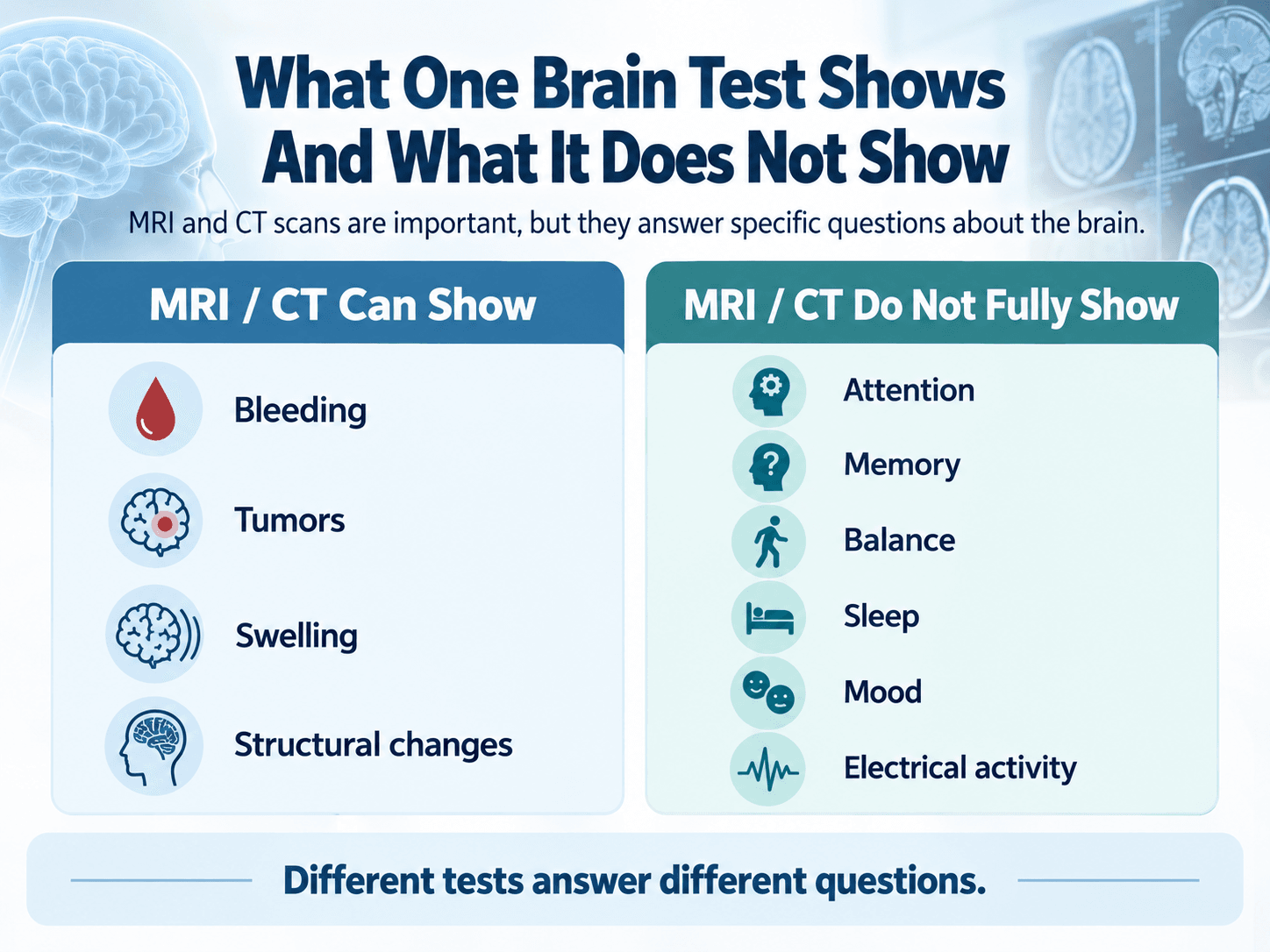
That can be great news. These tests are important for finding structural problems such as bleeding, tumors, swelling, and other physical changes. But they answer specific questions about the brain. They do not answer every question about how your brain is functioning.
“Different tests give us different pieces of the picture. No single test tells us everything about the brain.” — Dr. Fabian Consbruck
During a recent team training at Genesis Brain Institute, Dr. Fabian Consbruck explained why. The brain has physical structure, blood flow, electrical activity, chemical signals, and systems tied to memory, attention, vision, balance, movement, mood, and sleep. Different tests look at different parts of that picture.
Think about your car. A mechanic would never inspect the tires and declare the entire car healthy. The tires could look perfect while the battery, engine, or electrical system has a problem.
The brain deserves the same kind of thinking.
In this article, we are going to explain what disorders of the brain are, what common brain tests measure, why symptoms can remain when imaging looks normal, and what most people miss when trying to understand how their brain is functioning.
One brain test can give you an important answer.
It just cannot answer every question.
What Are Disorders of the Brain?
Disorders of the brain are conditions that affect the way the brain is built, works, communicates, or changes over time.
A brain disorder can involve physical damage from a stroke or traumatic brain injury. It can involve abnormal electrical activity, as seen with seizures. Other conditions affect movement, memory, attention, mood, behavior, or the way the brain processes information.
Alzheimer’s disease, Parkinson’s disease, epilepsy, traumatic brain injury, concussion, ADHD, and many forms of cognitive decline can all involve the brain, but they do not affect every person in the same way.
During our team training, Dr. Fabian explained that we often try to place a condition into one simple category. Is it structural? Is it electrical? Is it chemical? In real life, the answer can be more complicated. One condition can affect several systems at the same time.
Think about a concussion. Two people can both be told they have a concussion, yet one struggles with headaches and balance while another struggles with memory, sleep, anxiety, or focus.
The label is the same.
The way each brain is functioning can be very different.
That is one reason symptoms matter so much when evaluating disorders of the brain. Common symptoms can include memory problems, trouble concentrating, dizziness, changes in balance, headaches, sleep problems, mood changes, weakness, tremors, vision problems, or changes in how someone thinks or acts.
The challenge is that many of these symptoms overlap.
Trouble concentrating can happen with ADHD, poor sleep, anxiety, concussion, depression, or cognitive decline. Forgetfulness can come from a memory problem, but it can also happen when someone was not paying attention well enough to store the information in the first place.
This is why a diagnosis is useful, but it is not always the end of the story.
At Genesis Brain Institute, we believe the next question should be:
What is happening in this person’s brain and body right now?
That question moves the conversation from simply naming a disorder to understanding how the person is actually functioning.
What Are Some Common Disorders of the Brain?
There is no single type of brain disorder.
During our team training, Dr. Fabian used stroke, seizures, Parkinson’s disease, Alzheimer’s disease, ADHD, traumatic brain injury, and other conditions to show how differently the brain can be affected. His bigger point was simple: these conditions do not all start in the same place or affect the same systems.
Some common examples include:
Traumatic brain injury and concussion can happen after a fall, car accident, sports injury, or other impact. Symptoms can include headaches, dizziness, sleep changes, memory problems, mood changes, and trouble concentrating.
Stroke happens when blood flow to part of the brain is blocked or when a blood vessel breaks. Because different areas of the brain control different jobs, symptoms can vary depending on where the stroke occurs.
Epilepsy and seizure disorders involve abnormal electrical activity in the brain. A seizure can affect movement, awareness, behavior, sensation, or consciousness.
Alzheimer’s disease and other forms of dementia affect memory, thinking, and daily function. These conditions can also affect sleep, mood, behavior, and communication as they progress.
Parkinson’s disease affects areas of the brain involved in movement and other functions. Tremors are well known, but Parkinson’s can also affect balance, sleep, thinking, mood, and daily life.
ADHD is a neurodevelopmental disorder that affects attention, impulse control, and activity levels. Two people can have the same diagnosis while experiencing very different challenges.
The diagnosis matters, but understanding how that person is functioning matters too.
What Symptoms Can Brain Disorders Cause?
Brain disorders can show up in ways that seem completely unrelated.
One person notices memory problems (they forget things quickly). Another gets dizzy. Someone else becomes more anxious, sleeps poorly, loses balance, or struggles to find the right word.
That happens because the brain does not have one job. It helps control thinking, movement, vision, balance, emotions, sleep, speech, and many other parts of daily life.
Brain Disorder Symptoms can include:
- Trouble with memory, focus, processing speed, or finding words
- Headaches, dizziness, weakness, numbness, or fatigue
- Balance problems, tremors, poor coordination, or changes in walking
- Vision changes, sensitivity to light or sound, or trouble tracking objects
- Changes in mood, anxiety, irritability, motivation, or behavior
- Sleep problems, including trouble falling asleep, staying asleep, or feeling rested
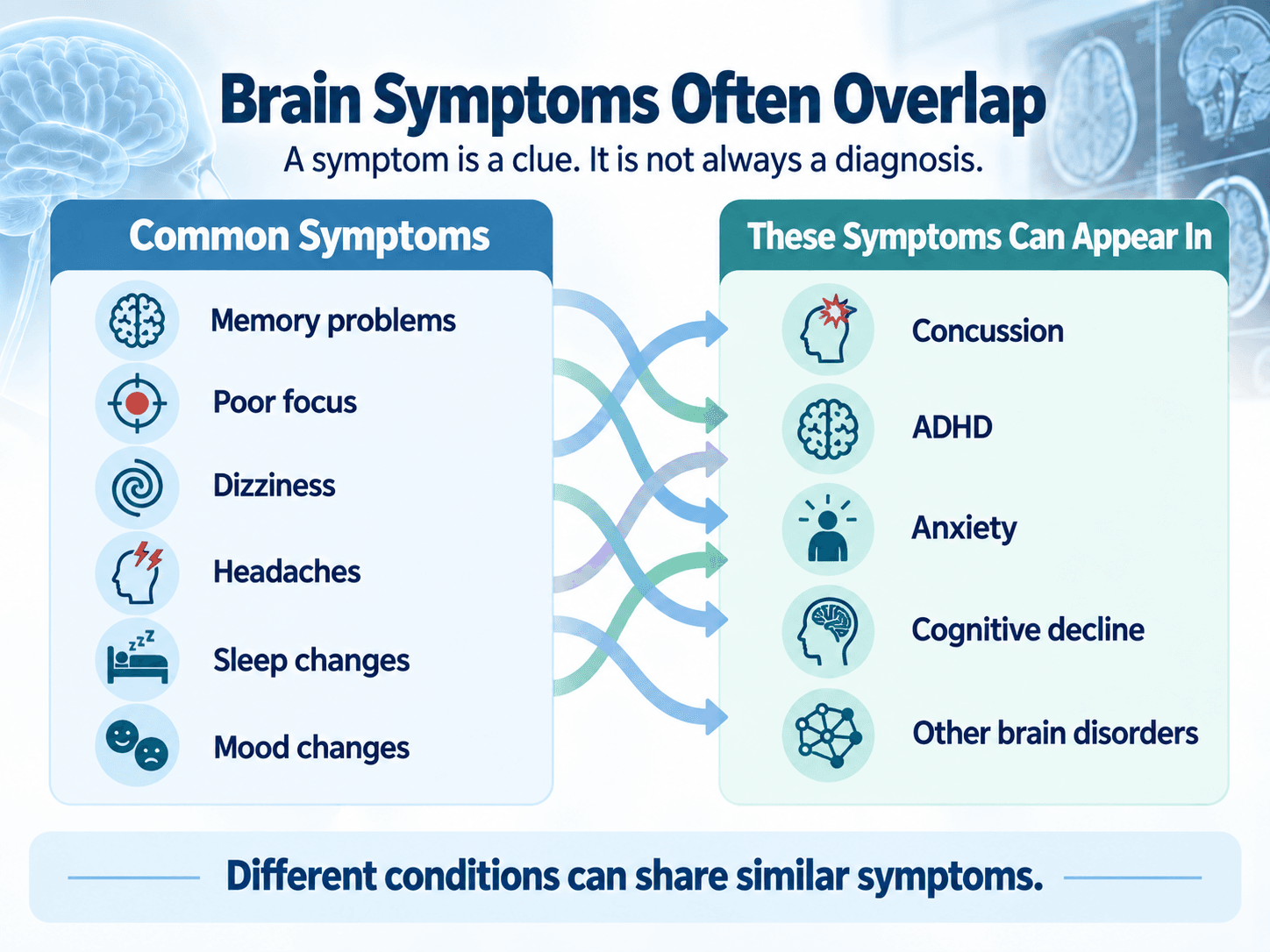
The important thing to understand is that a symptom is a clue. It is not always a diagnosis.
Take forgetfulness.
Someone could be forgetting because memory itself is struggling. But another person could have trouble paying attention in the first place. If the brain never clearly takes in the information, there is less information to remember later.
The same is true with dizziness. Dizziness can involve the inner ear, eye movements, balance systems, blood pressure, medication, migraine, or parts of the nervous system that help your brain understand where your body is in space.
Symptoms often overlap between different brain conditions. A person recovering from a concussion can struggle with focus and sleep. Someone with ADHD or anxiety can struggle with some of those same symptoms.
The symptom alone does not always tell you the cause.
This is one of the reasons a deeper evaluation can matter. Instead of asking only, “What diagnosis does this symptom fit?” it can be helpful to ask:
What part of brain or body function could be contributing to this symptom?
That question can lead to better testing, better understanding, and a clearer next step.
Can You Have Brain Symptoms With a Normal MRI?
Yes.
A normal MRI can be very good news. It can show that doctors do not see certain structural problems such as a tumor, bleeding, major swelling, or other visible changes in brain tissue.
But an MRI is designed mainly to show structure.
It does not measure every part of how the brain is functioning.
That difference matters.
Think about a house. A photo can show that the walls, roof, and windows are still standing. It cannot tell you whether the electricity is working correctly, the air conditioner is running, or the plumbing has a problem.
Brain testing works in a similar way.
An MRI gives doctors detailed pictures of brain anatomy. Other tests answer different questions.
An EEG looks at electrical activity in the brain. Cognitive testing can measure memory, attention, processing speed, and other thinking skills. Balance testing can show how well the brain is combining information from the eyes, inner ear, and body. Eye movement testing can provide information about systems involved in vision, coordination, and neurological function.
This is especially important after a concussion.
A person can have headaches, dizziness, poor sleep, trouble concentrating, light sensitivity, memory problems, or mood changes (feeling anxious for no reason) after a concussion while routine brain imaging does not show a clear structural injury. Concussion is diagnosed by looking at the injury, symptoms, examination, and other clinical information, not by relying on an MRI alone.
The same basic idea applies beyond concussion.
Someone can struggle with attention, memory, balance, sleep, or processing speed without having a large structural problem visible on an MRI.
That does not mean the MRI failed. It means the MRI answered the question it was designed to answer.
This is why hearing “your MRI looks normal” and saying “I still do not feel normal” are not contradictions.
The better question is not, “Was my MRI normal?”
It is:
“What has been tested so far, and what part of my brain function still needs to be understood?”
How Do Doctors Test How the Brain Is Functioning?
There is no single test that measures everything the brain does.
That is why a good brain evaluation often combines several types of information. Each test answers a different question.
MRI and CT scans look mainly at structure. They can help doctors identify things such as bleeding, tumors, swelling, stroke, or other physical changes.
EEG measures the brain’s electrical activity. It is commonly used when doctors are looking for seizures or other abnormal electrical patterns.
qEEG brain mapping uses the same type of electrical signals, then analyzes them mathematically to look for patterns in brainwave activity. It can add information about how different brain regions are functioning, but it should not be used by itself to diagnose conditions such as ADHD, concussion, anxiety, or dementia.
Cognitive testing looks at how someone thinks so we can look for cognitive decline. Depending on the test, it can measure memory, attention, processing speed, reaction time, problem solving, and other mental skills.
Balance testing looks at how well the brain combines information from the eyes, inner ear, and body to keep someone steady.
Eye movement testing can give information about neurological systems involved in tracking, focusing, coordination, and balance.
Pupil testing can measure how the pupils respond to light. Those responses are controlled by the nervous system and can provide another piece of information about brain and nervous system function.
Then there is something just as important as all the technology: the person’s story.
When did the symptoms start? Was there an injury? Have they changed over time? What happens with sleep? What medications are being taken? What does the person notice at work, school, home, or while driving?
Dr. Fabian’s point during our team training was simple: different tests look at different parts of the brain.
The goal is not to collect as many tests as possible.
The goal is to use the right tests to answer the right questions.
Why Can Two People With the Same Diagnosis Need Different Care?
A diagnosis is useful, but it does not tell the whole story.
Two people can have the same diagnosis and still need very different care because the condition can affect different brain functions.
That difference matters because treatment should not be built around the label alone.
Dr. Fabian explained during training that even people with the same diagnosis can have different symptoms and different areas of brain dysfunction. The name of the condition gives us a starting point. Testing helps us understand what is happening in that individual person.
That is the real question:
What does this diagnosis look like in your brain, your body, and your daily life?
That is where medical history, symptoms, testing, and the person’s goals start to guide the next step.
Can Mental Health Symptoms Be Connected to Brain Function?
Yes. Mood, attention, stress, sleep, and behavior all involve the brain.
That does not mean every case of anxiety, depression, ADHD, or PTSD comes from one abnormal brain area or one chemical being “too high” or “too low.” The science is more complex than that.
These symptoms can involve networks that help regulate attention, emotion, memory, threat response, sleep, and self control. Stress hormones, sleep quality, past injury, genetics, environment, and physical health can all influence how those networks function.
Dr. Fabian made this point during training when he challenged the idea that conditions should be placed into one simple box. A person can have changes involving more than one system at the same time. Structure, electrical activity, chemistry, and the way different brain regions communicate can all matter.
That helps explain why two people with anxiety can feel very different.
One person feels constant worry. Another becomes overwhelmed in noisy places. Someone else feels physical symptoms such as a racing heart, poor sleep, dizziness, or trouble concentrating.
A diagnosis can be useful, but it does not always explain why those symptoms are happening in that person.
An MRI does not diagnose anxiety or depression. A qEEG does not prove that someone has ADHD, PTSD, or another mental health condition. These diagnoses still require clinical history, symptoms, and evaluation by a qualified healthcare professional.
Brain testing can add another piece of information without replacing proper mental health care.
The goal is to better understand the whole person when symptoms, history, and function suggest there is more to explore.
What Is qEEG Brain Mapping and What Can It Tell You?
qEEG brain mapping looks at the electrical activity produced by the brain.
During the test, electrodes placed on the scalp record brainwave activity. A computer then analyzes those signals and creates maps that show patterns across different areas of the brain.
Dr. Fabian explains that qEEG and a standard EEG begin with the same basic information: electrical activity. The difference is how that information is analyzed. A standard EEG is often used to look for seizure activity. qEEG looks more closely at patterns in the brainwaves.
The results can help show whether certain areas are producing more or less activity than expected and, depending on the analysis, whether patterns of connectivity between brain regions stand out.
A qEEG is not a test that looks at a colorful brain map and says, “You have ADHD,” “You have anxiety,” or “You had a concussion.”
Dr. Fabian is very clear about that. The brain map is one piece of the puzzle. Symptoms, medical history, other testing, and the clinical evaluation still matter.
Instead of only asking, “What diagnosis does this person have?” it can add another question:
How is this person’s brain functioning electrically?
For someone who has been struggling with focus, memory, sleep, mood, or other symptoms, that can provide another piece of information when building the bigger picture.
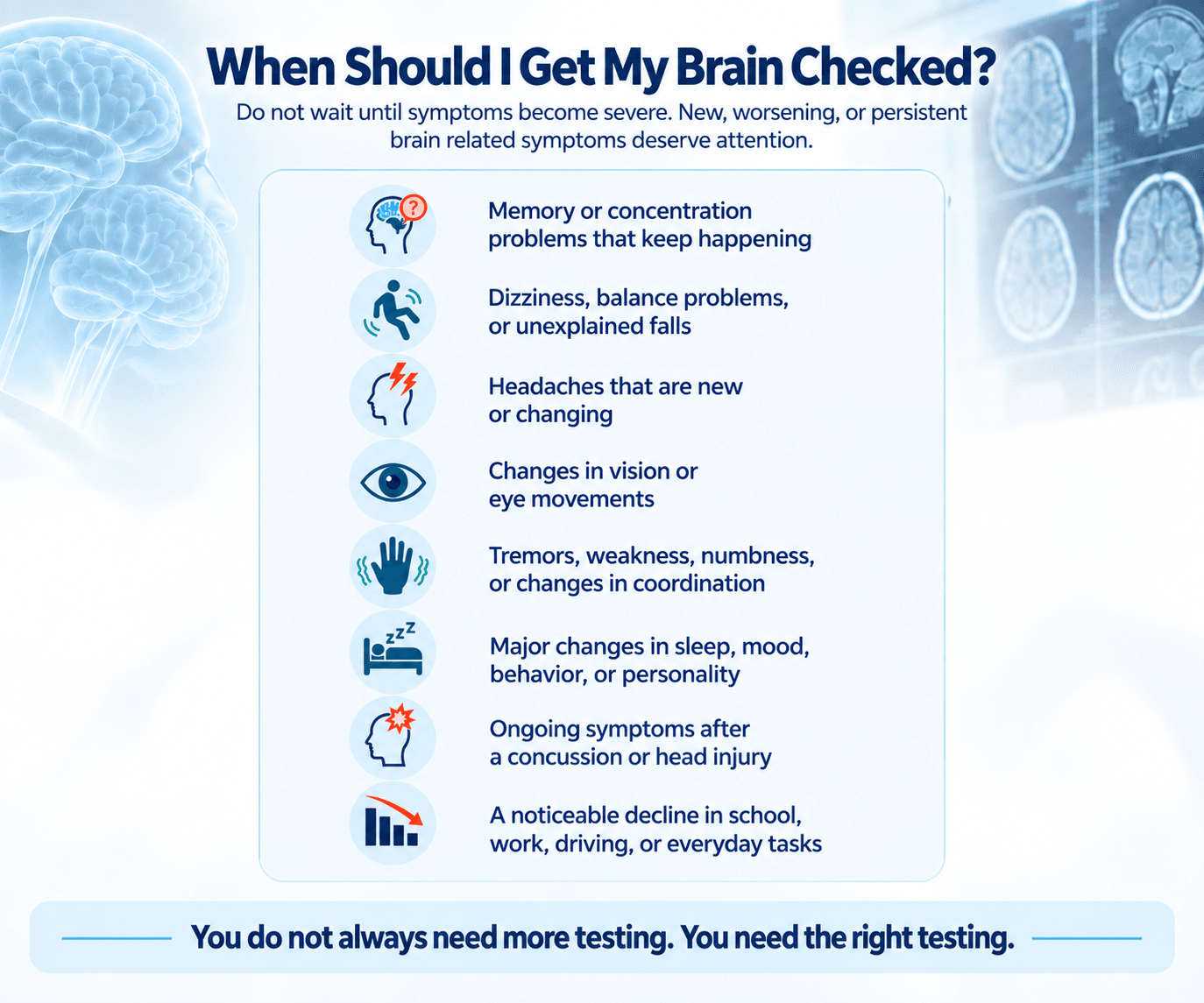
When Should I Get My Brain Checked?
You do not need to wait until symptoms become severe before asking questions about your brain.
Sometimes the first signs are easy to brush off. You forget things more often. Focus takes more effort. Your balance feels different. Headaches become more common. Sleep changes. You feel slower mentally, more irritable, or simply not like yourself.
A brain evaluation is worth discussing with a healthcare professional when symptoms are new, getting worse, interfering with daily life, or started after an injury.
That can include:
- Memory or concentration problems that keep happening
- Dizziness, balance problems, or unexplained falls
- Headaches that are new or changing
- Changes in vision or eye movements
- Tremors, weakness, numbness, or changes in coordination
- Major changes in sleep, mood, behavior, or personality
- Ongoing symptoms after a concussion or head injury
- A noticeable decline in school, work, driving, or everyday tasks
Some symptoms require immediate medical attention.
Sudden weakness or numbness on one side of the body, trouble speaking, facial drooping, a sudden severe headache, a new seizure, or loss of consciousness can be signs of a medical emergency. Call 911 or seek emergency care right away.
For symptoms that are not an emergency, the goal is to understand what changed.
That starts with your history, your symptoms, and the right testing for the questions being asked.
You do not always need more testing.
You need the right testing.
What Questions Should I Ask If My Brain Tests Are Normal?
If your tests look normal but you still do not feel like yourself, your next step can be asking better questions.
Start with:
- What exactly did this test measure?
- What did it rule out?
- What has not been tested yet?
- Could my symptoms involve memory, attention, balance, vision, sleep, or another system?
- Could medications, nutrition, hormones, stress, or another health condition be contributing?
- Is there another type of evaluation that would help explain my symptoms?
It also helps to track what you are experiencing before your appointment.
Write down when symptoms happen, how long they last, what makes them better or worse, and how they affect everyday life. Details about driving, work, exercise, sleep, reading, memory, or balance can give your healthcare team useful information that a scan cannot provide by itself.
The goal is not to prove something is wrong. It is to give your healthcare team enough information to ask the next right question to why you feel off.
What Does a More Complete Brain Evaluation Look Like?
A more complete brain evaluation does not depend on one test.
It looks at several systems together and asks whether they are telling the same story.
At Genesis Brain Institute, depending on the person and their symptoms, that can include:
- MRI, CT, or other medical imaging when appropriate to look at brain structure and physical changes
- qEEG to measure electrical brain activity
- Cognitive testing to look at memory, attention, processing speed, and other thinking skills
- Balance testing to see how well the brain uses information from the eyes, inner ear, and body
- Eye movement testing to evaluate systems involved in tracking, coordination, and balance
- A detailed medical history and neurological examination to connect the testing with what the person is actually experiencing
Imaging can be especially important when doctors need to look for structural changes. Dr. Christopher Gleis and our medical team can also review imaging alongside the other findings when appropriate.
The value is not simply having more data.
It is being able to compare the pieces.
For example, someone might report dizziness and trouble concentrating. An MRI can help answer structural questions. Balance testing could show one area of difficulty, while eye movement or cognitive testing reveals another. The medical team can then consider those findings alongside symptoms, history, and other testing.
Sometimes the tests agree. Other times, one test provides information another cannot.
The goal is to build a clearer picture of how the brain and body are functioning so the next step is based on more than one number, one scan, or one diagnosis.
It is not about more testing. It is about the right testing to better understand the whole picture.
Disorders of the Brain: Why the Bigger Picture Matters
The brain is too complex to understand from one test, one number, or one diagnosis.
Different tests look at different parts of brain function, while medical history and symptoms help connect those pieces to the person.
This matters because disorders of the brain do not affect everyone in exactly the same way. Two people can have the same diagnosis and experience completely different problems. A normal scan can also exist alongside very real symptoms because the scan and the symptoms are not always measuring the same thing.
So if your memory has changed, your balance feels different, you are struggling to focus, you have ongoing symptoms after a head injury, or you simply do not feel like yourself, do not start by assuming the worst.
Start by asking better questions.
What has already been tested? What has not? What systems could be involved? And what information would actually help your healthcare team understand what is happening?
At Genesis Brain Institute, that is how we approach brain health. We look at the person, the symptoms, the history, medical imaging when appropriate, and multiple measures of brain and body function to build a more complete picture.
Because sometimes hope begins with finally understanding what needs to be looked at next.
If something has changed and you are concerned, just get checked out.
One test can tell you something important.
The bigger picture can tell you much more.
Disclaimer: This content is for informational purposes only and does not constitute medical advice. Please consult with a licensed healthcare provider. Genesis Brain Institute is a Brain Treatment Center in Tampa offering non-pharmaceutical solutions that bring clarity, restore function, and offer real hope for those who feel lost, stuck, or simply want more from life.