Do you want to know how to get more deep sleep when you’re already sleeping eight hours but still waking up exhausted?
Your alarm goes off, and instead of feeling refreshed, you feel like you barely slept. You hit snooze, drag yourself out of bed, and reach for coffee, wondering how you could possibly be this tired after a full night’s sleep.
What if those eight hours aren’t giving your brain and body the rest they actually need?
Here’s something most people don’t realize. Not all sleep does the same job.
During deep sleep, your brain carries out important work that helps support memory, clear away waste, and restore your body. Yet you can spend eight hours asleep and still wake up feeling like you never truly rested.
And here’s where it gets interesting. Some of the everyday habits you think have nothing to do with sleep could be affecting how much deep sleep you’re getting.
So how do you get more deep sleep? What happens to your brain and body when you don’t get enough? And could a few changes to your daily routine make a difference in how you feel tomorrow morning?
Let’s explore what happens while you’re sleeping, what might be keeping you from getting the deep sleep you need, and what you can start doing tonight to give yourself a better chance of waking up refreshed.
How to Get More Deep Sleep: First, Understand What Happens While You Sleep
Think of your brain like a busy office.
All day long, it’s taking in information, making decisions, solving problems, and helping you get through life. Even when you’re relaxing, your brain is still working.
But what happens when the workday ends?
Your brain needs time to take care of important jobs that are harder to complete while you’re awake. That’s one reason deep sleep matters so much.
Deep sleep, also called slow wave sleep or stage 3 sleep, is one of the most restorative parts of your sleep cycle.
During this stage, your brain waves slow down, your heart rate and breathing become slower, and your body focuses on important recovery processes.
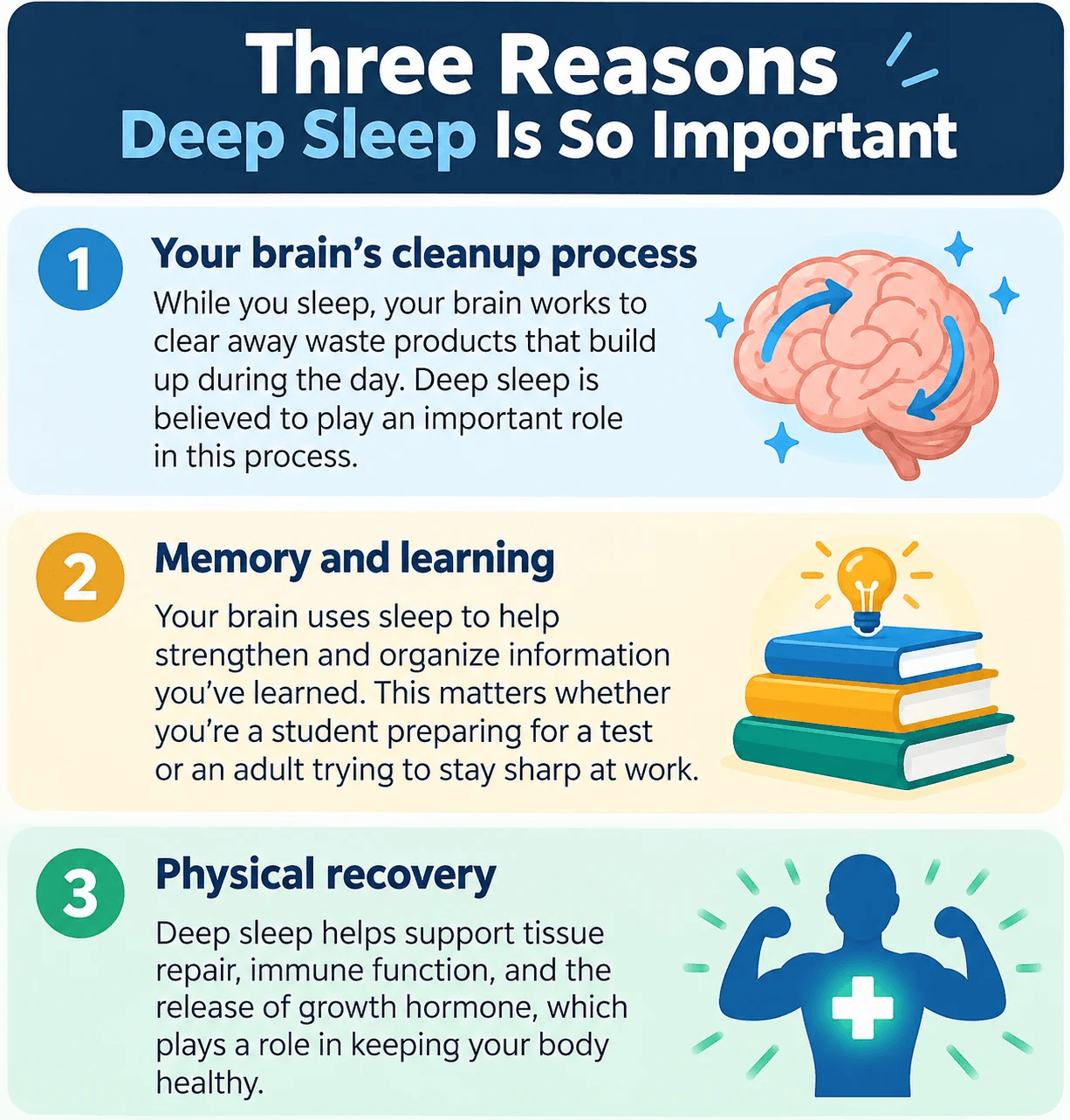
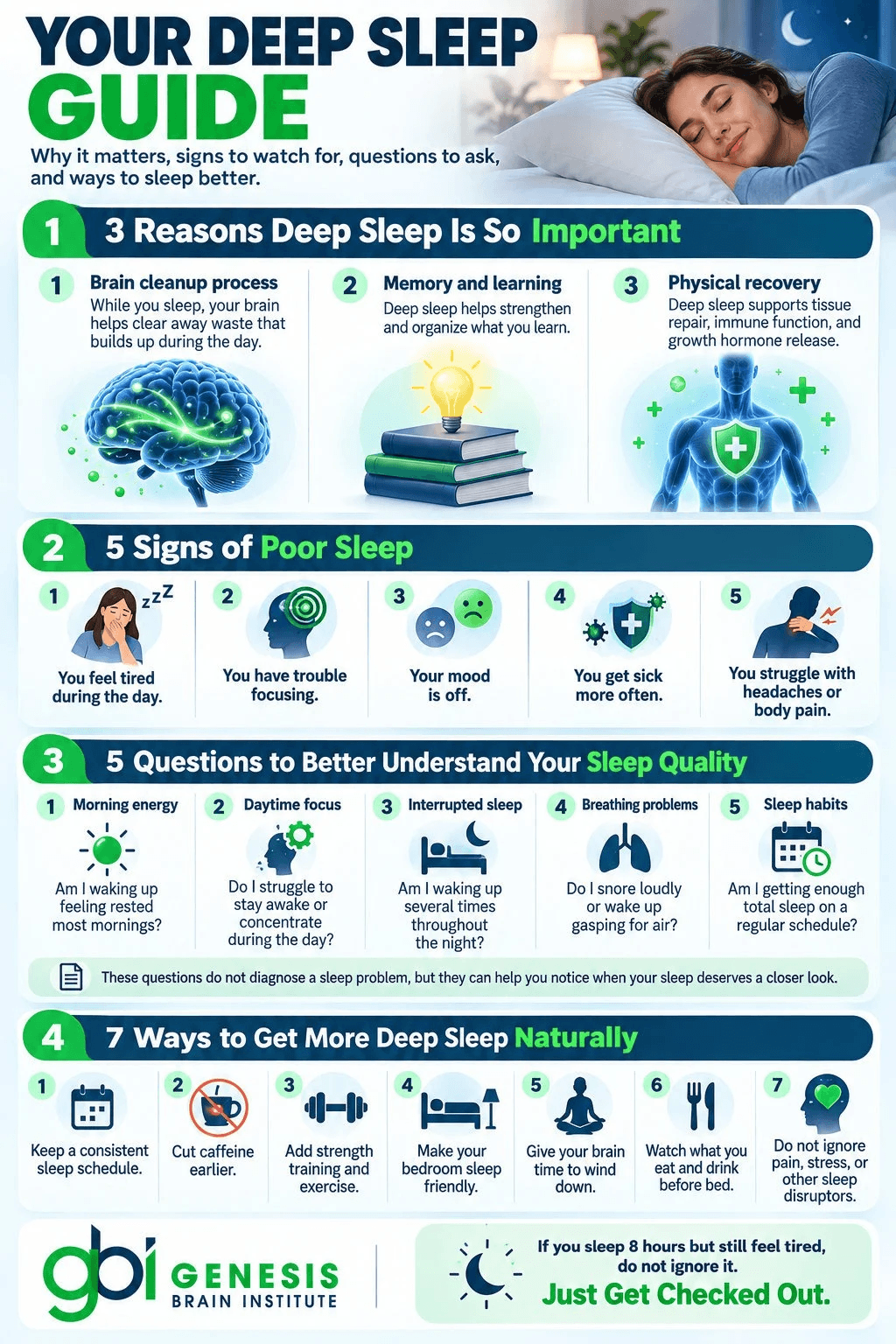
Here are three reasons deep sleep is so important:
Your brain’s cleanup process: While you sleep, your brain works to clear away waste products that build up during the day. Deep sleep is believed to play an important role in this process.
Memory and learning: Your brain uses sleep to help strengthen and organize information you’ve learned. This matters whether you’re a student preparing for a test or an adult trying to stay sharp at work.
Physical recovery: Deep sleep helps support tissue repair, immune function, and the release of growth hormone, which plays a role in keeping your body healthy.
And here’s something worth knowing.
You don’t spend all eight hours in deep sleep.
Instead, your brain moves through different stages of sleep several times throughout the night. Each stage has its own purpose, and deep sleep generally happens more often during the first part of the night.
In our earlier article on sleep and brain function, we explained how these stages work together and why getting enough hours isn’t the same as getting quality sleep.
That’s an important difference.
Because when you understand what your brain is supposed to be doing while you sleep, you can start to understand why the quality of those hours matters just as much as the number on your alarm clock.
5 Signs You’re Not Getting Enough Deep Sleep and How They Affect Your Health
Have you ever noticed how much harder life feels after a bad night’s sleep?
The little things bother you more. You forget something you were supposed to do. Tasks that normally take ten minutes suddenly feel like they take an hour.
Now imagine that happening night after night.
When you don’t get enough deep sleep, your brain and body can miss out on important recovery time. And while one poor night of sleep usually isn’t a major concern, ongoing poor sleep quality can affect how you think, feel, and perform.
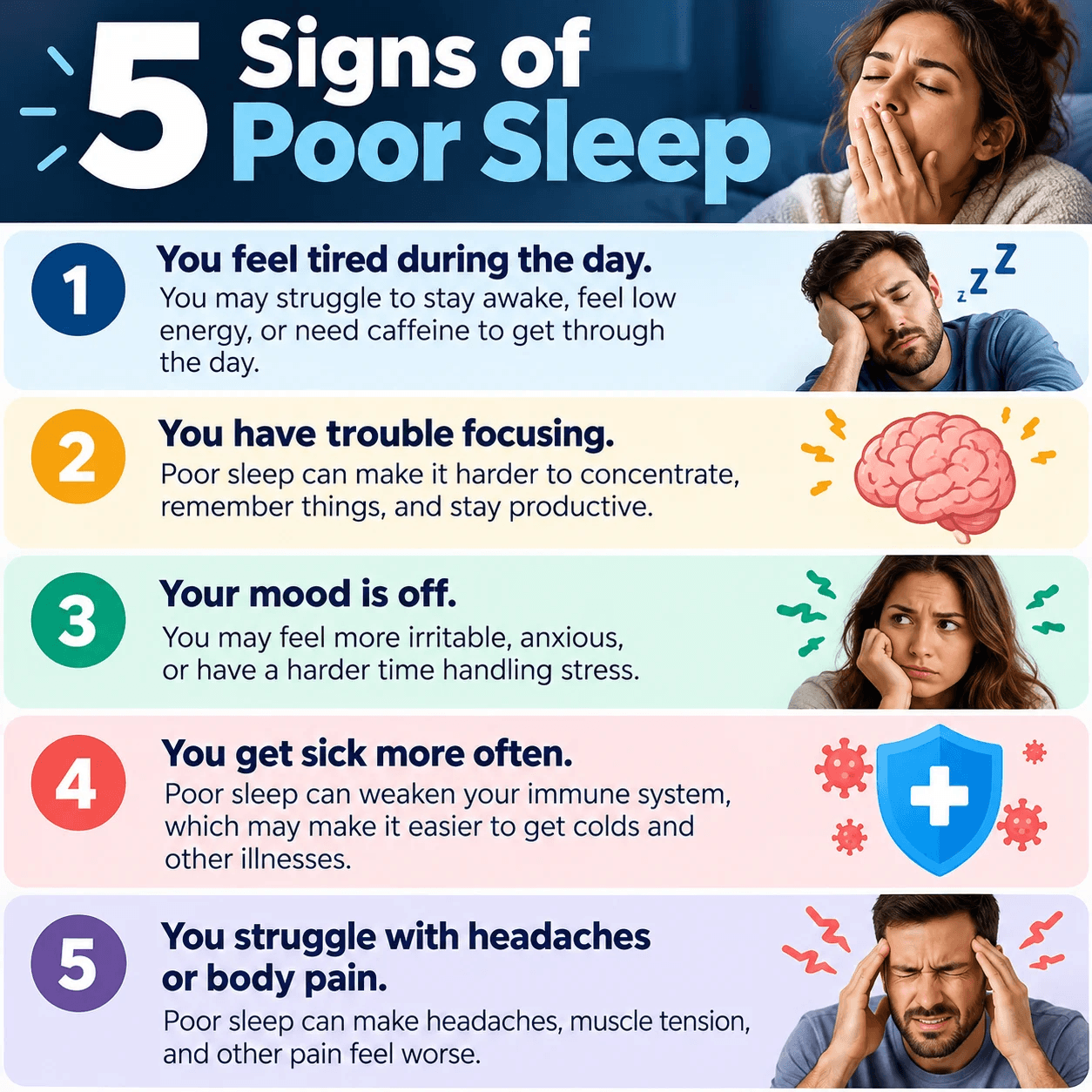
Here are 5 possible signs of poor sleep quality and not getting enough deep sleep that could affect your brain, body, and daily performance.
1. Brain Fog and Difficulty Concentrating After Poor Sleep
Ever read the same sentence three times because you can’t remember what you just read?
Poor sleep could be part of the problem.
Sleep helps your brain process information, stay alert, and prepare for the next day. When your sleep quality suffers, you might find it harder to focus, make decisions, or remember simple things.
This can affect your performance at work, school, and even in everyday conversations.
2. How Lack of Deep Sleep Affects Memory
Think about everything you learn in a single day.
Names, conversations, instructions, new ideas, and information you need to remember tomorrow.
Your brain doesn’t simply store all of that information the moment you hear it. Sleep helps strengthen and organize memories, and deep sleep plays an important role in that process.
In other words, getting enough sleep isn’t just about having energy tomorrow. It’s also about helping your brain hold on to what you learned today.
3. Poor Sleep, Anxiety, and Mood Changes
Have you ever snapped at someone over something small after a terrible night’s sleep?
You’re not imagining the connection.
Poor sleep can make it harder to manage emotions and respond calmly to stressful situations. You might feel more impatient, anxious, frustrated, or overwhelmed than usual.
Over time, ongoing sleep problems can also affect mental health.
That’s one reason healthy sleep habits matter for more than just physical energy.
4. Can Lack of Deep Sleep Cause Headaches?
You wake up feeling exhausted, and before the day even begins, your head starts hurting.
Sound familiar?
Poor sleep can contribute to headaches in some people, including those who experience migraines or tension headaches. Sleep disorders, such as sleep apnea, can also cause morning headaches.
However, headaches have many possible causes, so it’s important not to assume that a lack of deep sleep is always responsible.
If headaches are becoming a regular part of your morning, our article on what causes continuous headaches explores possible triggers, warning signs, and when to seek medical care.
5. How Poor Deep Sleep Affects Physical Recovery
Your brain isn’t the only part of your body that benefits from deep sleep.
During deep sleep, your body carries out important recovery processes that support your muscles, tissues, and immune system.
That’s especially important if you exercise regularly, play sports, or have a physically demanding job.
When your sleep is poor, you might notice that you’re more tired during workouts or that your body doesn’t feel as ready for the next day.
The Bigger Problem: You Might Not Realize Your Sleep Is the Issue
Here’s what makes all of this so frustrating.
You might blame your lack of energy on getting older, having too much work, or simply needing another cup of coffee.
Meanwhile, you could be overlooking how well you’re sleeping.
Of course, fatigue, brain fog, headaches, and memory problems can have many causes. They don’t automatically mean you’re missing deep sleep.
But if you’re spending enough time in bed and still waking up exhausted, your sleep quality deserves a closer look.
And that brings us to an important question: How much deep sleep should you actually be getting each night?
How Much Deep Sleep Do You Need Each Night?
If you sleep eight hours, how much of that time should actually be deep sleep?
You might be surprised by the answer.
Most adults spend roughly 10% to 20% of their total sleep time in deep sleep.
That means if you’re sleeping eight hours, you might spend approximately 48 to 96 minutes in deep sleep.
Not four hours. Not half the night. Just a relatively small part of your total sleep.
But here’s what matters.
There isn’t one perfect deep sleep number that everyone needs to reach. Your age, health, sleep patterns, and other factors can all affect how much deep sleep you get.
As Gabriela Vieira, PA-C, of Genesis Brain Institute helps us understand, healthy sleep isn’t simply about spending a certain number of hours in bed. The different stages of sleep serve different purposes, and getting quality rest matters.
In fact, the National Institutes of Health explains that the amount of deep sleep we experience naturally decreases as we get older.
So comparing your deep sleep to someone else’s isn’t always helpful.
Is 1 Hour of Deep Sleep Enough?
For some adults, one hour of deep sleep falls within a typical range. However, that doesn’t mean one hour is the perfect amount for everyone.
Think about two people who both sleep eight hours.
One wakes up feeling refreshed, alert, and ready for the day. The other wakes up exhausted, struggles to concentrate, and needs coffee just to get moving.
Both spent the same number of hours sleeping, but their overall sleep quality and health needs could be very different.
That’s why we want you to look beyond a single number.
Can Your Smartwatch Tell You How Much Deep Sleep You’re Getting?
Maybe you’ve checked your Apple Watch, Fitbit, or another sleep tracker and noticed that it says you only got 45 minutes of deep sleep.
Should you be worried?
Not necessarily.
Sleep trackers can be useful for following habits, such as when you go to bed, when you wake up, and how consistent your sleep schedule is.
However, consumer sleep trackers estimate sleep stages using signals such as movement and heart rate. They don’t directly measure brain waves the way a clinical sleep study does.
As a result, the deep sleep number on your watch is an estimate, not a diagnosis.
Rather than worrying about one night’s reading, pay attention to patterns over time and how you’re feeling during the day.
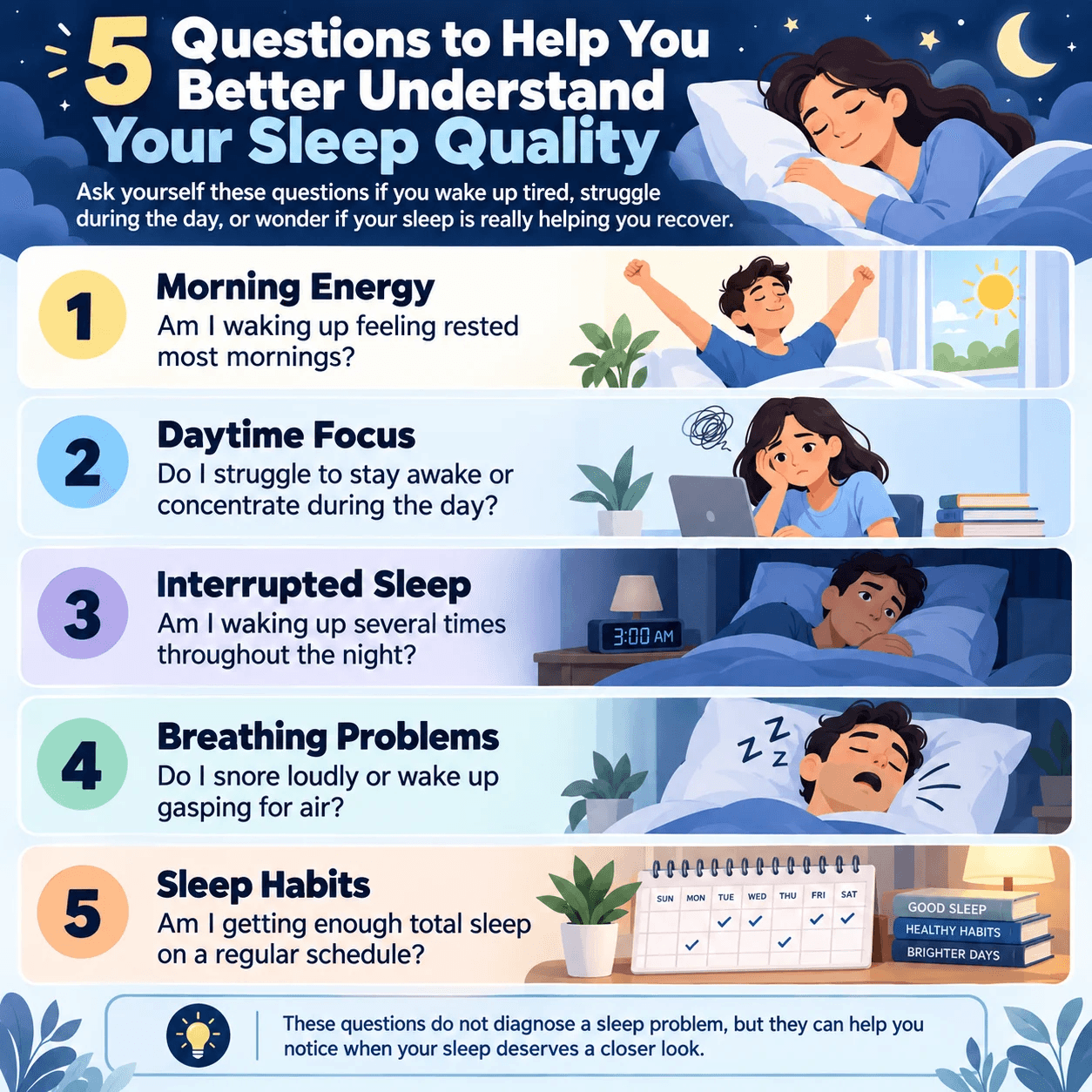
Here are 5 questions to help you better understand your sleep quality:
Morning energy: Am I waking up feeling rested most mornings?
Daytime focus: Do I struggle to stay awake or concentrate during the day?
Interrupted sleep: Am I waking up several times throughout the night?
Breathing problems: Do I snore loudly or wake up gasping for air?
Sleep habits: Am I getting enough total sleep on a regular schedule?
These questions won’t tell you exactly how much deep sleep you’re getting, but they can help you recognize when your sleep deserves a closer look.
If you’re consistently exhausted despite getting enough sleep, it’s worth speaking with a healthcare professional. Problems such as sleep apnea, medication effects, or other health conditions could be affecting your rest.
Why Your Deep Sleep Percentage Isn’t the Whole Story
Here’s the part I don’t want you to miss.
Deep sleep is important, but so are the other stages of sleep.
Your brain needs light sleep, deep sleep, and REM sleep to carry out different jobs throughout the night.
This is an important part of the sleep education Gabby shares at Genesis Brain Institute. Rather than focusing only on how many hours you’re sleeping or what your smartwatch reports, consider the bigger picture of your sleep habits and how you feel during the day.
Instead of chasing a perfect percentage, focus on building habits that support your entire sleep cycle.
Which raises a much more useful question.
What can you actually do to help your body get more deep sleep?
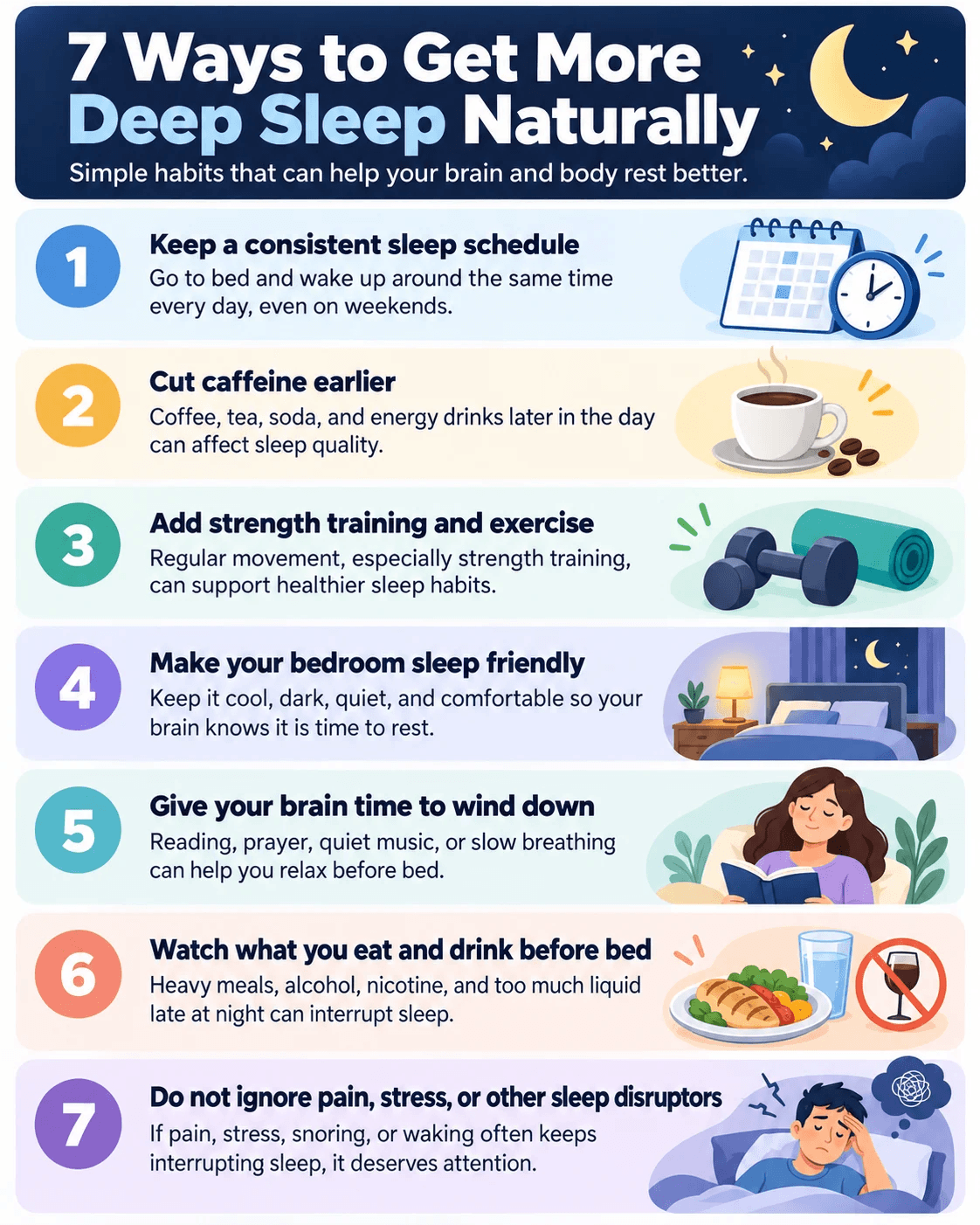
7 Ways to Get More Deep Sleep Naturally
What if getting better sleep started long before your head hit the pillow?
That’s something Gabriela (Gabby) Vieira, PA-C, wants people to understand about sleep.
Your brain doesn’t have an on and off switch. What you eat, drink, and do throughout the day can influence how well you sleep at night.
The good news? You don’t need to change your entire life to start building healthier sleep habits.
Here are 7 ways to help your body get more deep sleep naturally and improve your overall sleep quality.
1. Keep a Consistent Sleep Schedule, Even on Weekends
Do you wake up at 6 a.m. during the week but sleep until 10 a.m. on Saturday?
It might feel like you’re catching up on lost sleep, but big changes in your schedule can confuse your body’s internal clock.
Your brain follows a natural 24 hour cycle called your circadian rhythm. This helps control when you feel awake and when you feel sleepy.
When your bedtime and wake time constantly change, your body has a harder time following that rhythm.
Try going to bed and waking up around the same time each day, including weekends.
You don’t have to be perfect. The goal is consistency.
2. Stop Drinking Caffeine Earlier Than You Think
That afternoon cup of coffee might be affecting your sleep more than you realize.
Caffeine blocks a chemical in your brain called adenosine, which helps you feel sleepy as the day goes on.
Here’s the problem.
Even if you can fall asleep after drinking coffee, caffeine can still affect your sleep quality, including the amount of deep sleep you get.
And caffeine stays in your body for hours.
Gabby encourages people to pay attention to when they’re consuming caffeine, not just how much they’re drinking.
A practical starting point is to avoid caffeine after lunchtime, especially if you struggle with sleep.
Remember that caffeine isn’t just in coffee. Tea, energy drinks, soda, and even some headache medications can contain it.
3. Try Strength Training and Exercise to Support Deep Sleep
Did you know that lifting weights could help you sleep better at night?
When most people think about improving sleep, they picture a relaxing bedtime routine. But what you do during the day can be just as important.
Regular exercise can improve sleep quality, and strength training is one way to support healthier sleep habits.
Strength training, also called resistance training, involves making your muscles work against a weight or another form of resistance.
You don’t need to become a bodybuilder, either.
Here are 5 simple ways to add strength training to your routine:
Dumbbells: Start with light weights you can comfortably lift.
Resistance bands: Use stretchy bands to challenge your muscles.
Bodyweight exercises: Try squats, wall pushups, or lunges.
Weight machines: Use gym equipment designed to work different muscle groups.
Strength classes: Join a beginner class to learn safe exercises.
Research suggests that resistance training can improve overall sleep quality. However, that doesn’t mean every workout will directly increase your deep sleep percentage.
Walking, biking, swimming, and other forms of exercise can also support better rest.
And here’s something else worth remembering.
Timing matters.
An intense workout right before bed can leave some people feeling too energized to fall asleep easily.
If that happens to you, try finishing harder workouts at least two to three hours before bedtime.
The takeaway? Your path to better sleep might begin at the gym, not in the bedroom.
4. Make Your Bedroom Cool, Dark, and Quiet
Your bedroom should help your brain understand that it’s time to sleep.
Unfortunately, many bedrooms are full of things that can interrupt rest.
Bright lights, televisions, outside noise, and rooms that are too warm can all make it harder to sleep comfortably.
Try making a few simple changes:
Keep your bedroom comfortably cool.
Use curtains or shades to block outside light.
Turn off bright screens before bedtime.
Reduce noise or use gentle background sound if it helps.
Make sure your mattress and pillows are comfortable.
Think of your bedroom as a place designed for recovery, not another room where your brain has to stay busy.
Small changes to your sleep environment can make it easier to fall asleep and stay asleep.
5. Give Your Brain Time to Wind Down Before Bed
Have you ever climbed into bed physically exhausted, only to have your mind suddenly start racing?
You remember tomorrow’s meeting. Then you start thinking about something you forgot to do. Before you know it, you’re wide awake.
Your body might be ready for sleep, but your mind hasn’t slowed down.
That’s why Gabby encourages creating a calming bedtime routine.
Reading, journaling, listening to quiet music, praying, or practicing slow breathing can help you transition from a busy day into a more relaxed evening.
You can also try progressive muscle relaxation, which involves gently tightening and relaxing different muscle groups.
Start with just 15 to 30 minutes of quiet time before bed.
The goal isn’t to force yourself to sleep. It’s to give your brain a chance to settle down.
6. Watch What You Eat and Drink Before Bed
Eating a large meal right before bedtime can make sleep uncomfortable, especially if you experience heartburn or acid reflux.
Alcohol can also be misleading.
You might feel sleepy after drinking, but alcohol can disrupt normal sleep patterns and cause more awakenings later in the night.
Nicotine is another substance that can interfere with sleep because it acts as a stimulant.
Try finishing heavy meals two to three hours before bedtime when possible, and avoid using alcohol as a sleep aid.
Also, pay attention to how much you’re drinking right before bed. Waking up several times to use the bathroom can interrupt your sleep.
The goal is to give your body a comfortable environment for rest.
7. Don’t Ignore Pain, Stress, or Other Problems That Wake You Up
Sometimes improving deep sleep isn’t as simple as changing your bedtime.
Maybe your back hurts every time you lie down. Perhaps you wake up with neck pain or struggle to get comfortable.
Or maybe stress keeps your mind active long after you’ve turned off the lights.
These problems can interrupt your sleep throughout the night, making it harder to get the continuous rest your brain and body need.
At Genesis Brain Institute, Dr. Chris Gleis works with patients experiencing pain. It’s an important reminder that sleep problems and physical discomfort can sometimes be connected.
If pain regularly wakes you up, addressing the underlying problem could be an important part of improving your rest.
The same goes for loud snoring, waking up gasping for air, or feeling exhausted despite getting enough hours of sleep. These symptoms deserve medical attention because conditions such as sleep apnea can interfere with sleep.
And if you’re taking medication to help you sleep, remember that feeling sedated isn’t always the same as experiencing normal, restorative sleep. Talk with your healthcare provider about concerns, and never stop prescribed medication on your own.
Which Deep Sleep Habit Should You Start With Tonight?
Here’s what I want you to remember.
You don’t have to tackle all seven habits at once.
Maybe your biggest problem is that afternoon coffee. Perhaps your sleep schedule changes every weekend, or you spend the last hour before bed scrolling through your phone.
Or maybe it’s time to add some resistance training to your weekly routine.
Pick one habit and start there.
Give yourself time to build a routine, then pay attention to how you’re feeling in the morning.
Because improving your sleep isn’t about chasing a perfect number on a smartwatch.
It’s about giving your brain and body a better opportunity to get the rest they need so you can feel and perform better tomorrow.
Why Am I Still Tired After 8 Hours of Sleep?
You’ve started going to bed earlier. You’ve cut back on afternoon caffeine, added exercise to your routine, and made your bedroom more comfortable.
But there’s still one problem.
You’re waking up exhausted.
So what happens when you’re doing everything right and still don’t feel rested?
Here’s something important to understand. Not every sleep problem can be solved by changing your bedtime habits.
Sometimes the issue isn’t how many hours you’re sleeping. It’s what’s happening during those hours.
Can Sleep Apnea Prevent You From Getting Deep Sleep?
Imagine trying to read a book while someone interrupts you every few minutes.
You might spend an hour reading, but how much would you actually remember?
Something similar can happen with your sleep.
Sleep apnea is a condition in which your breathing repeatedly stops or becomes reduced while you’re sleeping. These interruptions can briefly wake your brain, sometimes without you remembering them.
As a result, you could spend eight hours in bed but still struggle to get the restful sleep your body needs.
Common signs of sleep apnea include:
Loud, frequent snoring.
Waking up gasping or choking.
Feeling exhausted after a full night’s sleep.
Morning headaches.
Trouble concentrating during the day.
Not everyone who snores has sleep apnea, and not everyone with sleep apnea snores loudly. A medical evaluation can help determine whether testing is needed.
Can Stress and Anxiety Affect Deep Sleep?
Have you ever had a stressful day and found yourself replaying everything that happened as soon as your head touched the pillow?
Stress can keep your body more alert when it should be preparing for rest.
Even if you manage to fall asleep, ongoing stress can affect your overall sleep quality.
That’s why Gabby emphasizes the value of calming routines, breathing exercises, and giving your mind time to settle before bed.
However, when stress or anxiety continues to interfere with sleep, additional support could be helpful.
Can Chronic Pain Keep You From Getting Restorative Sleep?
If you’ve ever tried to sleep with a sore back, painful neck, or throbbing headache, you know how difficult it can be to get comfortable.
Pain can cause you to wake up repeatedly, change positions throughout the night, or struggle to fall back asleep.
And poor sleep can sometimes make pain feel harder to manage the next day.
This can create a frustrating cycle.
At Genesis Brain Institute in Tampa, Dr. Chris Gleis helps evaluate and manage different types of pain. Understanding whether physical discomfort is affecting your sleep can be an important part of finding the right next steps.
When Should You Seek Help for Poor Sleep?
An occasional restless night happens to almost everyone.
But if you’re regularly getting enough hours of sleep and still feeling exhausted, don’t simply assume it’s normal.
Consider speaking with a healthcare professional when your sleep problems continue, interfere with daily life, or come with symptoms such as loud snoring, breathing interruptions, ongoing headaches, or severe daytime sleepiness.
Your provider can review your symptoms, medications, sleep habits, and health history to determine whether further evaluation is appropriate. Depending on your symptoms, that could include a sleep study.
And remember, feeling tired doesn’t automatically mean you’re missing deep sleep. Other health conditions can cause fatigue, too.
The important thing is not to ignore a problem that’s affecting how you feel, think, and function.
Because getting more sleep is one goal. Understanding why you’re still tired is another.
And sometimes, getting the right answers is where better sleep begins.
How to Get More Deep Sleep and Start Waking Up Refreshed
Let’s go back to where we started.
You slept eight hours. Your alarm goes off, but instead of feeling rested, you’re exhausted.
Now you understand why that could be happening.
Getting enough sleep matters, but so does the quality of those hours. Your brain moves through different stages of sleep, and deep sleep plays an important role in memory, brain health, and physical recovery.
When your sleep quality suffers, the effects can follow you into the next day. You might struggle with brain fog, headaches, low energy, mood changes, or difficulty concentrating.
So what can you do about it?
Here are 7 ways to support better deep sleep and give your brain and body a better chance to recover:
Keep a regular bedtime and wake time, even on weekends.
Cut off caffeine earlier in the day, ideally around lunchtime.
Make regular exercise, including strength training, part of your routine.
Keep your bedroom cool, dark, quiet, and comfortable.
Give yourself time to relax before bed with reading, prayer, or slow breathing.
Avoid heavy meals, alcohol, and nicotine close to bedtime.
Pay attention to pain, stress, snoring, and other problems that could be interrupting your sleep.
Remember, you don’t need to make all seven changes tonight. Start with one or two habits you can stick with, then build from there.
And don’t get caught up chasing the perfect deep sleep percentage on your smartwatch. Those numbers are estimates. How you feel, how consistently you sleep, and whether you’re having symptoms deserve attention, too.
What If You’re Still Exhausted After a Full Night’s Sleep?
This is where I want to leave you with something important.
You shouldn’t have to accept feeling exhausted every morning as simply part of getting older, having a busy life, or working too hard.
Sometimes poor sleep habits are part of the problem. Other times, conditions such as sleep apnea, chronic pain, or other health concerns need a closer look.
At Genesis Brain Institute in Tampa, Gabriela (Gabby) Vieira, PA-C, and our team believe that understanding what’s happening is an important first step toward making informed decisions about your health.
Because the goal isn’t simply to spend more time in bed.
It’s to give your brain and body the opportunity to rest, recover, and help you perform at your best throughout the day.
And if you’re still waking up tired, struggling to focus, or wondering why you never feel fully rested, don’t ignore what your body is telling you.
You deserve to understand what could be affecting your sleep.
Disclaimer: This content is for informational purposes only and does not constitute medical advice. Please consult with a licensed healthcare provider. Genesis Brain Institute is a Brain Treatment Center in Tampa offering non-pharmaceutical solutions that bring clarity, restore function, and offer real hope for those who feel lost, stuck, or simply want more from life.